
Loading, please wait...


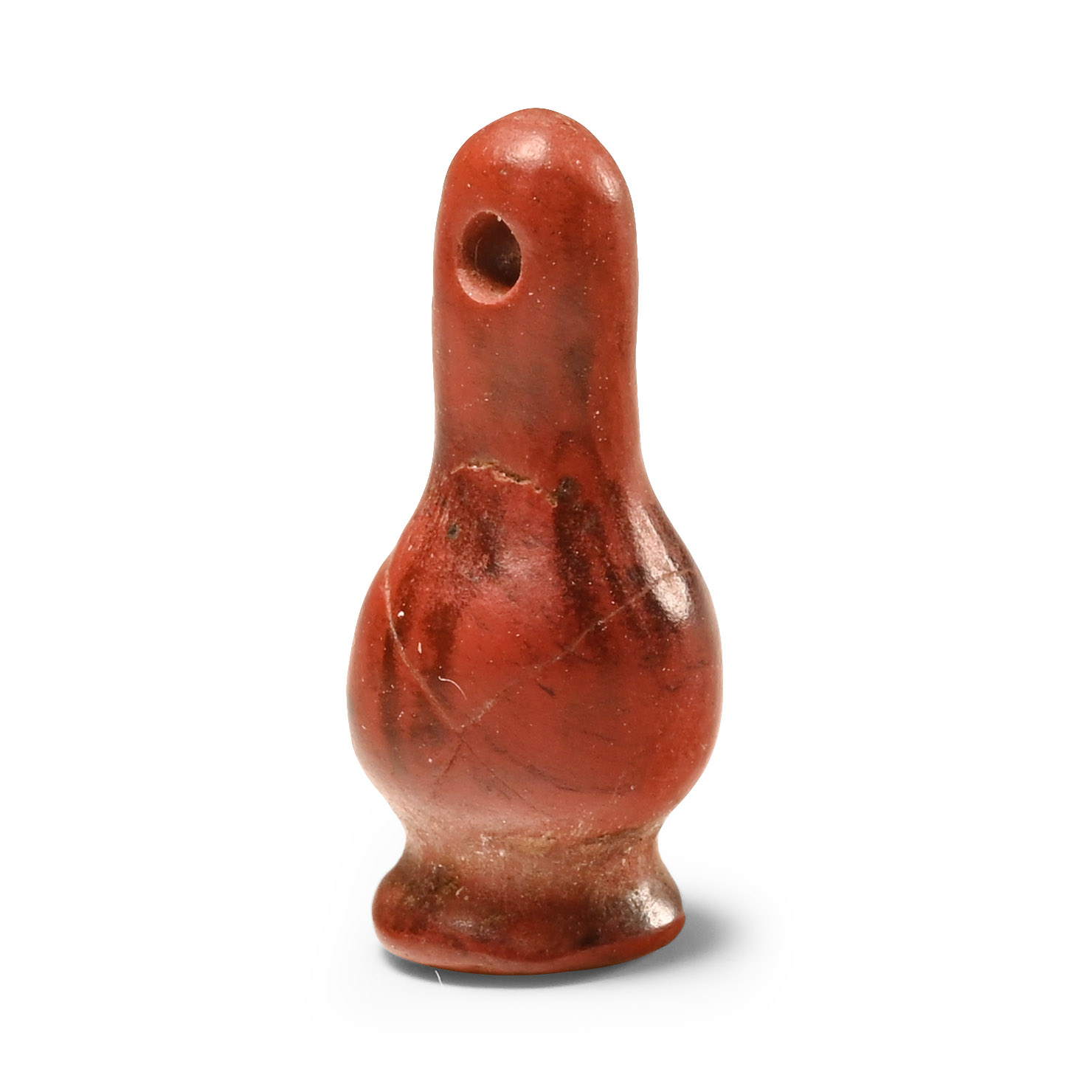
LOT 0484
Egyptian Jasper Poppy Head Amulet
NEW KINGDOM, 18TH-19TH DYNASTY, CIRCA 1550-1213 B.C.
5/8 in. (0.78 grams, 15 mm).
Polished and with integral pierced suspension loop. [No Reserve]
ProvenanceFrom an early 20th century collection.
LiteratureCf. The Metropolitan Museum, New York, accession number 40.9.26, for similar; cf. Andrews, C., Amulets of Ancient Egypt, London, 1994, pl.65 (n).
FootnotesAmulets in the form of poppies were used to heal, alleviate pain, and ward off death. This type of amulet was also associated with Osiris, the Egyptian deity of agriculture, death, and the afterlife.
CONDITIONTimeLine Auctions follows a vetting process to ensure the authenticity and legality of all items, reinforcing our commitment to integrity and responsible trading. Each antiquity, antique, and coin lot undergoes thorough examination by a vetting committee of at least ten external specialists, professional trade association members, scientists, and archaeologists: Our Vetting Process
AUCTIONS:
TimeLine is a leading auction house specialising in antiquities, ancient art, collectables, natural history, coins, medals, and books. Our auctions offer museums, collectors, historians, and enthusiasts the opportunity to acquire unique and historically significant pieces.
-
Large Egyptian Expedition Lithograph Print with Hieroglyphs
1820 A.D.Sold for (Inc. bp): £111
Willemin - Thèbes - Hypogées - Manuscrit sur papyrus en caractères hiéroglyphiques. Troisième partie - Proof etching on laid paper of plate 74 from La Description de l’Égypte: Antiquités, Volume II: Commission des sciences et arts d’Égypte with later backing sheet. 360 grams, 136 x 66 cm
From the collection of a North American priest. Acquired between 1981-1996. Property of a North American collector.
Produced between February 1802 and 1830 on the orders of Napoleon Bonaparte; published between 1809 and 1828. Just 1,000 copies were distributed to various institutions, printed on on laid paper with an 'Égypte ancienne et moderne' watermark. The book is subtitled Recueil des observations et des recherches qui ont été faites en Égypte pendant l’expédition de l’Armée française, publié par les ordres de Sa Majesté l’Empereur Napoléon le Grand (Gathering of observations and discoveries which were made in Egypt during the expedition of the French army, published on the orders of His Majesty the Emperor Napoleon the Great). It was the world's first encyclopedia devoted exclusively to the remains of ancient Egypt. The plates of this book are the first to present the archaeological sites of Thebes (Luxor). The papyrus manuscript was recovered from the underground chambers (hypogea). The original papyrus is now held in the Bibliothèque Nationale (1-19), Paris (Papyrus Cadet). -
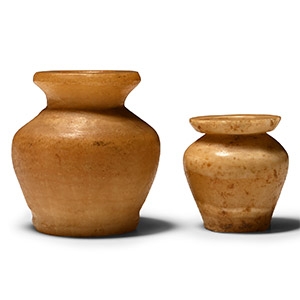
Egyptian Alabaster Kohl Jars
New Kingdom, circa 1550-1070 B.C.Estimate: £1,500 - 2,000 (+bp*)
Opening Bid: £556
The larger with squat profile, slight flare to the foot, carinated shoulder and small rounded rim; the smaller with wide flat rim, round shoulder and body tapering to a flat base. 310 grams total, 43-61 mm high
Mary Stout Shaw (1880-1962); thence by direct descent to the present owner. Accompanied by a copy of a 1976 family photo featuring some of the collection on display, the larger kohl jar is clearly visible on a 1976 family photo. This lot has been checked against the Interpol Database of stolen works of art and is accompanied by search certificate number no.12197-220887.
Mary Kilgour Stone was born in 1880 in Cincinnati, Ohio. On 25 November 1903, she married Percy Wyfold Stout from Gloucester (DSO, OBE, 1875-1937), who had moved to Cairo after an international rugby career. After fighting in the First World War, Percy became the Director of the Egyptian Delta Land Company and the Anglo-American Nile Tourist Company. He and Mary were friends with the famous Major Gayer-Anderson, who worked as a doctor on the company’s cruise boats between 1930 and 1939. Gayer-Anderson tells in his memoir how this allowed him to make frequent trips to Upper Egypt and fulfil his passion for collecting (and dealing in) ancient Egyptian art. In his company, Mary became an enthusiast about all things Egypt and formed an elegant collection of ancient Egyptian alabaster vessels, including the following lots. She was particularly fascinated with the ancient cat goddess Bastet. Therefore, when Gayer-Anderson decided to give his famous ancient bronze cat to the British Museum in 1939, he made sure the donation was in both his name and Mary Stout Shaw’s, as a tribute to their friendship. -
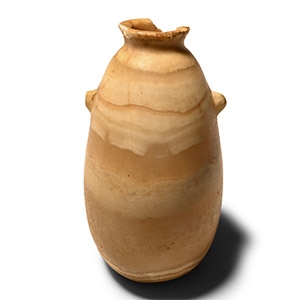
Egyptian Alabaster Alabastron
Late Period, circa 664-332 B.C.Estimate: £600 - 800 (+bp*)
Opening Bid: £222
With small everted rim, the body of oval shape with two ear-shaped vestigial handles; rim chipped and base partly absent. 174 grams, 87 mm high
Mary Stout Shaw (1880-1962); thence by direct descent to the present owner. Accompanied by a copy of a 1976 family photo featuring some of the collection on display.
Mary Kilgour Stone was born in 1880 in Cincinnati, Ohio. On 25 November 1903, she married Percy Wyfold Stout from Gloucester (DSO, OBE, 1875-1937), who had moved to Cairo after an international rugby career. After fighting in the First World War, Percy became the Director of the Egyptian Delta Land Company and the Anglo-American Nile Tourist Company. He and Mary were friends with the famous Major Gayer-Anderson, who worked as a doctor on the company’s cruise boats between 1930 and 1939. Gayer-Anderson tells in his memoir how this allowed him to make frequent trips to Upper Egypt and fulfil his passion for collecting (and dealing in) ancient Egyptian art. In his company, Mary became an enthusiast about all things Egypt and formed an elegant collection of ancient Egyptian alabaster vessels, including the following lots. She was particularly fascinated with the ancient cat goddess Bastet. Therefore, when Gayer-Anderson decided to give his famous ancient bronze cat to the British Museum in 1939, he made sure the donation was in both his name and Mary Stout Shaw’s, as a tribute to their friendship.
