
Loading, please wait...
_900x900.jpg "Egyptian Jasper Lion-Headed Cobra Amulet in Gold Frame")
_200x200.jpg "Egyptian Jasper Lion-Headed Cobra Amulet in Gold Frame")
_900x900.jpg "Egyptian Jasper Lion-Headed Cobra Amulet in Gold Frame")
_200x200.jpg "Egyptian Jasper Lion-Headed Cobra Amulet in Gold Frame")
.jpg "Egyptian Jasper Lion-Headed Cobra Amulet in Gold Frame")
.jpg "Egyptian Jasper Lion-Headed Cobra Amulet in Gold Frame")
LOT 0416
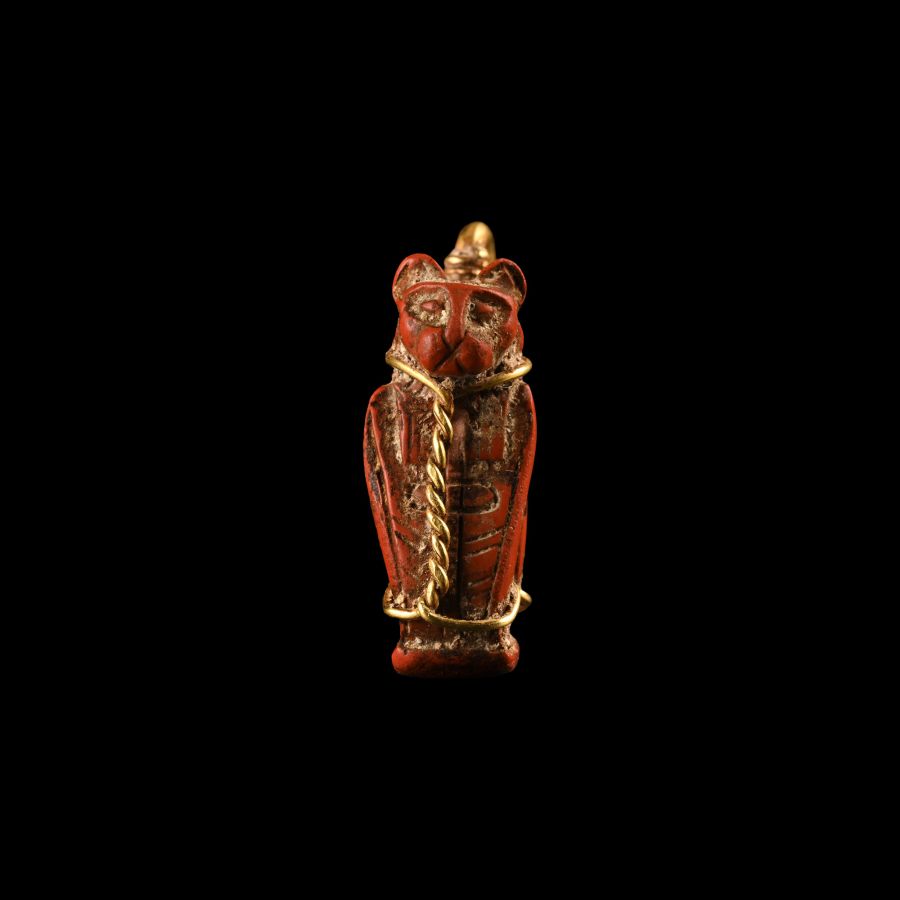
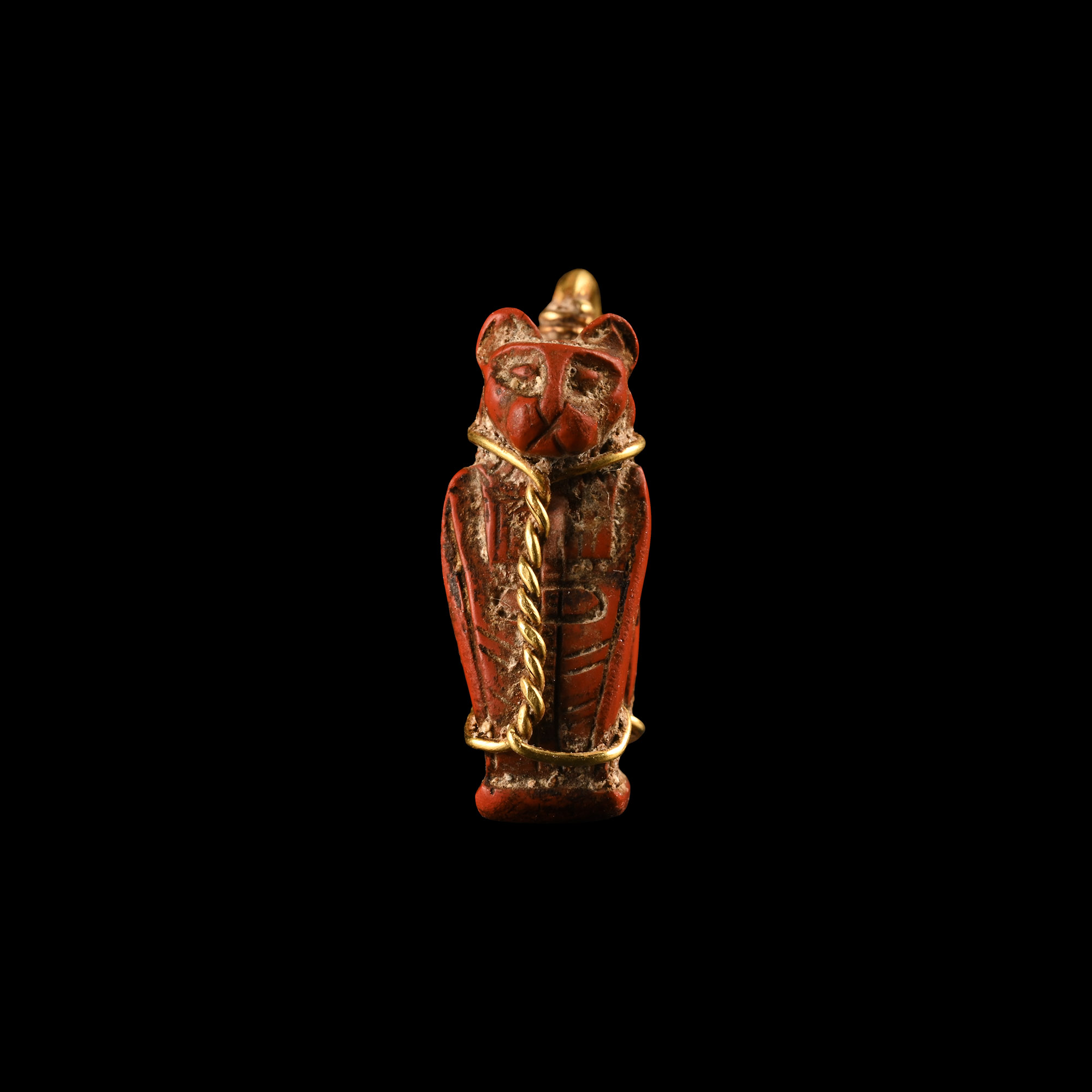
Egyptian Jasper Lion-Headed Cobra Amulet in Gold Frame
NEW KINGDOM, CIRCA 1550-1070 B.C.
3/4 in. (2 grams, 18 mm).
The S-curved body resting on a tongue-shaped based, detailed hood, and delicate details to the head of a lioness; wrapped in a gold frame with suspension loop.
ProvenancePrivate collection of Mr K.A.
Private collection, Europe, 26 June 2009.
This lot has been checked against the Interpol Database of stolen works of art and is accompanied by a search certificate number no.12590-232325.
This lot has been cleared against the Art Loss Register database, and is accompanied by an illustrated lot declaration signed by the Head of the Antiquities Department, Dr Raffaele D'Amato.
Cf. Reisner, G.A., Catalogue général des antiquités égyptiennes du Musée du Caire, Nos.12528-13595, Vol. II, Amulets, Cairo, 1958, p.115, (no. CG13434) and pl.XVII, for a similar example in opaque red glass.
FootnotesThis amulet likely represents a goddess, either Sekhmet or Wadjet. Sekhmet is typically depicted as a lioness or lion-headed woman, while Wadjet appears in the form of a cobra. The lion-headed cobra form can be an allusion to the uraeus, worn on the crowns of royalty and deities for protection.
CONDITIONTimeLine Auctions follows a vetting process to ensure the authenticity and legality of all items, reinforcing our commitment to integrity and responsible trading. Each antiquity, antique, and coin lot undergoes thorough examination by a vetting committee of at least ten external specialists, professional trade association members, scientists, and archaeologists: Our Vetting Process
AUCTIONS:
TimeLine is a leading auction house specialising in antiquities, ancient art, collectables, natural history, coins, medals, and books. Our auctions offer museums, collectors, historians, and enthusiasts the opportunity to acquire unique and historically significant pieces.
LOT 0416
Egyptian Jasper Lion-Headed Cobra Amulet in Gold Frame
Sold for (Inc. bp): £1,895
-
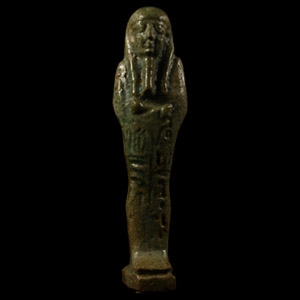
Egyptian Faience Shabti for Hor-sa-Iset
Late Period, circa 4th century B.C.Sold for (Inc. bp): £975
Of mummiform type, wearing a tripartite wig and long plaited divine beard; holding a pick in the left hand, a hoe in the right, and the cord of a seed bag hanging over his left shoulder; standing on an integral plinth, a plain back pillar terminating at the base of the wig; two vertical panels of hieroglyphic inscription to the front, including dedication: sḥḏ wsỉr ḥr sꜢ Ꜣst, ‘The illuminated, the Osiris, Hor-sa-Iset’; mounted on a custom-made display stand. 124 grams, 15.2 cm
Jacques René Fiechter, Switzerland (1920-1950). with Auction Martin, Egyptian collection of André Bircher, 1949. with Cahn Auktionen AG, Basel, 5 November 2011, no.20. Private collection, Europe. Accompanied by copies of the relevant Cahn catalogue pages. This lot is accompanied by an illustrated lot declaration signed by the Head of the Antiquities Department, Dr Raffaele D'Amato. -
.jpg)
Coptic Marble Liturgical Vessel Fragment with Inscription
6th century A.D.Estimate: £1,800 - 2,400 (‡+bp*)
Opening Bid: £900
Tongue-shaped with low rounded pad on the underside, raised edge with low-relief decoration of grape vines and leaves, the edge with pairs of opposing doves eating grapes; dedicatory Demotic inscription on the underside. 87 grams, 55 mm
Acquired in the mid 1980s-1990s. Private collection, Switzerland, thence by descent. Private collection, since the late 1990s. Accompanied by an academic report by Dr Raffaele D'Amato. This lot has been checked against the Interpol Database of stolen works of art and is accompanied by a search certificate number no.12575-232108. This lot has been cleared against the Art Loss Register database, and is accompanied by an illustrated lot declaration signed by the Head of the Antiquities Department, Dr Raffaele D'Amato.
These vessels were used as liturgical objects for church offerings or ritual cult and were extensively employed from late antiquity in ecclesiastical contexts. -
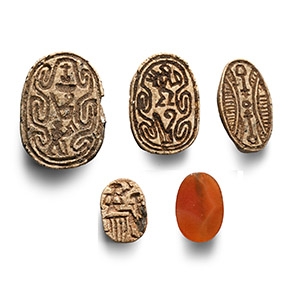
Egyptian Mixed Scarab Collection
Mostly Late Period, 664-332 B.C.Estimate: £500 - 700 (+bp*)
Opening Bid: £250
Comprising: three faience scarabs with detailed bodies and hieroglyphs on the underside; one carnelian scarab with plain base; one scaraboid with hieroglyphs to the underside. 22.75 grams total, 15-28 mm
From the collection of a gentleman, acquired on the London art market in the 1990s. This lot is accompanied by an illustrated lot declaration signed by the Head of the Antiquities Department, Dr Raffaele D'Amato.
