
Loading, please wait...
LOT 0440
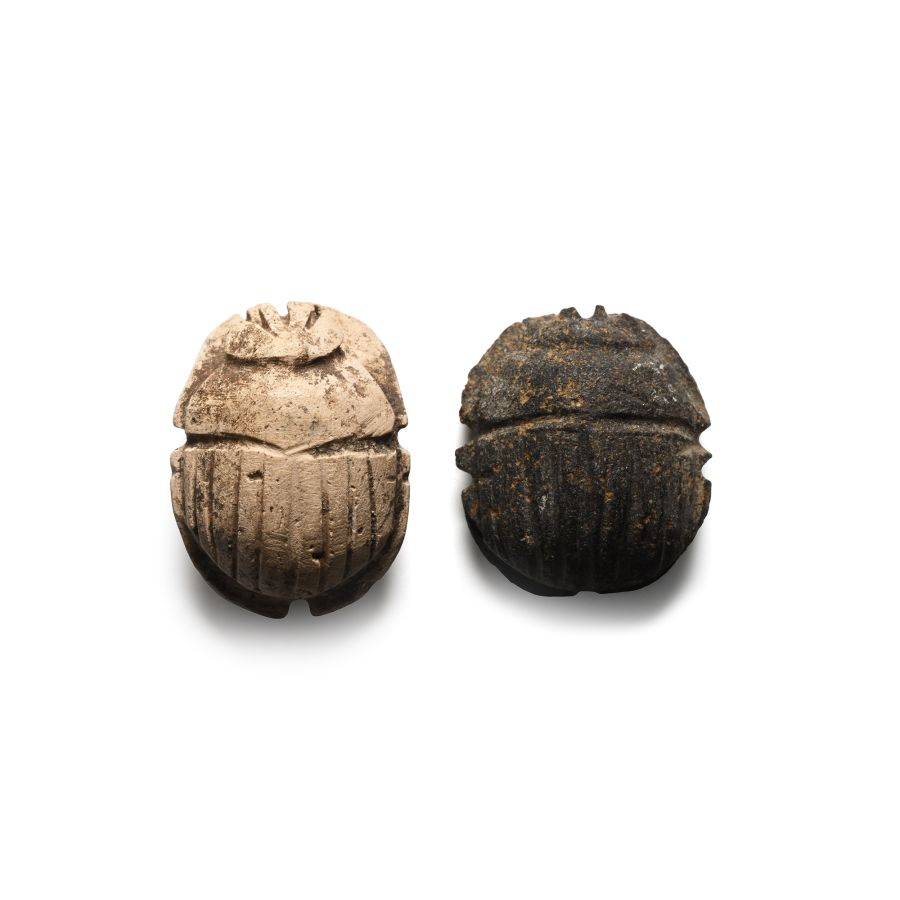
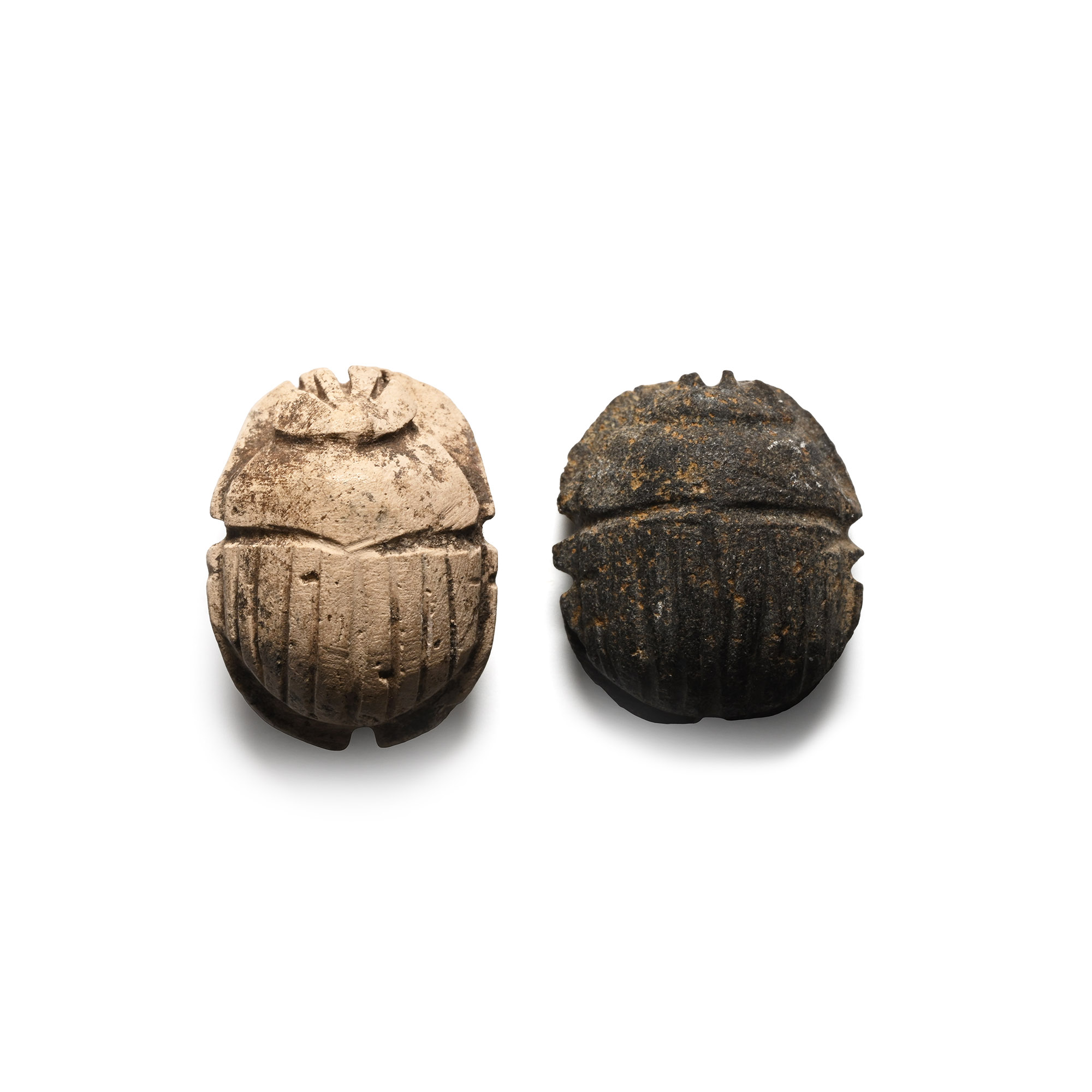
Egyptian Heart Scarab Group
LATE PERIOD, 664-332 B.C.
3/4 in. (7.5 grams total, 18-20 mm).
Comprising two scarabs with striated wing cases and ribbed underside. [2]
ProvenanceFrom the collection of a gentleman, acquired on the London art market in the 1990s.
This lot is accompanied by an illustrated lot declaration signed by the Head of the Antiquities Department, Dr Raffaele D'Amato.
Cf. Ben-Tor, D., The Scarab: A Reflection of Ancient Egypt, Tel Aviv, 1993, pp. 76-77, for similar examples.
FootnotesThe scarab amulet was a powerful symbol of rebirth, transformation, and protection in ancient Egypt. Modelled after the beetle linked to the sun god Khepri, it represented the cycle of life and regeneration. Used from the Middle Kingdom (c. 2050 BCE) onwards, scarabs served as funerary amulets, personal charms, and seals—often inscribed with prayers or names—reflecting both spiritual beliefs and daily life.
CONDITIONTimeLine Auctions follows a vetting process to ensure the authenticity and legality of all items, reinforcing our commitment to integrity and responsible trading. Each antiquity, antique, and coin lot undergoes thorough examination by a vetting committee of at least ten external specialists, professional trade association members, scientists, and archaeologists: Our Vetting Process
AUCTIONS:
TimeLine is a leading auction house specialising in antiquities, ancient art, collectables, natural history, coins, medals, and books. Our auctions offer museums, collectors, historians, and enthusiasts the opportunity to acquire unique and historically significant pieces.
LOT 0440
Egyptian Heart Scarab Group
Estimate £180 - 240€210 - 280 (for guidance only)$240 - 320 (for guidance only)
-
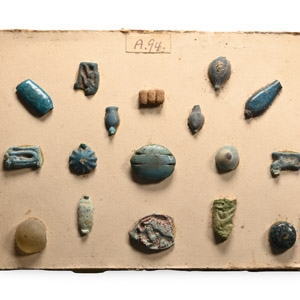
Egyptian Faience Bead and Amulet Collection
Late-Ptolemaic Period, 664-30 B.C.Sold for (Inc. bp): £520
Including floral, poppy seed, uraeus, an eye bead, a bull with solar disc, a standing deity holding a sceptre, and other types; mounted on cardboard backing with collector's label 'A.94.'. 24 grams total, 11.4 x 8.4 cm
From the private collection of Walter Thomas Gaze Cooper (1895-1980). This lot is accompanied by an illustrated lot declaration signed by the Head of the Antiquities Department, Dr Raffaele D'Amato. -
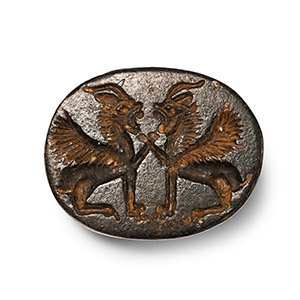
Phoenicio-Egyptian Black Stone Scaraboid with Lions
6th century B.C.Sold for (Inc. bp): £910
With gusset to the sidewall and incuse design to the underside of opposed winged lions each with one forepaw raised. 14.5 grams, 28 mm
Ex collection of the late Mr S. M., London, UK, 1970-1990s. This lot is accompanied by an illustrated lot declaration signed by the Head of the Antiquities Department, Dr Raffaele D'Amato.
Phoenician scarabs with winged lions were often used as guardian figures, much like Mesopotamian lamassu or Egyptian sphinxes. On amulets and seals, they likely served as apotropaic (evil-averting) symbols. In Phoenician and Persian art, hybrid creatures like winged lions reflect a cosmopolitan visual language, blending Egyptian, Assyrian, and Achaemenid motifs. They could symbolise imperial power or transcultural authority. In some cases, winged lions are linked to deities or divine guardianship, especially when shown flanking sacred symbols like trees, thrones, or sun discs. -
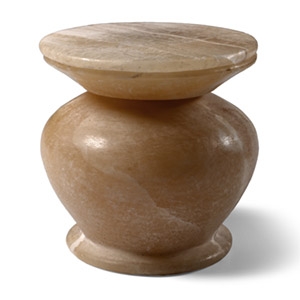
Egyptian Travertine Kohl Jar and Lid
Middle Kingdom-early New Kingdom, 12th-early 18th Dynasty, circa 1985-1479 B.C.Estimate: £1,500 - 2,000 (‡+bp*)
Opening Bid: £833
Piriform vessel with flared foot and wide rim, discoid lid with raised central panel to verso. 355 grams, 65 mm
Ex Galerie Nefer, Zurich, Switzerland. with Galerie Rhéa, Zurich, Switzerland. This lot has been cleared against the Art Loss Register database, and is accompanied by an illustrated lot declaration signed by the Head of the Antiquities Department, Dr Raffaele D'Amato.
