
Loading, please wait...
_900x900.jpg "Egyptian Hardstone Scarab with Horus")
_200x200.jpg "Egyptian Hardstone Scarab with Horus")
_900x900.jpg "Egyptian Hardstone Scarab with Horus")
_200x200.jpg "Egyptian Hardstone Scarab with Horus")
.jpg "Egyptian Hardstone Scarab with Horus")
.jpg "Egyptian Hardstone Scarab with Horus")
LOT 0026
Egyptian Hardstone Scarab with Horus
1ST MILLENNIUM B.C.
5/8 in. (2.51 grams, 17 mm).
Carved with naturalistic anatomical detailing, the base with incused sun-disk and Horus falcon holding a flail, above neb hieroglyph; drilled for suspension.
ProvenanceFrom an early 20th century Home Counties, UK, collection.
LiteratureCf. Matouk, F.S., Corpus du scarabée égyptien, Volume 2, Beirut, 1976, p.390, no.903, for similar design.
FootnotesThe sign group reads: 'Lord Ra-Horakhty'.
CONDITIONTimeLine Auctions follows a vetting process to ensure the authenticity and legality of all items, reinforcing our commitment to integrity and responsible trading. Each antiquity, antique, and coin lot undergoes thorough examination by a vetting committee of at least ten external specialists, professional trade association members, scientists, and archaeologists: Our Vetting Process
AUCTIONS:
TimeLine is a leading auction house specialising in antiquities, ancient art, collectables, natural history, coins, medals, and books. Our auctions offer museums, collectors, historians, and enthusiasts the opportunity to acquire unique and historically significant pieces.
LOT 0026
Egyptian Hardstone Scarab with Horus
Estimate £600 - 800€700 - 930 (for guidance only)$810 - 1,080 (for guidance only)
-
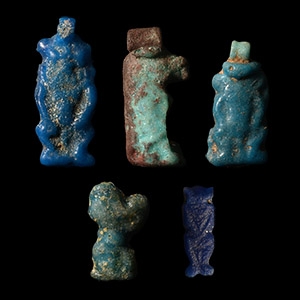
Egyptian Amarna Faience Amulet Group
New Kingdom, Amarna Period, 1353-1336 B.C.Sold for (Inc. bp): £208
Comprising polychrome amulets of various types, with suspension loops, including figures of Bes and other deities in animal form. 0.99 grams total, 10-16 mm
From an early 20th century collection, Surrey, UK. -
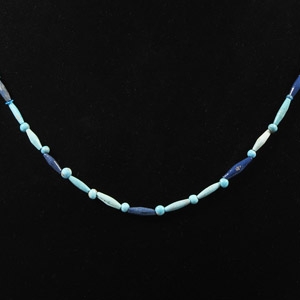
Egyptian Faience Bead Necklace
New Kingdom, 1569-1081 B.C.Sold for (Inc. bp): £221
Composed of gently tapering biconical beads of various shades of turquoise and blue, interspersed with coin-shaped and spherical beads; restrung. 6.43 grams, 66 cm long
From an early 20th century UK collection. -
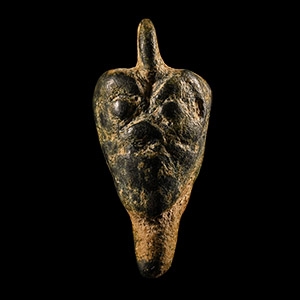
Phoenician Bronze Pazuzu Head Amulet
7th-6th century B.C.Sold for (Inc. bp): £351
Piriform pendant with janiform facial detailing and loop. 16.2 grams, 31 mm
Acquired 1969-1999. From the private collection of the late Mr S.M., London, UK, thence by descent.
Pazuzu was a divine personification of the southwestern wind, and ruled supreme over other wind demons. As an apotropaic entity, he was considered as both destructive and dangerous, whose power could repel other demons and safeguard homes from their malevolent influence. Phoenician artisans produced many cross-cultural items with Egyptian and Mesopotamian influences.
