
Loading, please wait...
_900x900.jpg "Egyptian Hardstone Amulet Group")
_200x200.jpg "Egyptian Hardstone Amulet Group")
.jpg "Egyptian Hardstone Amulet Group")
LOT 0470
Egyptian Hardstone Amulet Group
LATE PERIOD, 664-332 B.C.
1/2 - 1 in. (3.61 grams total, 14-23 mm).
Comprising: a melon bead; double plume with inked collector's reference to the reverse 'ES.7'. [2, No Reserve]
ProvenanceLeft Amulet: Brought by missionaries in the 19th century. Acquired in 1962. Ex Haeberlin collection. From a North German private collection E.S. with Gorny Mosch, Munich, Germany, 16 December 2015, 828 (Part)
Right Amulet: From the collection of Doctor Girard, a collector for over 60 years. with Hotel des Ventes de Clermont-Ferrand, 22 May 2017. Property of a French collector.
TimeLine Auctions follows a vetting process to ensure the authenticity and legality of all items, reinforcing our commitment to integrity and responsible trading. Each antiquity, antique, and coin lot undergoes thorough examination by a vetting committee of at least ten external specialists, professional trade association members, scientists, and archaeologists: Our Vetting Process
AUCTIONS:
TimeLine is a leading auction house specialising in antiquities, ancient art, collectables, natural history, coins, medals, and books. Our auctions offer museums, collectors, historians, and enthusiasts the opportunity to acquire unique and historically significant pieces.
-
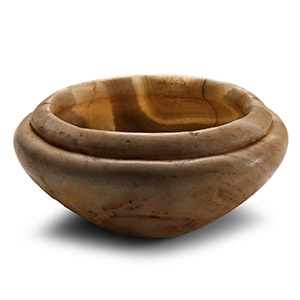
Egyptian Alabaster Bowl
1st Dynasty, circa 3000 B.C.Estimate: £1,800 - 2,400 (‡+bp*)
Opening Bid: £1,000
Of conical profile with flattened base, carinated shoulder and stepped rounded rim, possibly for accepting a lid. 380 grams, 11.6 cm wide
Property from an American deceased estate, acquired between 19770-1989. with Bonhams, London, 28 October 2009, no.16 (Part). Private European collection. Accompanied by copies of the relevant Bonhams catalogue pages. This lot has been checked against the Interpol Database of stolen works of art and is accompanied by a search certificate number no.12071-215259. -
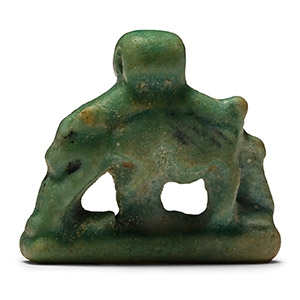
Egyptian Faience Amulet of Nut
Late Period, 664-332 B.C.Sold for (Inc. bp): £98
Amulet of a sow representing the goddess Nut; suspension loop on top. 2.63 grams, 24 mm
From the Florence Rosetti collection, UK, circa 1950s. Property of a Cambridgeshire, UK, gentleman.
This miniature sow pendant features a loop at the top and was worn as an amulet. The sow is often associated with the sky goddess Nut, who was believed to give birth to the stars every night, and then consume them at dawn. Despite the sow's reputation for devouring its offspring, Nut, in this form, was revered as a nurturing and safeguarding deity. A sow-shaped amulet was likely intended to offer protection to its wearer. -
.jpg)
Egyptian Hardstone Amulet Group
Late Period, 664-332 B.C.Sold for (Inc. bp): £39
Comprising: a melon bead; double plume with inked collector's reference to the reverse 'ES.7'. 3.61 grams total, 14-23 mm
Left Amulet: Brought by missionaries in the 19th century. Acquired in 1962. Ex Haeberlin collection. From a North German private collection E.S. with Gorny Mosch, Munich, Germany, 16 December 2015, 828 (Part) Right Amulet: From the collection of Doctor Girard, a collector for over 60 years. with Hotel des Ventes de Clermont-Ferrand, 22 May 2017. Property of a French collector.
