
Loading, please wait...
_900x900.jpg "Egyptian Green Stone Frog Amulet")
_200x200.jpg "Egyptian Green Stone Frog Amulet")
.jpg "Egyptian Green Stone Frog Amulet")
LOT 0025
Egyptian Green Stone Frog Amulet
LATE PERIOD, 664-332 B.C.
1/2 in. (1.47 grams, 13 mm).
Modelled seated on an oval base; pierced for suspension.
ProvenanceMrs Allinson to Mrs Foster, 1867 and thence by descent to the current owner, Stanley Crescent, London, UK.
FootnotesFrog amulets in ancient Egypt symbolised fertility, rebirth, and renewal. Associated with the goddess Heket, who was connected to childbirth and life-giving forces, these amulets were especially popular in contexts related to fertility and protection during pregnancy and labour. Their association with the annual Nile flood, which brought new life to the land, further underscored their symbolism of revival and abundance.
CONDITIONTimeLine Auctions follows a vetting process to ensure the authenticity and legality of all items, reinforcing our commitment to integrity and responsible trading. Each antiquity, antique, and coin lot undergoes thorough examination by a vetting committee of at least ten external specialists, professional trade association members, scientists, and archaeologists: Our Vetting Process
AUCTIONS:
TimeLine is a leading auction house specialising in antiquities, ancient art, collectables, natural history, coins, medals, and books. Our auctions offer museums, collectors, historians, and enthusiasts the opportunity to acquire unique and historically significant pieces.
-
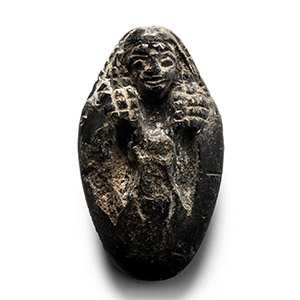
Egyptian Black Stone Heart Amulet
New Kingdom, circa 1500-1200 B.C.Sold for (Inc. bp): £312
Carved in the half-round, lentoid in plan, with a human head wearing a hatched wig, remains of a scarab beetle in the centre, pierced to reverse for suspension. 13.3 grams, 41.6 mm
with Archaeologia, Switzerland, before 1983. Ex private North American collection. London private collection, 2016. -
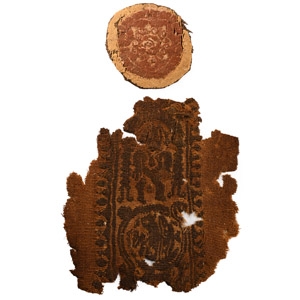
Egyptian Coptic Textile Fragment Group
Circa 5th-6th century A.D.Sold for (Inc. bp): £91
Comprising a fragment of a large segmentum in linen and wool, embroidered with a dancer, followed by a tondo with a Nereid riding a dolphin, borders with geometric decorations; an orbiculus decorated with vegetal patterns. 37 grams total including package, 6.7-14 cm
Acquired 1970s-1996. Property of a North American collector. London collection, 2016.
The segmentum was probably part of the vertical clavus of a tunic; it is highly probable that the embroidery refers to the Dionysian cycle with dancers, animals and probably, in the missing parts, hunters. -
.jpg)
Egyptian Rock Crystal Scarab
Late Period, 664-332 B.C.Sold for (Inc. bp): £650
Carved scarab with segmented carapace and legs. 6.45 grams, 23 mm
Ex Belinda Elliston collection, a member of the Egyptian Exploration Society, 1940s onwards.
