
Loading, please wait...
LOT 0462
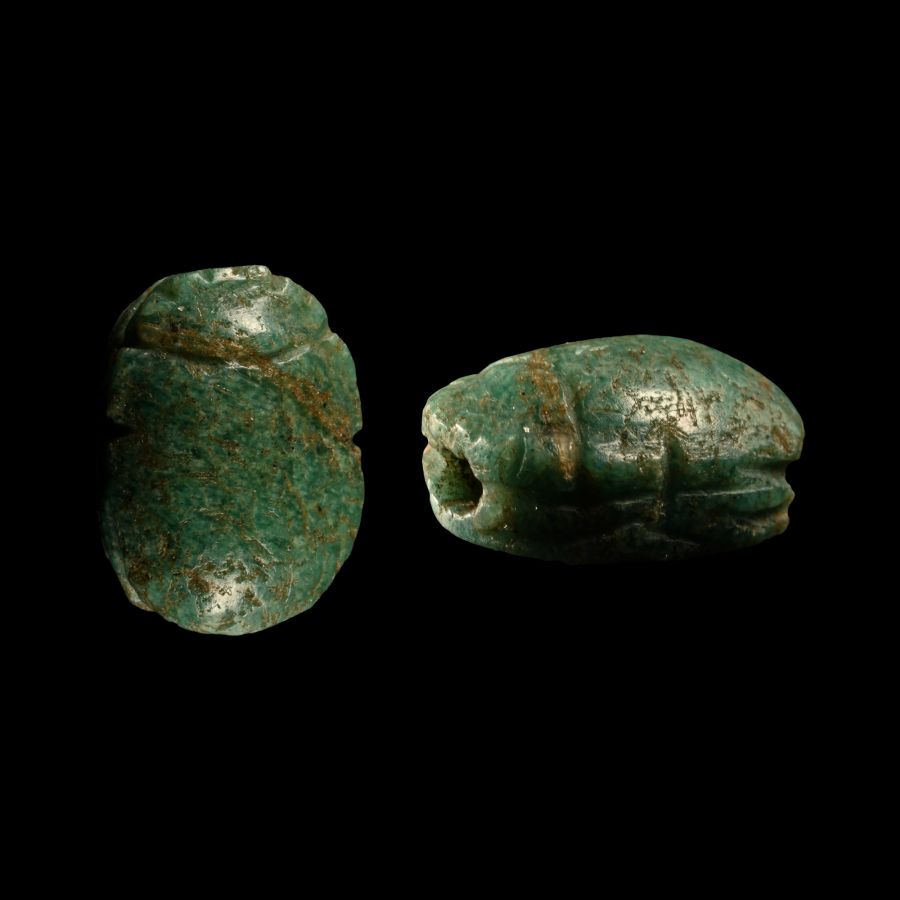
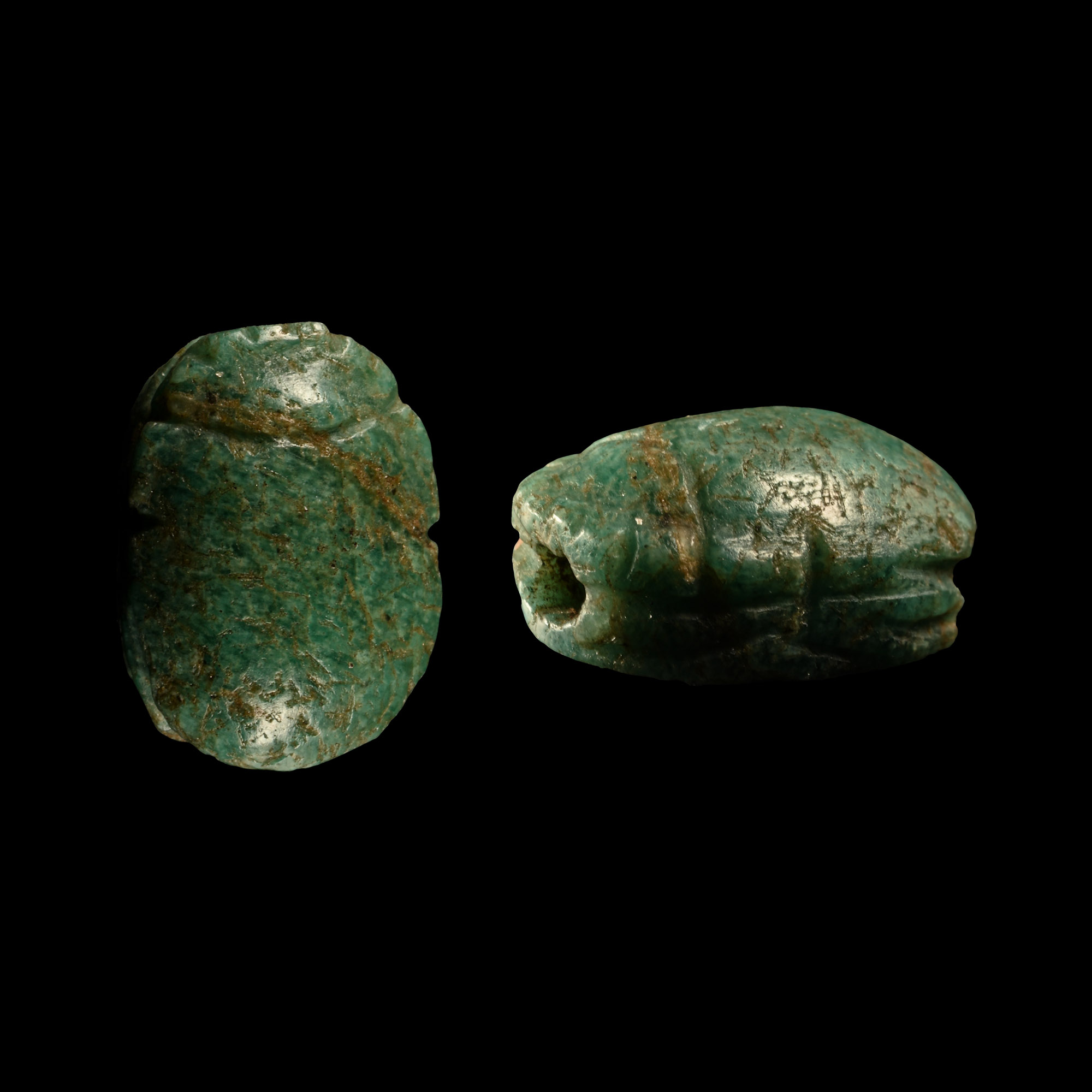
Egyptian Green Hardstone Scarab
LATE PERIOD, 664-332 B.C.
1/2 in. (1.61 grams, 14 mm).
Pierced longitudinally; plain underside with old collector's label attached.
ProvenanceFrom the property of the late Mr SM, London, UK, 1969-1999.
CONDITIONTimeLine Auctions follows a vetting process to ensure the authenticity and legality of all items, reinforcing our commitment to integrity and responsible trading. Each antiquity, antique, and coin lot undergoes thorough examination by a vetting committee of at least ten external specialists, professional trade association members, scientists, and archaeologists: Our Vetting Process
AUCTIONS:
TimeLine is a leading auction house specialising in antiquities, ancient art, collectables, natural history, coins, medals, and books. Our auctions offer museums, collectors, historians, and enthusiasts the opportunity to acquire unique and historically significant pieces.
-
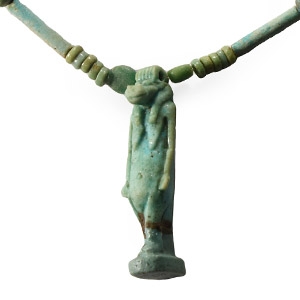
Egyptian Faience Bead Necklace String with Taweret Amulet
Late Period, 664-332 B.C.Estimate: £300 - 400 (+bp*)
Opening Bid: £150
Restrung using mainly annular and tubular beads, two wedjat eye pendants with black detailing; a large Taweret pendant to the centre, the hippopotamus goddess modelled advancing on a tongue-shaped plinth and wearing a tripartite wig; repaired. 12.7 grams, 31 cm
From the vendor's grandfather's collection, formed in the 1950s; thence by family descent circa 1974.
Taweret was a female hippopotamus, with the arms and legs of a lion and the back and tail of a crocodile. Despite her fearsome appearance, Taweret was a household deity and protector of women in childbirth. -
.jpg)
Egyptian Faience Scarab
Late Period, 6th-5th century B.C.Sold for (Inc. bp): £910
With detailed ribbing to the carapace, legs and mouth; underside with central ribbed loop; old inked collector's reference 'E.45'. 4.18 grams, 27 mm
Collected between the 1950s-1990s. Ex Roger Liechti (1934-2010) collection, Geneva, Switzerland. -
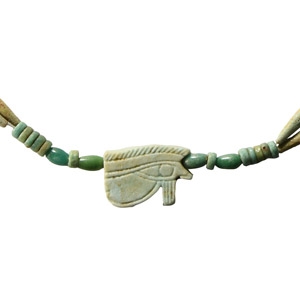
Egyptian Faience Bead Necklace String with Wedjat Eyes
Late Period, 664-332 B.C.Estimate: £400 - 600 (+bp*)
Opening Bid: £200
Restrung on two parallel strands using mainly annular and tubular beads, enhanced with two pairs of small wedjat eye pendants, one pair with applied black detailing and the other pair with moulded low-relief detailing; with a central, large wedjat eye pendant with low-relief detailing. 14.1 grams, 44 cm
From the vendor's grandfather's collection, formed in the 1950s; thence by family descent circa 1974.
