Loading, please wait...

Egyptian Grand Tour Shabti Group with 1939 Photograph Egyptian Grand Tour Shabti Group with 1939 Photograph Egyptian Grand Tour Shabti Group with 1939 Photograph
Use mousewheel to zoom in and out, click to enlarge
Details

LOT 1919

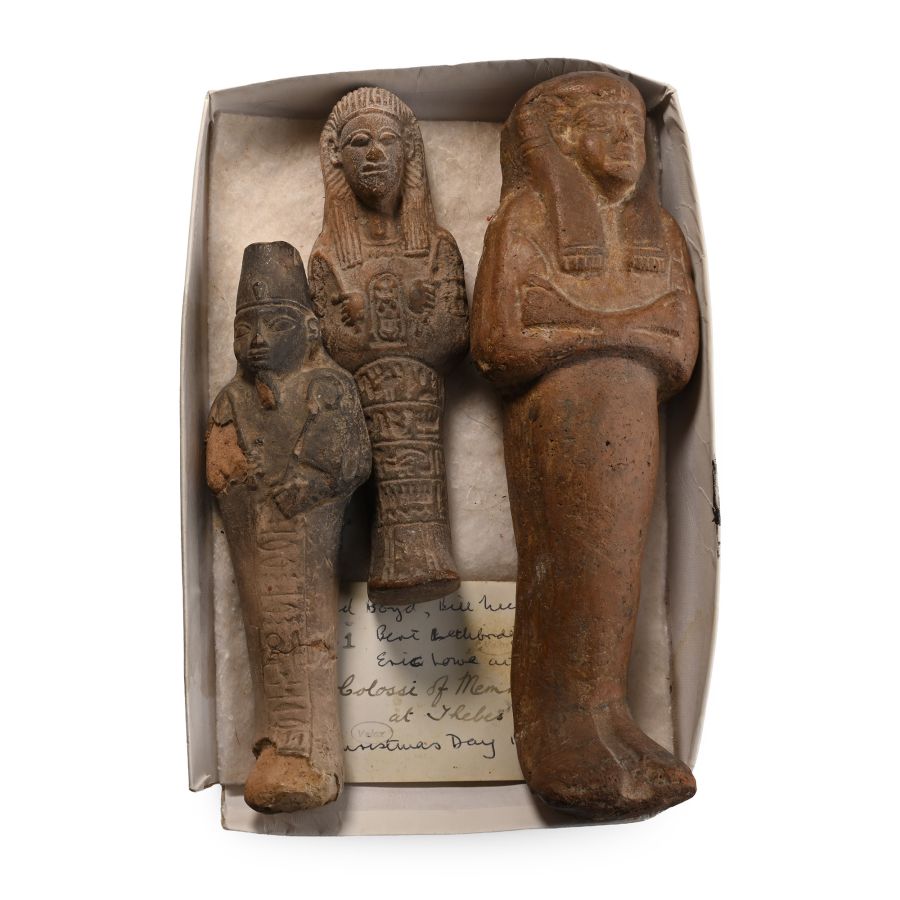
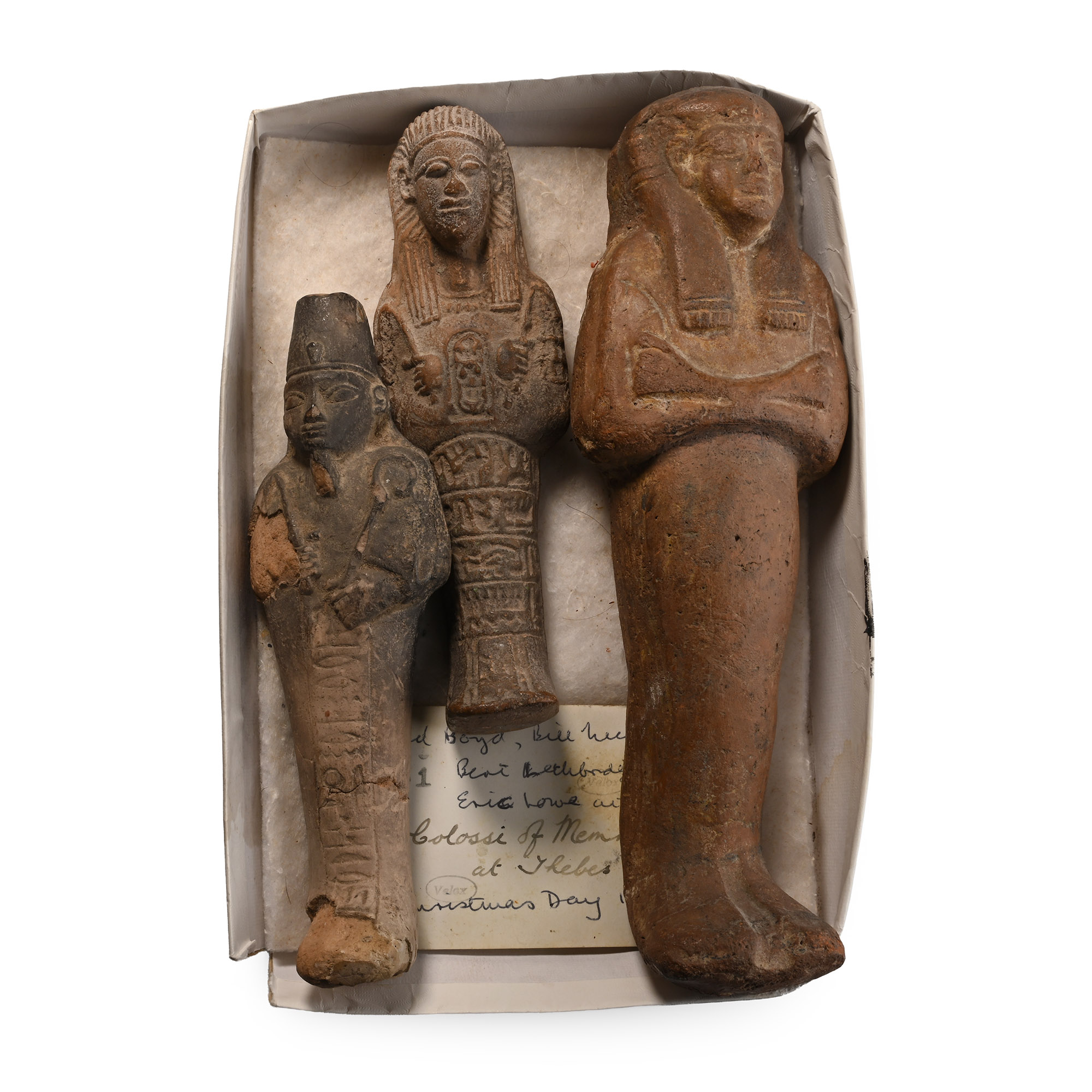
Egyptian Grand Tour Shabti Group with 1939 Photograph

19TH-EARLY 20TH CENTURY A.D.

6 - 8 1/2 in. (884 grams total, 15.4-21.7 cm).

Comprising: large ceramic shabti with agricultural tools in the crossed hands, some pigment to wig; mould-formed shabti with hieroglyphs to lower body; shabti in conical cap with hieroglyphs in column to lower body, chipped to reveal inner core; photograph of four travellers in Thebes with handwritten legend (two different hands) to reverse 'David Boyd, Bill Nichols, Bert Lethbridge + eric Lowe at the Colossi of Memmon at Thebes on Christmas Day 1939'; in old card collector's tray with padded liner. [3, No Reserve]

Provenance

Property of a Norwich, Norfolk, UK, gentleman.

CONDITION
VETTING:

TimeLine Auctions follows a vetting process to ensure the authenticity and legality of all items, reinforcing our commitment to integrity and responsible trading. Each antiquity, antique, and coin lot undergoes thorough examination by a vetting committee of at least ten external specialists, professional trade association members, scientists, and archaeologists: Our Vetting Process


AUCTIONS:

TimeLine is a leading auction house specialising in antiquities, ancient art, collectables, natural history, coins, medals, and books. Our auctions offer museums, collectors, historians, and enthusiasts the opportunity to acquire unique and historically significant pieces.

LOT 1919

Egyptian Grand Tour Shabti Group with 1939 Photograph

Sold for (Inc. bp): £234

Print page

RELATED LOTS
  • Painted Wooden Icon with Saints Boris and Gleb
    Painted Wooden Icon with Saints Boris and Gleb
    Russia, 16th-17th century A.D.

    Estimate: £2,000 - 3,000 (+bp*)

    Opening Bid: £1,000

    Painted on a wooden board with gessoed surface, tempera on wood panel with kovcheg (recessed central panel on the obverse) executed on a pale yellow ground; Boris and Gleb depicted on horseback wearing Russian 16th century Boyar costume, both with nimbus, each with a lance and pennant; on the right upper corner, God is represented as a half figure making a blessing gesture, inscription in Greek letters 'ΙϹ ΧϹ' (ΙΗϹΟΥϹ ΧΡΙϹΤΟϹ = Jesus Christ); rectangular wooden board with mounting slots to reverse. 1 kg, 32 x 26.5 cm

    ; good condition, losses to the borders, areas of retouching.

    Acquired on the UK art market. Private collection, London, UK. Accompanied by an academic report by Dr Raffaele D'Amato. This lot has been checked against the Interpol Database of stolen works of art and is accompanied by search certificate number no.12927-246338.

    Boris and Gleb, Princes of old Rus Nation, were the sons of Vladimir of Kiev, the first Christian Prince of Rus; according the history they were killed in 1015 and 1019 in the civil struggles for the succession to the Kiev’s throne, and sanctified for their faith. Standards with their image were worn by the medieval Russian army.

    Lot Details

  • Spanish Gold Ring with a Table-Cut Red Spinel
    Spanish Gold Ring with a Table-Cut Red Spinel
    16th-17th century A.D.

    Sold for (Inc. bp): £11,700

    A substantial ring with a box-shaped bezel set with a table-cut red spinel of deep purplish-red hue, the reverse of the bezel convex with chamfered ends. 6.93 grams, 24.30 mm overall, 17.05 mm internal diameter (approximate size British M 1/2 , USA 6 1/4, Europe 13.09, Japan 12)


    Private English collection, formed between the late 1970s and early 1990s. Private collection, UK. This lot has been checked against the Interpol Database of stolen works of art and is accompanied by search certificate number no.12996-245986.

    The box bezel is typical of both Spanish and Islamic goldsmithing traditions. The small pointed projection at the rear of the hoop, however, is not a common feature in Spanish rings but is a distinctive hallmark of Islamic goldwork — a form ultimately rooted in Middle Eastern traditions of the Sasanian, Fatimid, and Mamluk periods. This detail likely reached Spain through the transmission of techniques from the Middle East into Islamic North Africa, and subsequently into the goldsmithing repertoire of al-Andalus. These forms were adapted by Spanish goldsmiths to accommodate the tastes of a Christian clientele, reflecting the deep and enduring influence of Islamic craftsmanship in post-Reconquista Spain.

    Lot Details

  • Chinese Style Enamelled Silver-Coloured Metal Pendant Necklace
    Chinese Style Enamelled Silver-Coloured Metal Pendant Necklace
    20th century A.D.

    Sold for (Inc. bp): £26

    Comprising an oval pendant set with a red cabochon, enamelled flower above, reverse with Chinese stamp for 'silver', clasp ring hallmarked '925'. 23 grams, 54 cm


    From the family collection of a Hampstead gentleman; formerly acquired in the 1980s.

    Lot Details

Stay up-to-date with the latest from TimeLine Auctions by joining our mailing list