
Loading, please wait...
_900x900.jpg "Egyptian Gold Uraeus Amulet")
_200x200.jpg "Egyptian Gold Uraeus Amulet")
.jpg "Egyptian Gold Uraeus Amulet")
LOT 0501
Egyptian Gold Uraeus Amulet
LATE NEW KINGDOM, 1070-900 B.C.
3/8 in. (0.38 grams, 11 mm).
In rearing cobra pose with body coiled below.
ProvenanceFrom an early 20th century French collection.
LiteratureCf. Charron, A., Barbotin, C., Khâemouaset, le prince archéologue, savoir et pouvoir à l’époque de Ramsès II,Gand, 2016, p.111 nos.36-37, for two similarly styled examples.
CONDITIONTimeLine Auctions follows a vetting process to ensure the authenticity and legality of all items, reinforcing our commitment to integrity and responsible trading. Each antiquity, antique, and coin lot undergoes thorough examination by a vetting committee of at least ten external specialists, professional trade association members, scientists, and archaeologists: Our Vetting Process
AUCTIONS:
TimeLine is a leading auction house specialising in antiquities, ancient art, collectables, natural history, coins, medals, and books. Our auctions offer museums, collectors, historians, and enthusiasts the opportunity to acquire unique and historically significant pieces.
LOT 0501
Egyptian Gold Uraeus Amulet
Estimate £300 - 400€350 - 460 (for guidance only)$410 - 540 (for guidance only)
-
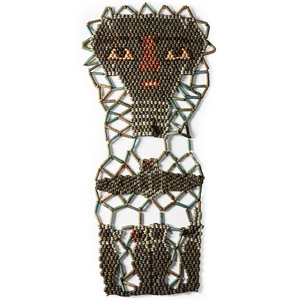
Egyptian Faience Mummy Bead Mask with Scarab and Four Sons of Horus
Ptolemaic Period, 332-30 B.C.Sold for (Inc. bp): £316
A netted beadwork panel of annular and tubular glazed composition beads in blues, greens, black, cream and red-brown colours, depicting a mummy face mask with false beard, a scarab with extended wings below, the 'Four Sons of Horus’ beneath the scarab, joined together with areas of open netting of tubular beads; restrung with some later beads. 58 grams, 25.5 cm
Ex Mariaud de Serres, Paris, France, 1980-1990s. From a London, UK, collection.
Winged scarabs were often used as funerary amulets and believed to symbolise the deceased's rebirth and regeneration. The Four Sons of Horus were deities responsible for protecting the deceased's internal organs. Here, on the left, is the baboon-headed Hapy, protector of the lungs, then the human-headed Imsety, protector of the liver, followed by the falcon-headed Qebehsenuef, who protects the intestines and, finally, the jackal-headed Duamutef on the right (note his erect ears are indicated), who protected the stomach. These internal organs were often placed in canopic jars with the head of the respective Son of Horus. Amulets depicting these deities were placed within the mummy wrappings. -
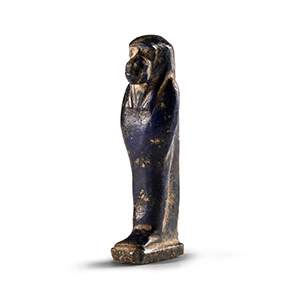
Egyptian Lapis Lazuli Son of Horus Amulet
Late Period, 664-332 B.C.Sold for (Inc. bp): £715
Carved amulet of the baboon-headed mummiform figure of Hapy shown standing with dorsal pillar, pierced for suspension. 2.52 grams, 28 mm
Private collection of Mr S.A., Switzerland, 1990s, thence by descent.
The Four Sons of Horus were deities responsible for protecting the internal organs of the deceased. The baboon-headed Hapy protected the lungs. -
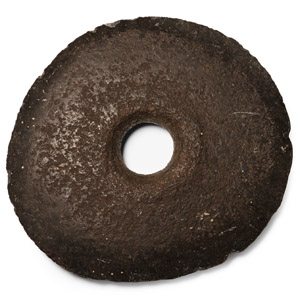
Egyptian Porphyry Disc-Mace
Neolithic Period, circa 2500-1500 B.C.Sold for (Inc. bp): £72
Circular in plan with worked cutting edge all round, socket with one chamfered face. 556 grams, 14 cm
Probably found Egypt, North Africa. Acquired on the British art market. From the collection of a South West London, UK, specialist Stone Age collector.
