
Loading, please wait...
_900x900.jpg "Egyptian Gold Setting with Glass Inlay")
_200x200.jpg "Egyptian Gold Setting with Glass Inlay")
.jpg "Egyptian Gold Setting with Glass Inlay")
LOT 0464
Egyptian Gold Setting with Glass Inlay
LATE PERIOD, 664-332 B.C.
3/8 in. (1.18 grams, 10 mm).
Square sheet gold cell with repoussé quatrefoil to the underside, inset glass panel in red glass and pale turquoise faience.
ProvenanceFrom a late Japanese specialist collector, 1970-2000s.
CONDITIONTimeLine Auctions follows a vetting process to ensure the authenticity and legality of all items, reinforcing our commitment to integrity and responsible trading. Each antiquity, antique, and coin lot undergoes thorough examination by a vetting committee of at least ten external specialists, professional trade association members, scientists, and archaeologists: Our Vetting Process
AUCTIONS:
TimeLine is a leading auction house specialising in antiquities, ancient art, collectables, natural history, coins, medals, and books. Our auctions offer museums, collectors, historians, and enthusiasts the opportunity to acquire unique and historically significant pieces.
-
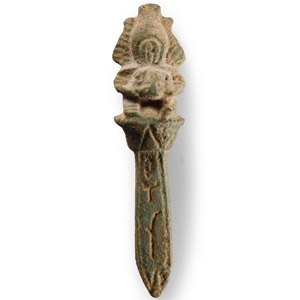
Egyptian Faience Wadj Amulet
Late Period, 664-332 B.C.Sold for (Inc. bp): £468
Square-section wadj papyrus stalk amulet surmounted by a ram's head wearing the Atef crown; the front inscribed with ankh (life) and renpet (year) hieroglyphs. 1.92 grams, 39 mm
From the collection of Doctor Girard, a collector for over 60 years. with Hotel des Ventes de Clermont-Ferrand, 22 May 2017. Property of a French collector.
The papyrus column or wadj amulet is typically made out of turquoise feldspar or faience, as is prescribed in the Book of the Dead. The word wadj, meaning “green”, evokes concepts of well-being and vitality. Papyrus amulets were often placed around the neck of the deceased to ensure eternal youth in the afterlife. The ram's head is associated with the god Amun and the Atef crown with Osiris, ruler of the Underworld. -
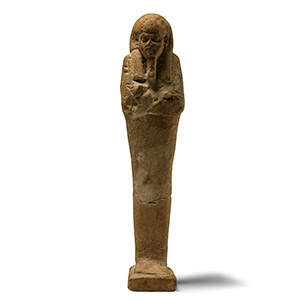
Egyptian Faience Shabti for Horemakhbit
Late Period, 664-332 B.C.Sold for (Inc. bp): £416
Of long, slender mummiform shape, wearing a tripartite wig and holding a pick and hoe, with a dorsal pillar bearing a hieroglyphic dedication to 'the Osiris, Horemakhbit'; repaired. 102 grams, 15.7 cm
Ex M.S. Ciappara collection, Norfolk, UK, 1939-1950.
Shabti figures were created to carry out heavy manual tasks on behalf of a person in the afterlife. The body of a shabti was usually in the form of a mummy and often depicted with tools in their hands, such as baskets, picks, and hoes. During the Late Period, it was customary to be buried with hundreds of shabtis. -
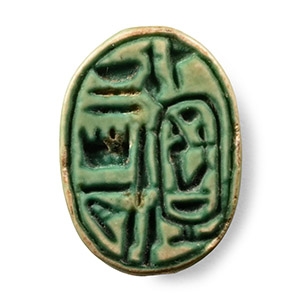
Egyptian Faience Scarab for Amenhotep III
New Kingdom, 18th Dynasty, 1410-1372 B.C.Sold for (Inc. bp): £1,300
Modelled with carapace and mouth details, the underside with hieroglyphic text giving the dedication: 'the good god, lord of the Two Lands, beloved of Amun', with the cartouche containing the throne name of Amenhotep III (Neb-Maat-Re). 2.53 grams, 17 mm
From the collection of Doctor Girard, a collector for over 60 years. with Hotel des Ventes de Clermont-Ferrand, 22 May 2017. Property of a French collector.
