
Loading, please wait...
_900x900.jpg "Egyptian Gold Lotus Type Pendant")
_200x200.jpg "Egyptian Gold Lotus Type Pendant")
.jpg "Egyptian Gold Lotus Type Pendant")
LOT 0486
Egyptian Gold Lotus Type Pendant
LATE PERIOD, 664-332 B.C.
1/4 in. (0.15 grams, 8 mm).
With palmette motif and filigree hoop.
ProvenanceAcquired 1980-2015.
Ex Abelita family collection.
See Andrews, C., Amulets of Ancient Egypt, London, 1994, for discussion.
FootnotesFlora-form amulets are thought to symbolise new life, like the growing plants they copied. Many gold palmette elements were found in the New Kingdom tomb of Aper-el at Saqqara, featuring pierced holes rather than a hoop for attachment (Cf. Zivie, A., Découverte à Saqqarah: Le vizir oublié, Paris, 1990, p.149 no.94 for examples).
CONDITIONTimeLine Auctions follows a vetting process to ensure the authenticity and legality of all items, reinforcing our commitment to integrity and responsible trading. Each antiquity, antique, and coin lot undergoes thorough examination by a vetting committee of at least ten external specialists, professional trade association members, scientists, and archaeologists: Our Vetting Process
AUCTIONS:
TimeLine is a leading auction house specialising in antiquities, ancient art, collectables, natural history, coins, medals, and books. Our auctions offer museums, collectors, historians, and enthusiasts the opportunity to acquire unique and historically significant pieces.
-
.jpg)
Egyptian Silver Signet Ring
Late Period, 664-332 B.C.Sold for (Inc. bp): £312
With a round-section hoop, the wide bezel encrusted but with decoration beneath. 7.11 grams, 26.03 mm overall, 18.22 mm internal diameter (approximate size British O 1/2, USA 7 1/4, Europe 15.61, Japan 15)
Collected from 1969-1999. From the collection of the late Mr S.M., London, UK. -
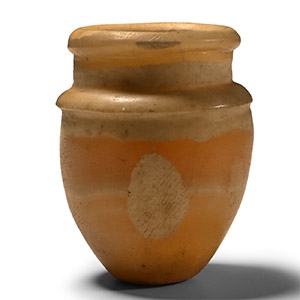
Egyptian Alabaster Vase with Carinated Shoulders
Later Period, circa 664-332 B.C.Sold for (Inc. bp): £910
With rounded rim, short neck, a raised carination to the shoulder, the body tapering to a flat base; usage wear. 172 grams, 69 mm high
Mary Stout Shaw (1880-1962); thence by direct descent to the present owner. Accompanied by a copy of a 1976 family photo featuring some of the collection on display,
Mary Kilgour Stone was born in 1880 in Cincinnati, Ohio. On 25 November 1903, she married Percy Wyfold Stout from Gloucester (DSO, OBE, 1875-1937), who had moved to Cairo after an international rugby career. After fighting in the First World War, Percy became the Director of the Egyptian Delta Land Company and the Anglo-American Nile Tourist Company. He and Mary were friends with the famous Major Gayer-Anderson, who worked as a doctor on the company’s cruise boats between 1930 and 1939. Gayer-Anderson tells in his memoir how this allowed him to make frequent trips to Upper Egypt and fulfil his passion for collecting (and dealing in) ancient Egyptian art. In his company, Mary became an enthusiast about all things Egypt and formed an elegant collection of ancient Egyptian alabaster vessels, including the following lots. She was particularly fascinated with the ancient cat goddess Bastet. Therefore, when Gayer-Anderson decided to give his famous ancient bronze cat to the British Museum in 1939, he made sure the donation was in both his name and Mary Stout Shaw’s, as a tribute to their friendship. -
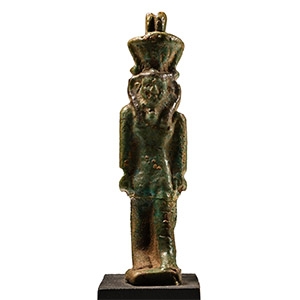
Egyptian Faience Figure of Nefertum
Ptolemaic Period, 332-30 B.C.Estimate: £700 - 900 (‡+bp*)
Opening Bid: £350
Turquoise faience standing figure of Nefertum in a striding pose with arms at the sides, sporting a black coloured tripartite wig surmounted by the god's distinctive headdress consisting of a lotus flower with two plumes on top; a suspension loop at the back; repaired. 71 grams total, 13 cm including stand
Property from an American deceased estate, acquired between 1970 and 1989. with Bonham's, London, 28 October 2009, no.81 [Part].
Nefertum was closely associated with the creator god Ptah and the goddesses Sekhmet and Bastet. He represented the first sunlight and the sweet scent of the Egyptian blue lotus flower (nymphaea caerulea). According to beliefs, the sun rose from the bloom of a blue lotus, embodying notions of rebirth and rejuvenation. Additionally, as the lotus was seen as a symbol of fertility, it is possible that this amulet was also worn for that purpose.
