
Loading, please wait...
_900x900.jpg "Egyptian Gold Cartonnage Inlays")
_200x200.jpg "Egyptian Gold Cartonnage Inlays")
.jpg "Egyptian Gold Cartonnage Inlays")
LOT 0007
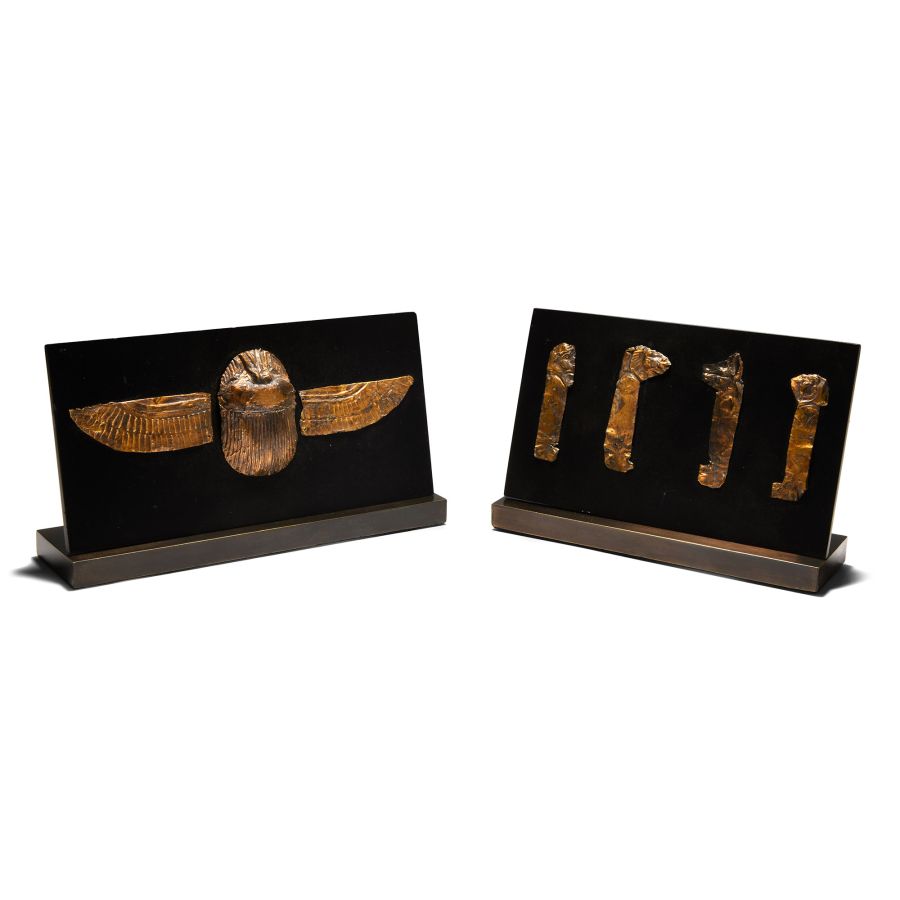
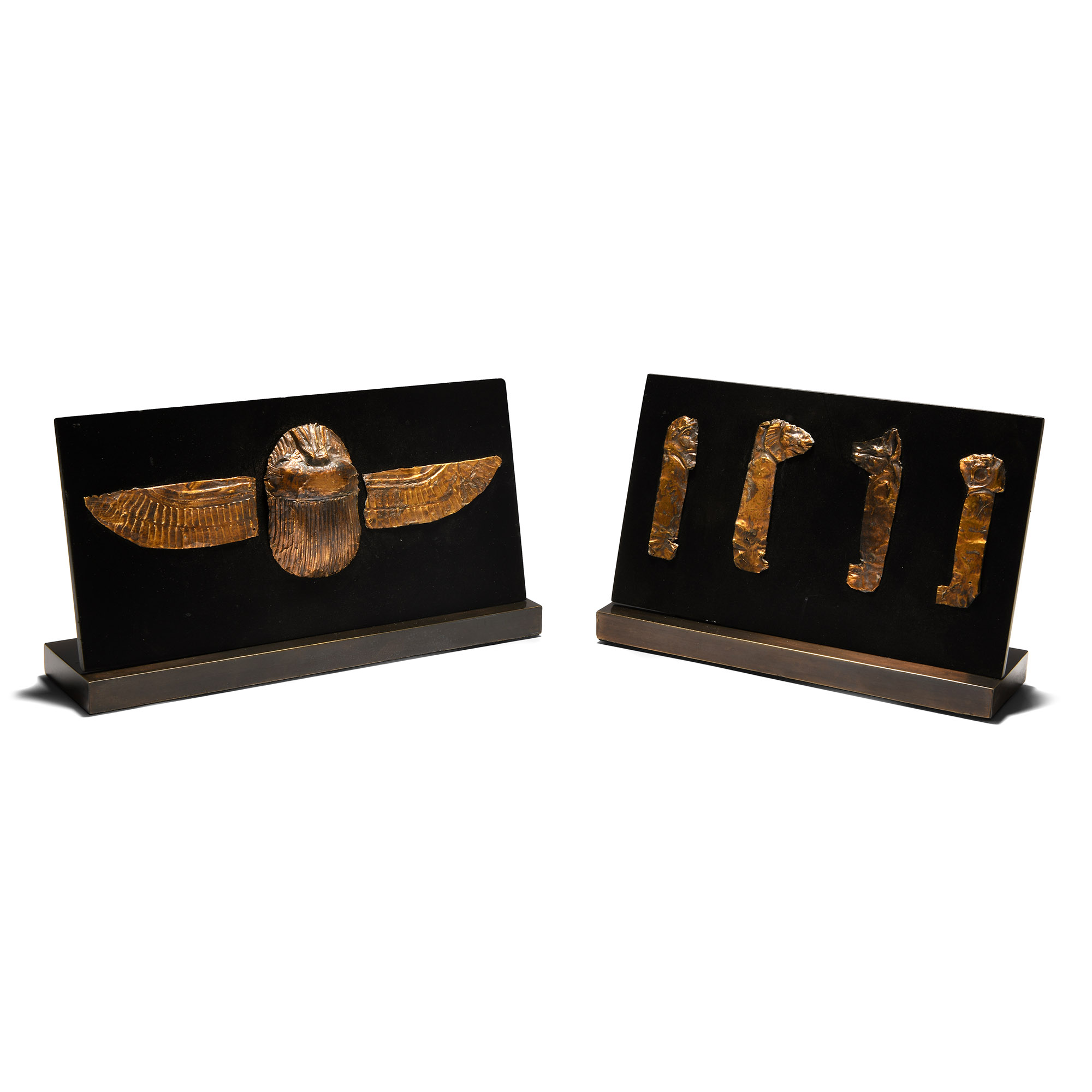
Egyptian Gold Cartonnage Inlays
LATE PERIOD-PTOLEMAIC PERIOD, 664-31 B.C.
6 1/2 - 7 7/8 in. (635 grams total, 16.5-20 cm wide including stand).
Comprising: a winged scarab with detailed carapace and wings; and the mummiform figures of the four Sons of Horus, Imsety, Hapy, Duamutef, and Qebehsenuef; mounted on custom-made display stands. [2]
ProvenanceFrom a 1920s French collection.
Ex German gallery, 1970-1980s.
Spanish collection, 1980s-1990s.
London, UK, collection, 2000s.
This lot has been checked against the Interpol Database of stolen works of art and is accompanied by search certificate no.12126-214208.
The Four Sons of Horus were deities responsible for protecting the internal organs of the deceased. The human-headed Imsety protected the liver, the baboon-headed Hapy protected the lungs, the jackal-headed Duamutef protected the stomach, and the falcon-headed Qebehsenuef protected the intestines.
CONDITIONTimeLine Auctions follows a vetting process to ensure the authenticity and legality of all items, reinforcing our commitment to integrity and responsible trading. Each antiquity, antique, and coin lot undergoes thorough examination by a vetting committee of at least ten external specialists, professional trade association members, scientists, and archaeologists: Our Vetting Process
AUCTIONS:
TimeLine is a leading auction house specialising in antiquities, ancient art, collectables, natural history, coins, medals, and books. Our auctions offer museums, collectors, historians, and enthusiasts the opportunity to acquire unique and historically significant pieces.
-
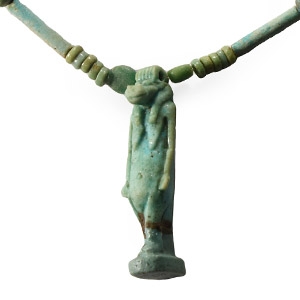
Egyptian Faience Bead Necklace String with Taweret Amulet
Late Period, 664-332 B.C.Estimate: £300 - 400 (+bp*)
Opening Bid: £150
Restrung using mainly annular and tubular beads, two wedjat eye pendants with black detailing; a large Taweret pendant to the centre, the hippopotamus goddess modelled advancing on a tongue-shaped plinth and wearing a tripartite wig; repaired. 12.7 grams, 31 cm
From the vendor's grandfather's collection, formed in the 1950s; thence by family descent circa 1974.
Taweret was a female hippopotamus, with the arms and legs of a lion and the back and tail of a crocodile. Despite her fearsome appearance, Taweret was a household deity and protector of women in childbirth. -
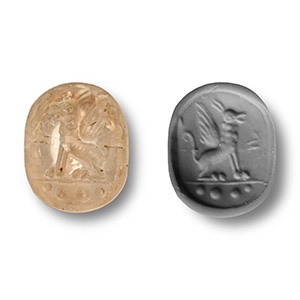
Egypto-Phoenician Rock Crystal Scaraboid with Winged Sphinx
Circa 900-700 B.C.Sold for (Inc. bp): £182
With detailed carapace and mouth parts, underside with intaglio winged sphinx sitting on a baseline with pellets beneath; supplied with a museum-quality impression. 2.85 grams, 16 mm
Ex London, UK, gallery, 1971. -
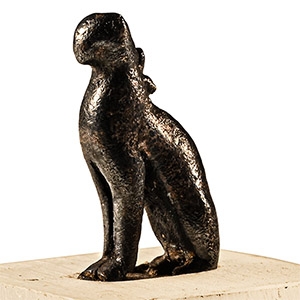
Egyptian Silver Bastet Cat Goddess
Late Period, 664-332 B.C.Estimate: £800 - 1,000 (‡+bp*)
Opening Bid: £400
Modelled seated on an oblong base; accompanied by a custom-made display base. 1.27 grams, 13 mm high (6.02 grams total, 33 mm including stand)
Ex Mrs Zimmermann Koutoulakis, December 1977. Ex R. Liechti (1934-2010) Geneva, Switzerland, collection between 1950-1990s.
Bastet was primarily a goddess of fertility, but she also represented festivities and intoxication, which formed part of the temple celebrations of her cult.
