
Loading, please wait...
LOT 0019
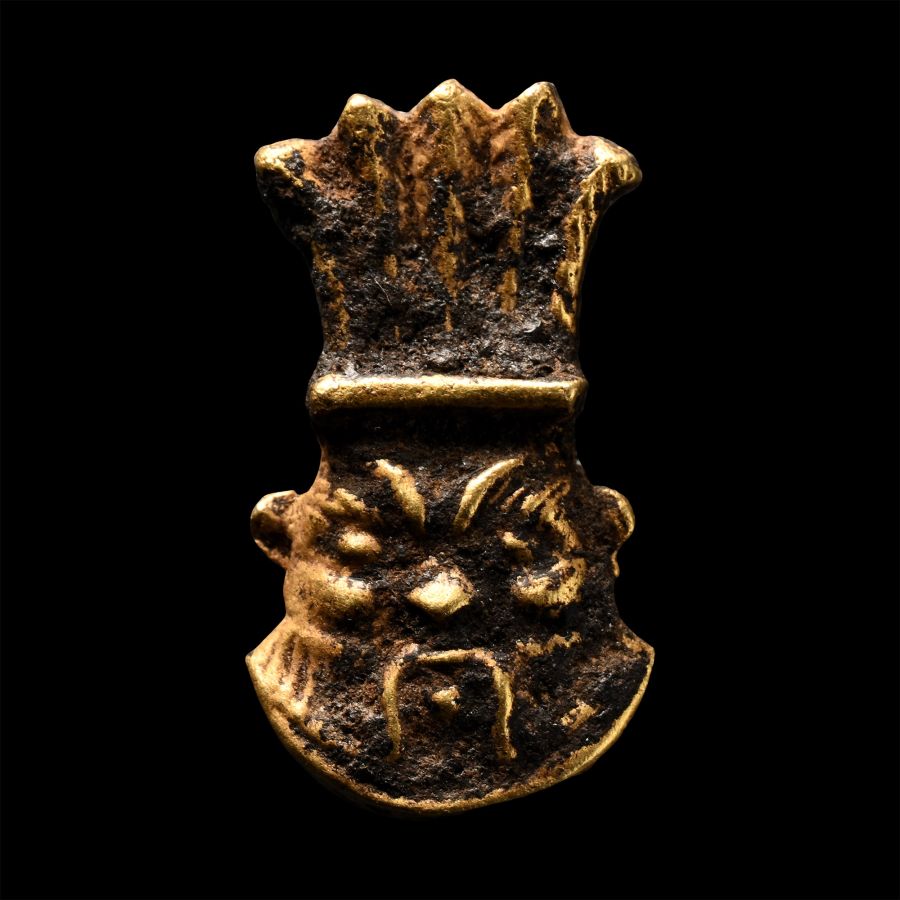
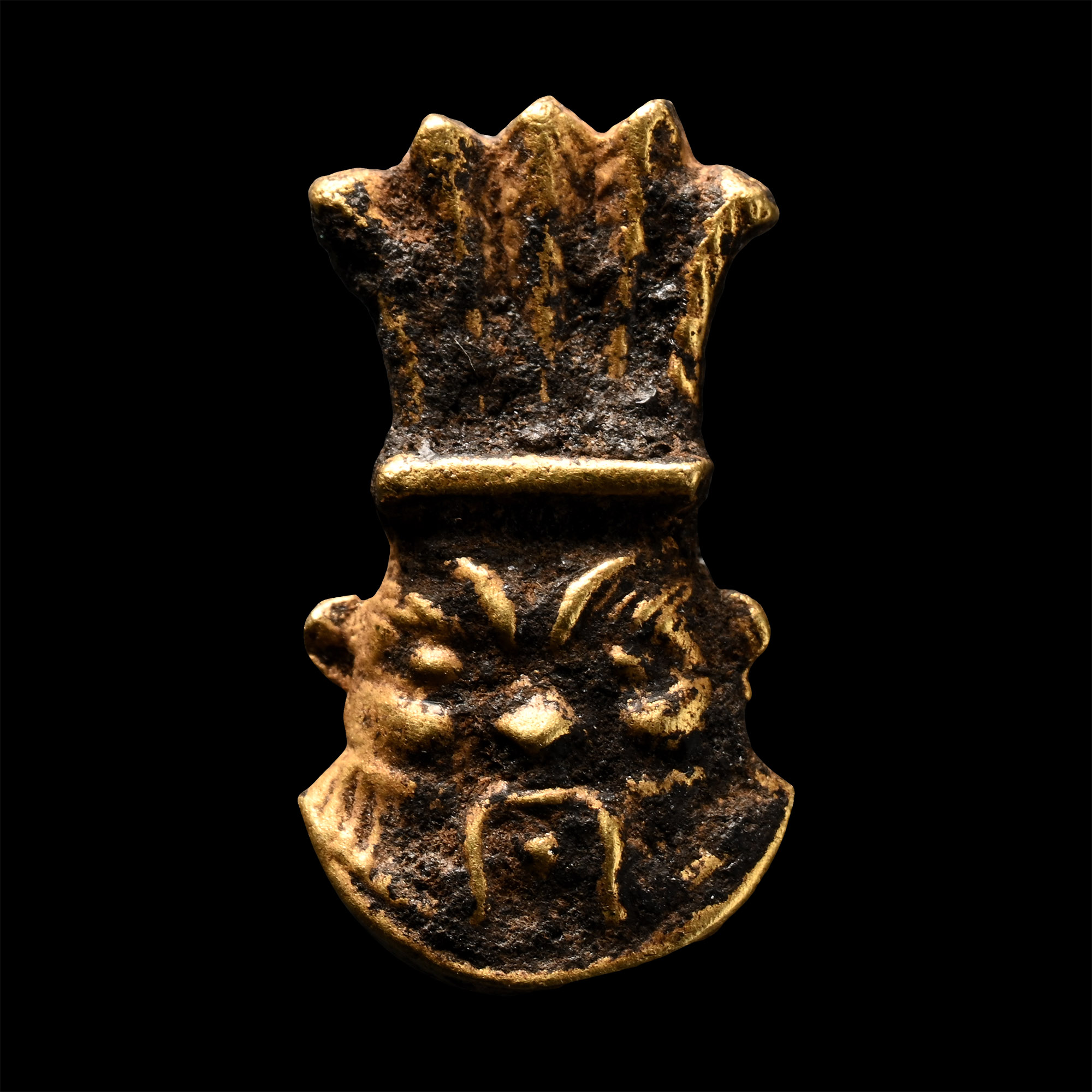
Egyptian Gold Bes Amulet
NEW KINGDOM, CIRCA 1550-1070 B.C.
3/4 in. (3.57 grams, 18 mm).
Mask of Bes with feathered crown; attachment bar to reverse.
ProvenanceEx French collection, early 20th century.
From the collection of a late Japanese gentleman, 1970s onwards.
Cf. Andrews, C., van Dijk, J., Objects for Eternity: Egyptian Antiquities from the W. Arnold Meijer Collection, Mainz am Rhein, 2006, p.217, no.3.27, for a similar example.
FootnotesFrom the New Kingdom onwards, Bes became one of ancient Egypt's most popular apotropaic deities. Despite his somewhat fearsome appearance, Bes served as the patron and protector of pregnant women and children, and was also believed to shield them from snakes.
CONDITIONTimeLine Auctions follows a vetting process to ensure the authenticity and legality of all items, reinforcing our commitment to integrity and responsible trading. Each antiquity, antique, and coin lot undergoes thorough examination by a vetting committee of at least ten external specialists, professional trade association members, scientists, and archaeologists: Our Vetting Process
AUCTIONS:
TimeLine is a leading auction house specialising in antiquities, ancient art, collectables, natural history, coins, medals, and books. Our auctions offer museums, collectors, historians, and enthusiasts the opportunity to acquire unique and historically significant pieces.
-
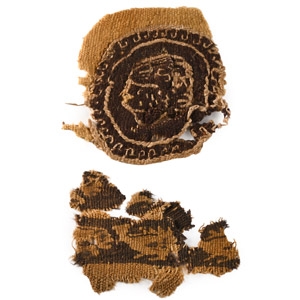
Egyptian Coptic Textile Fragment Group
Circa 4th-5th century A.D.Sold for (Inc. bp): £65
Comprising: an orbiculus in coarse linen and brown wool, S torsion, embroidered with the image of a stylised bird, surrounded by tondos ornamented with geometric embroidery, borders meander decorated; a similar fragment of double segmenta, embroidered with hares alternated to fishes. 9 grams total including package, 60-64 mm
Acquired 1970s-1996. Property of a North American collector. London collection, 2016.
The iconography of this fragment is called "Nilotic," as it depicts plant and human elements linked to life on the Nile River. These images are very recurrent on Coptic textiles. Weavers created patterns that allowed them to reproduce these motifs on any type of fabric (curtains, tassels, clothing). -
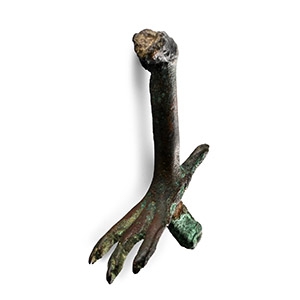
Egyptian Bronze Ibis Statue Foot
Late Period, 664-332 B.C.Sold for (Inc. bp): £78
Modelled in the round with three spreading claws and spur to rear, attachment lug to underside. 35 grams, 62 mm
From the collection of a Buckinghamshire, UK, collector established from the earlier 1960s. -
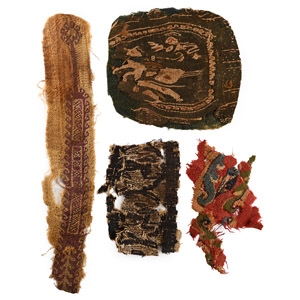
Egyptian Coptic Textile Fragment Group
Circa 4th-8th century A.D.Sold for (Inc. bp): £143
Comprising: a decorative tunic stripe (clavus) in purple wool over coarse linen, S-twist tapestry, divided in three sections embroidered with geometric ornaments, borders meander decorated; an orbiculus in white and black wool, S-twist tapestry, embroidered with stylised animals; fragment of fabric in red, yellow, blue and green wool, with vegetal patterns; fragments of a segmentum, in white and black wool, S-twist tapestry, embroidered with stylised figures. 42 grams total including package, 8.5-22.5 cm
Acquired 1970s-1996. Property of a North American collector. London collection, 2016.
Among the many fragments of wool tunics, several long strips that match to form nearly full-length central pectoral clavi can be found. They are patterned with a profusion of small figures or interlaced abstract designs, birds, plants and animals with a contrasting border filled with geometric motifs.
