
Loading, please wait...
LOT 0461
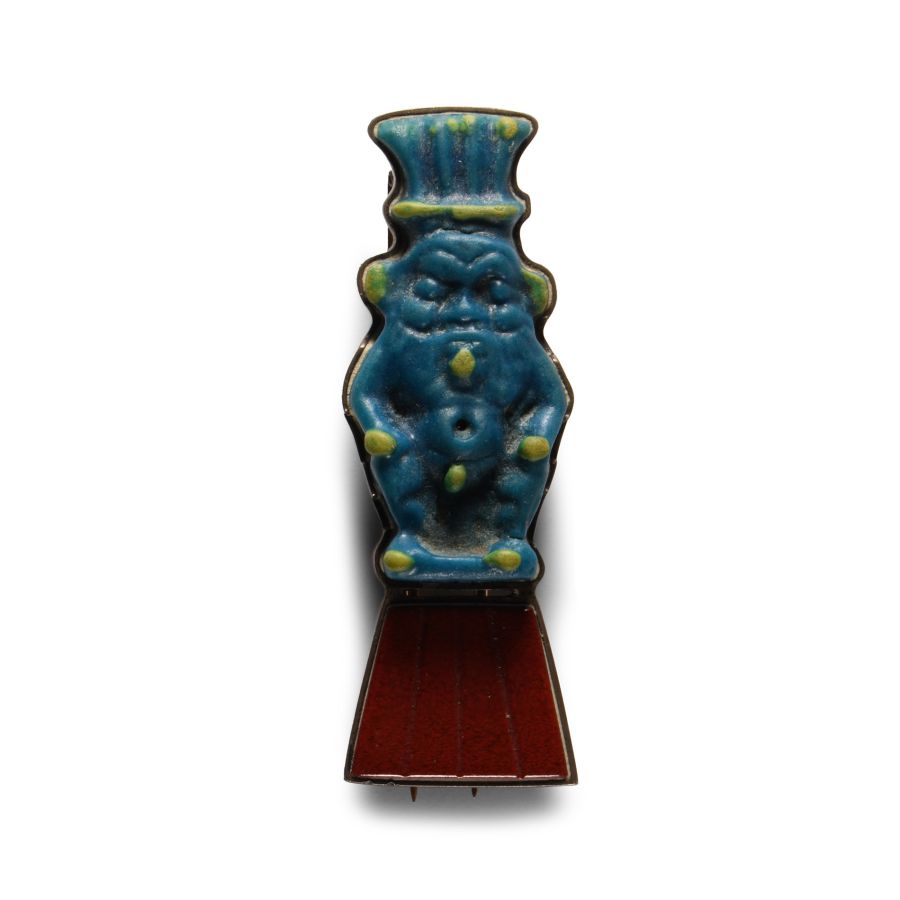
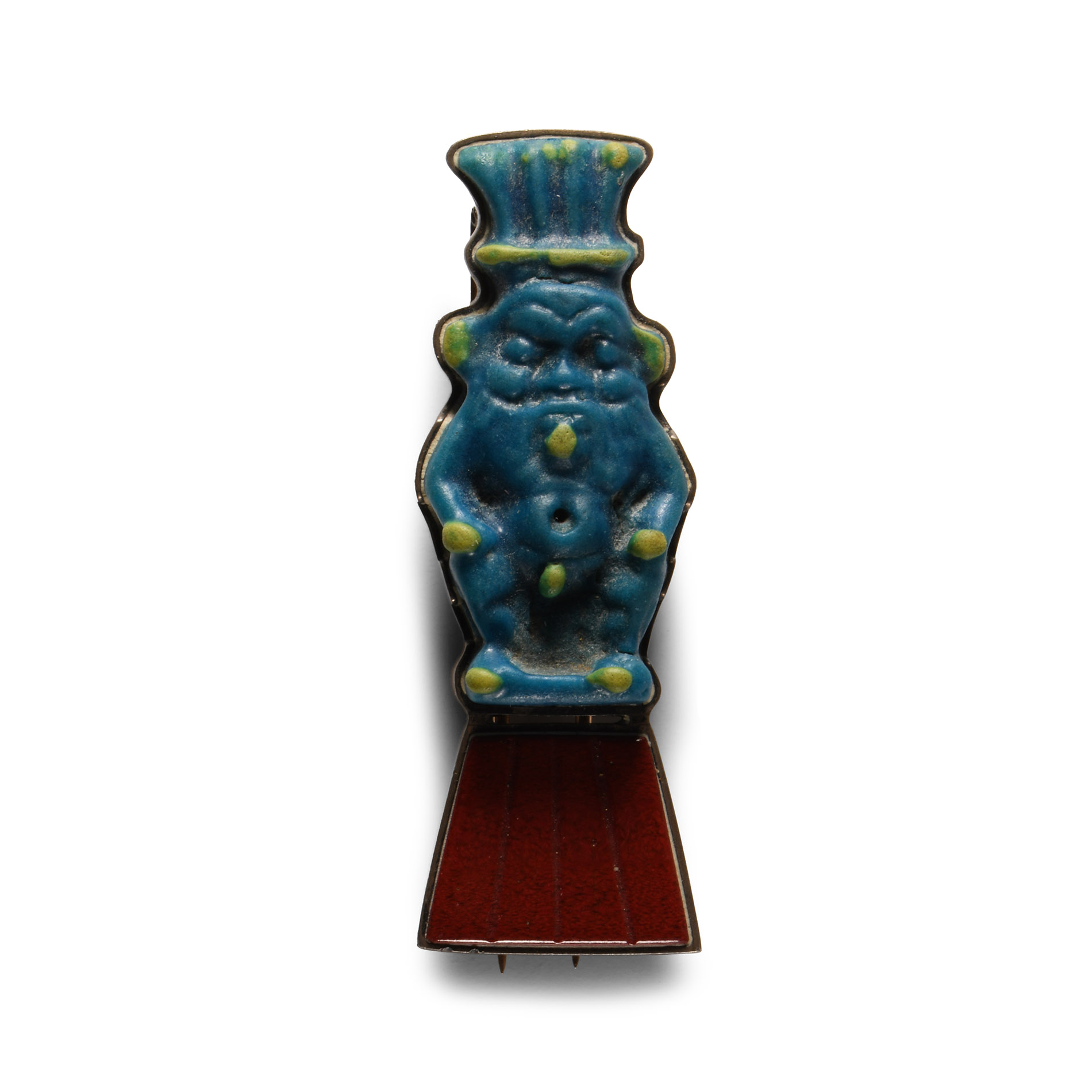
Egyptian Glass Bes Amulet in Gold Pin
LATE PERIOD-ROMAN PERIOD, 664 B.C.-323 A.D. AND LATER
2 in. (13.7 grams, 51.6 mm).
Comprising a large blue amulet of facing Bes with yellow highlighting, the grimacing god wearing a plumed headdress and depicted nude; set in a later gold casing with a plume-shaped red jasper insert, an articulated pin attachment on the reverse.
ProvenanceEx AH collection, London, UK, 1980s.
Accompanied by a previous cataloguing slip.
Cf. Lacovara, P., and Markowitz, Y.J., Jewels of the Nile: Ancient Egyptian Treasures from the Worcester Art Museum, Worcester MA, 2020, pp.110-111, no.6, for a comparable blue faience Bes with yellow decoration.
FootnotesDespite his rather fearful appearance, Bes was the patron and protector of pregnant women and children. He was also believed to provide protection from snakes.
CONDITIONTimeLine Auctions follows a vetting process to ensure the authenticity and legality of all items, reinforcing our commitment to integrity and responsible trading. Each antiquity, antique, and coin lot undergoes thorough examination by a vetting committee of at least ten external specialists, professional trade association members, scientists, and archaeologists: Our Vetting Process
AUCTIONS:
TimeLine is a leading auction house specialising in antiquities, ancient art, collectables, natural history, coins, medals, and books. Our auctions offer museums, collectors, historians, and enthusiasts the opportunity to acquire unique and historically significant pieces.
LOT 0461
Egyptian Glass Bes Amulet in Gold Pin
Estimate £400 - 600€460 - 700 (for guidance only)$540 - 810 (for guidance only)
-
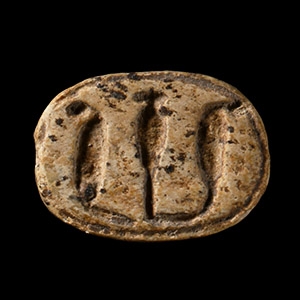
Egyptian Steatite Scaraboid Amulet with Royal Uraei and Vessel
Late Period, 664-332 B.C.Sold for (Inc. bp): £78
Ellipsoid scaraboid bead with base inscribed with a central hes-vase flanked by two uraei. 1.16 grams, 14 mm
Ex ArtAncient Ltd, London, SW6, in 2013, with stock no.15989. From the private collection of Mr A Hills, Kent, UK. Accompanied by a copy of an ArtAncient certificate of authenticity. -
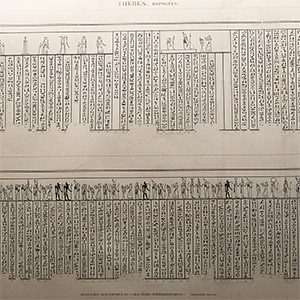
Large Egyptian Expedition Lithograph Print with Hieroglyphs
1820 A.D.Estimate: £150 - 200 (‡+bp*)
Opening Bid: £50
Willemin - Thèbes - Hypogées - Manuscrit sur papyrus en caractères hiéroglyphiques. Troisième partie - Proof etching on laid paper of plate 74 from La Description de l’Égypte: Antiquités, Volume II: Commission des sciences et arts d’Égypte with later backing sheet. 360 grams, 136 x 66 cm
From the collection of a North American priest. Acquired between 1981-1996. Property of a North American collector.
Produced between February 1802 and 1830 on the orders of Napoleon Bonaparte; published between 1809 and 1828. Just 1,000 copies were distributed to various institutions, printed on on laid paper with an 'Égypte ancienne et moderne' watermark. The book is subtitled Recueil des observations et des recherches qui ont été faites en Égypte pendant l’expédition de l’Armée française, publié par les ordres de Sa Majesté l’Empereur Napoléon le Grand (Gathering of observations and discoveries which were made in Egypt during the expedition of the French army, published on the orders of His Majesty the Emperor Napoleon the Great). It was the world's first encyclopedia devoted exclusively to the remains of ancient Egypt. The plates of this book are the first to present the archaeological sites of Thebes (Luxor). The papyrus manuscript was recovered from the underground chambers (hypogea). The original papyrus is now held in the Bibliothèque Nationale (1-19), Paris (Papyrus Cadet). -
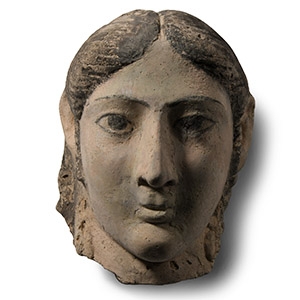
Egyptian Painted Plaster Mummy Mask of a Lady
Roman Period, 30 B.C.-323 A.D.Sold for (Inc. bp): £1,820
Hollow-formed with finely modelled facial details, dark hair parted in the middle and drawn back to each side with a ringlet before each ear; narrow brow with painted eyebrows, lentoid eyes with dark irises; narrow nose and small pursed lips; impressions of bandaging on the rear where attached to mummy. 777 grams, 20 cm high
From a London, UK, collection. Formerly with a central London auction house.
