
Loading, please wait...


LOT 0478
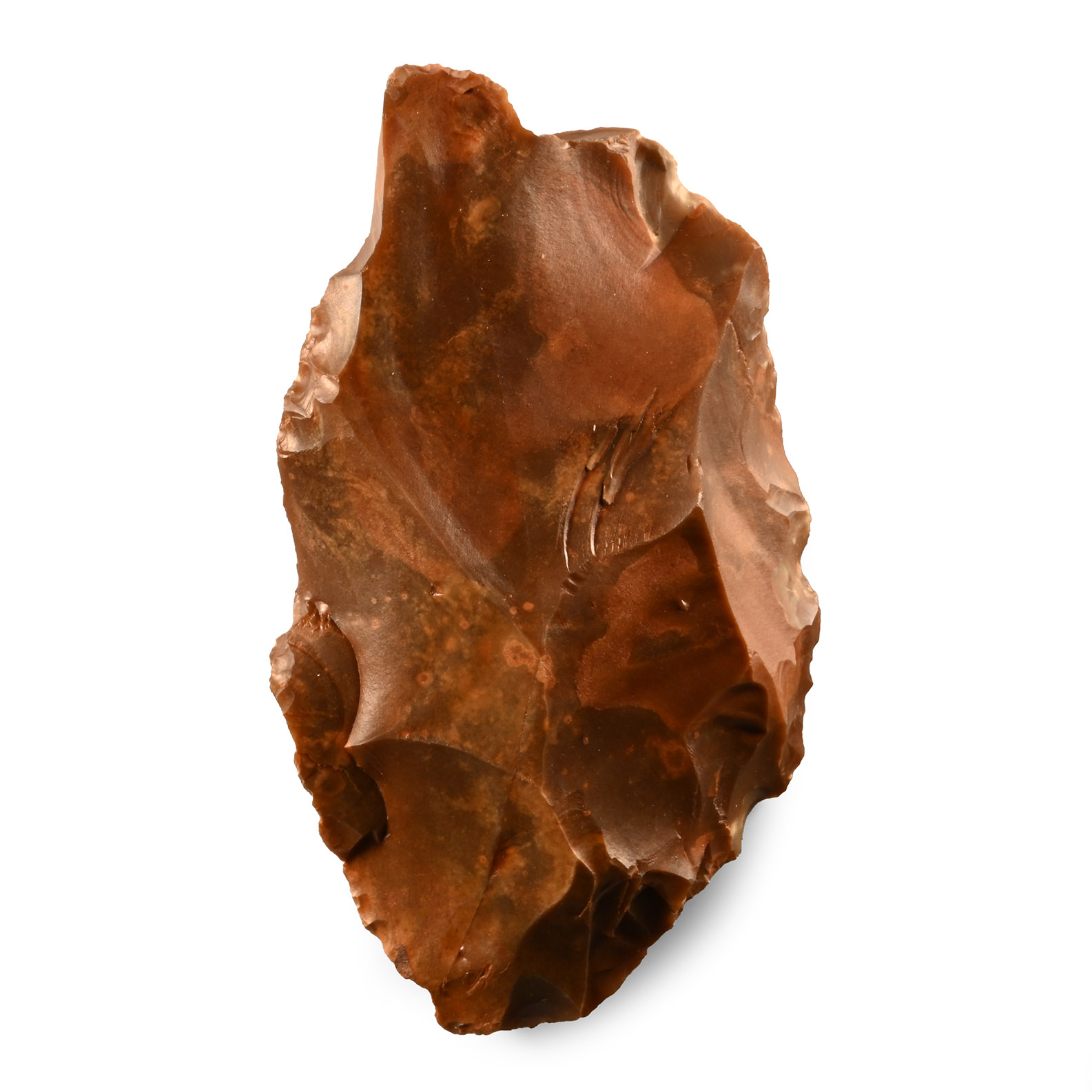
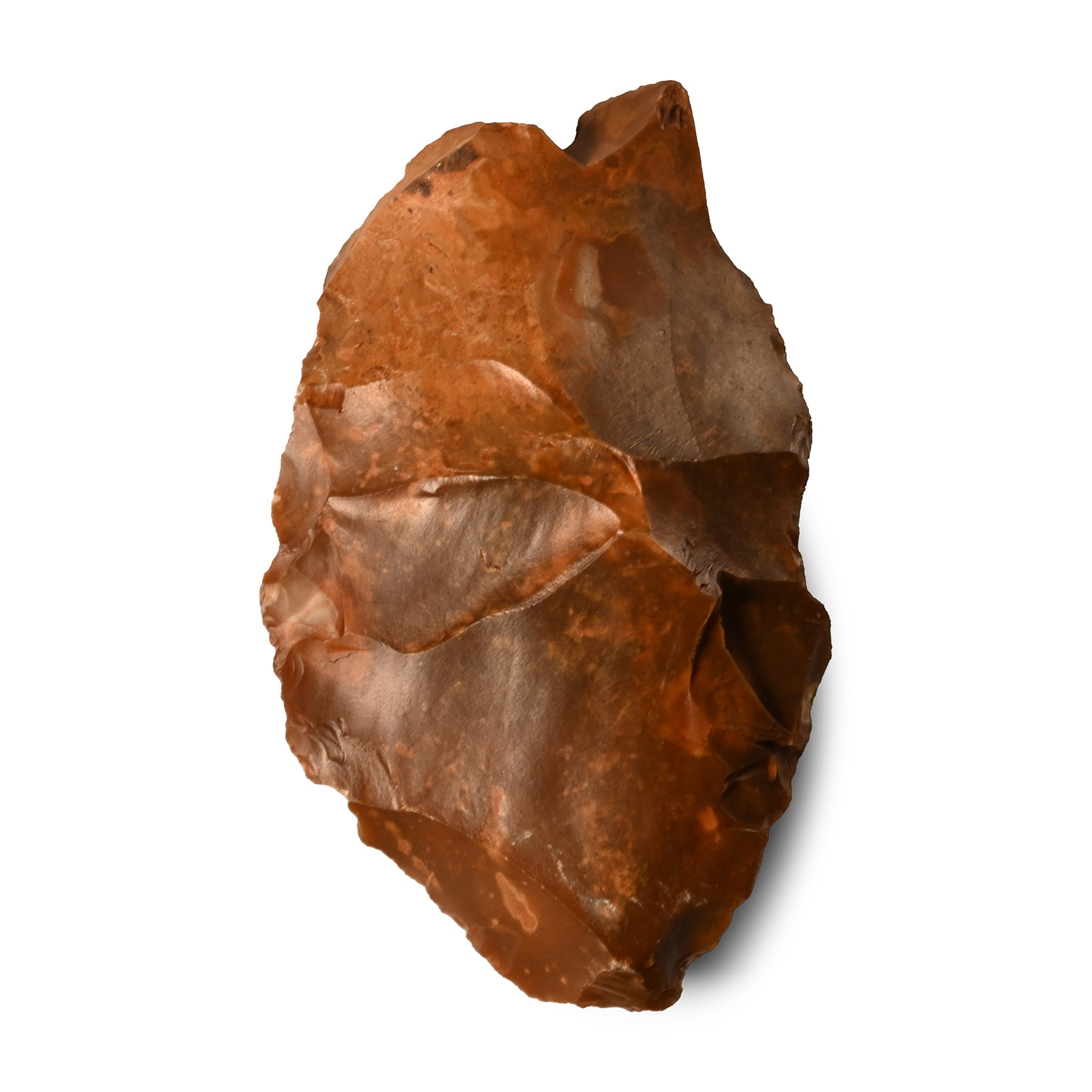
Egyptian Flint Handaxe
LOWER PALAEOLITHIC PERIOD, CIRCA 450,000-280,000 B.P.
5 1/2 in. (380 grams, 14 cm).
Irregular in plan with biconvex section. [No Reserve]
ProvenanceFound Egypt, North Africa.
From the British art market in the 1970s-1980s.
Acquired via inheritance, 1988.
From the collection of a South West London, UK, specialist Stone Age collector.
TimeLine Auctions follows a vetting process to ensure the authenticity and legality of all items, reinforcing our commitment to integrity and responsible trading. Each antiquity, antique, and coin lot undergoes thorough examination by a vetting committee of at least ten external specialists, professional trade association members, scientists, and archaeologists: Our Vetting Process
AUCTIONS:
TimeLine is a leading auction house specialising in antiquities, ancient art, collectables, natural history, coins, medals, and books. Our auctions offer museums, collectors, historians, and enthusiasts the opportunity to acquire unique and historically significant pieces.
-
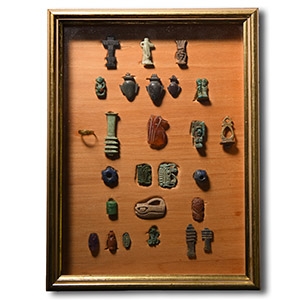
Egyptian Hardstone and Faience Amulets and Other Items
Late Period, 664-332 B.C. and laterSold for (Inc. bp): £2,210
A group of amulets in a glazed wooden frame, comprising: 1 –stone Sma amulet Although rather gruesome, as it represents an animal’s windpipe and lungs, this amulet symbolised the benign concepts of unity and ensured the integrity of the deceased’s body, which was deemed essential for entry into the Afterlife. Cf. Reisner, G.A., Catalogue général des antiquitéségyptiennes du Musée du Caire, Nos.12528-13595, Vol. II, Amulets, Cairo, 1958, p.52, no. 5582, and pl.III, for a similar black stone example. 2 – Tawaret amulet The goddess Tawaretis a female hippopotamus with the arms and legs of a lion and the back and tail of a crocodile. Despite her fearsome appearance, Tawaret was a household deity and protector of women in childbirth. Cf. Tinius, I., Altägypten in Braunschweig. Die Sammlungen des Herzog Anton Ulrich-Museums und des StädtischenMuseums, Wiesbaden, 2011, p.130, no.216, for similar. 3 – Bes amulet Bes emerged as one of ancient Egypt’s most favoured protective deities during the New Kingdom period and beyond. Despite his intimidating appearance, Bes served as the guardian and defender of pregnant women and children and was also thought to protect them from snakes. Cf. Petrie, W.M.F., Amulets. Illustrated by the Egyptian Collection in University College, London, 1914, pl. XXXIII 188e, for a similar example. 4 – faience Pataikos amulet Pataikos was first mentioned by the historian Herodotus, who refers to dwarf-like representations of Ptah. The name is still used today. These diminutive amulets symbolise Ptah’s immense magical power and protect the wearer from dangerous creatures such as snakes and crocodiles. Cf. Petrie, W.M.F., Amulets. Illustrated by the Egyptian Collection in University College, London, 1914, pl. XXXI, 176c, for a similar small example. 5 – three hardstone heart amulets According to ancient Egyptian beliefs, the heart (ib) was considered to be the centre of intelligence, emotions, and behaviour, as well as the storehouse of an individual's memories. During the Weighing of the Heart ceremony in the afterlife, the heart could advocate for the deceased and account for their lifetime of actions before Osiris. For this reason, heart amulets were placed on the mummy to safeguard the organ and ensure a favourable outcome during judgment. Cf. Andrews, C., and van Dijk, J., Objects for Eternity: Egyptian Antiquities from the W. Arnold Meijer Collection, Mainz am Rhein, 2006, p.128, no. 2.34b, for a similar brown jasper heart amulet. 6 – faience double falcon amulet This uncommon amulet represents two falcons wearing sun disc headdresses. One falcon may represent Horus, the god of the sky, war, and protection; the other perhaps another falcon deity such as Montu. Alternatively, they may be two ba-birds, representing an element of the deceased’s spirit, similar to our concept of soul. Cf. Camino, L., Papier-Lacostey, C., Collections égyptiennes du musée Antoine Vivenel de Compiègne, Compiègne, 2007, p.209, no.259, for a comparable amulet. 7 – Djed pillar The djed pillar symbolised the concepts of 'enduring' and 'stability' and was a common funerary amulet from the Old Kingdom onwards. It was first associated with the gods Ptah and Sokar but later became a symbol of Osiris, representing the god's backbone. In this context, the djed pillar appears in Chapter 155 of the Book of the Dead, concerned with the deceased's resurrection. Cf. Andrews, C., Amulets of Ancient Egypt, London, 1994, p.83, no.84c, for an example with similar detailing. 8 – carnelian wedjat eye The wedjat-eye amulet represents the healed eye of the god Horus, featuring both human and falcon elements. The name wedjat in ancient Egyptian means ‘the one that is sound.’ According to Egyptian mythology, Horus' eye was wounded or taken by the god Seth and restored by Thoth. The wedjat-eye amulet was thought to protect its wearer and bestow the power of recovery and regeneration onto them. It was very popular and used by both the living and the dead. Cf. Lacovara, P., and Markowitz, Y.J., Jewels of the Nile: Ancient Egyptian Treasures from the Worcester Art Museum, Worcester MA, 2020, p.113, no.19, for a similar carnelian example. 9 – faience Shu amulet This Egyptian faience amulet is a schematic depiction of the god Shu, depicted kneeling with his hands upraised, supporting a sun disc. According to Egyptian mythology, Shu was sneezed out by the creator god Atum, initiating the universe’s creation. Shu represents the air that separates the sky and the earth. He is also responsible for holding up the sky, represented by the goddess Nut, thus allowing the cyclical journey of the sun to take place. In the context of the afterlife, Shu allowed the deceased to traverse unhindered on their journey towards rebirth. Shu amulets were placed on the lower part of the deceased's torso, between the mummy bandages. Shu could also serve as a magical amulet at the birth of the living, symbolising a protector of new life. Cf. Camino, L., Papier-Lacostey, C., Collections égyptiennes du musée Antoine Vivenel de Compiègne, Compiègne, 2007, p.174, no.193, for a comparable amulet. 10 – two faiencewedjat eye amulets Both represent less common variants of the wedjat amulet. On these, a series of small front-facing uraei run across the top of the amulet, with a larger uraeus depicted in profile on either side of the eye. Cf. World Museum Liverpool, M11893aa, for a similar, though less well-defined example. 11 – stone wedjat eye Cf. Petrie, W.M.F., Amulets. Illustrated by the Egyptian Collection in University College, London, 1914, pl. XXIV139e, for a similar example. 12 - carnelian Bes amulet This somewhat cursorily fashioned example of a Bes amulet may date to around a century before the New Kingdom. Cf. Thomas, G.A., A Handbook of the Egyptian Collection (Chicago: The Art Institute of Chicago, 1923), p. 130, for a similar example. 13 – carnelian poppy pendant Amulets in the form of poppies were used to heal and alleviate pain and to ward off death. These amulets were also linked to Osiris, the Egyptian deity of agriculture, death, and the afterlife. Cf. Lacovara, P., and Markowitz, Y.J., Jewels of the Nile: Ancient Egyptian Treasures from the Worcester Art Museum, Worcester MA, 2020, p.145, no.2, for a necklace composed of similar examples. 14 – faience uraeus amulet The uraeus represents a rearing cobra and symbolises royal power and authority, as well as the Lower Egyptian goddess Wadjet. The uraeus amulet was worn to ensure the protective power that was granted to the pharaoh. Cf. Petrie, W.M.F., Amulets. Illustrated by the Egyptian Collection in University College, London, 1914, pl. IV58f, for this amulet type. 15 – two lapis lazuli djed pillars Cf. Tinius, I., Altägypten in Braunschweig. Die Sammlungen des Herzog Anton Ulrich-Museums und des StädtischenMuseums, Wiesbaden, 2011, p.166, no.323, for a similar example of the taller pillar; Lacovara, P., and Markowitz, Y.J., Jewels of the Nile: Ancient Egyptian Treasures from the Worcester Art Museum, Worcester MA, 2020, p.115, no.1, for a similar example of the shorter pillar. 773 grams total, 23 x 17.5 cm
Ex H.M. Barker. Private collection, England. -
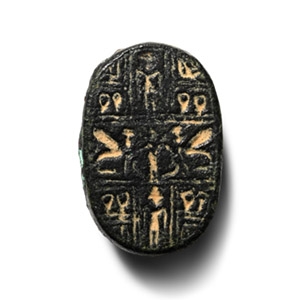
Phoenician Bronze Scarab
Late 1st millennium B.C.Estimate: £400 - 600 (+bp*)
Opening Bid: £200
Scaraboid with incised detailing to the underside, with a central column depicting standing figures top and bottom, each flanked by two ankh symbols, and a central motif of a standing figure grasping a sceptre and winged serpent in each hand. 6.54 grams, 17 mm
From an early 20th century Home Counties, UK, collection. -
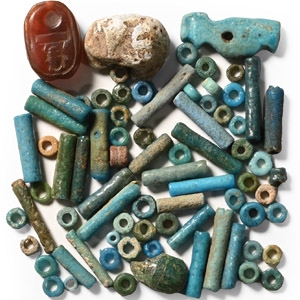
Egyptian Faience Bead and Scarab Group
Mainly Late Period, 664-332 B.C.Sold for (Inc. bp): £117
Comprising mainly blue tubular and annular beads, and a small Tawaret(?) amulet; a fragmentary glass bead(?) with some iridescence, a fragmentary scarab and a carnelian scarab with the throne name of Thutmose III, men-kheper-Re, to the underside, chipped. 8 grams total, 2-17 mm
Ex Belinda Elliston collection.
