
Loading, please wait...
_900x900.jpg "Egyptian Faience Sistrum Fragment with Hathor Head")
_200x200.jpg "Egyptian Faience Sistrum Fragment with Hathor Head")
_900x900.jpg "Egyptian Faience Sistrum Fragment with Hathor Head")
_200x200.jpg "Egyptian Faience Sistrum Fragment with Hathor Head")
.jpg "Egyptian Faience Sistrum Fragment with Hathor Head")
.jpg "Egyptian Faience Sistrum Fragment with Hathor Head")
LOT 0008
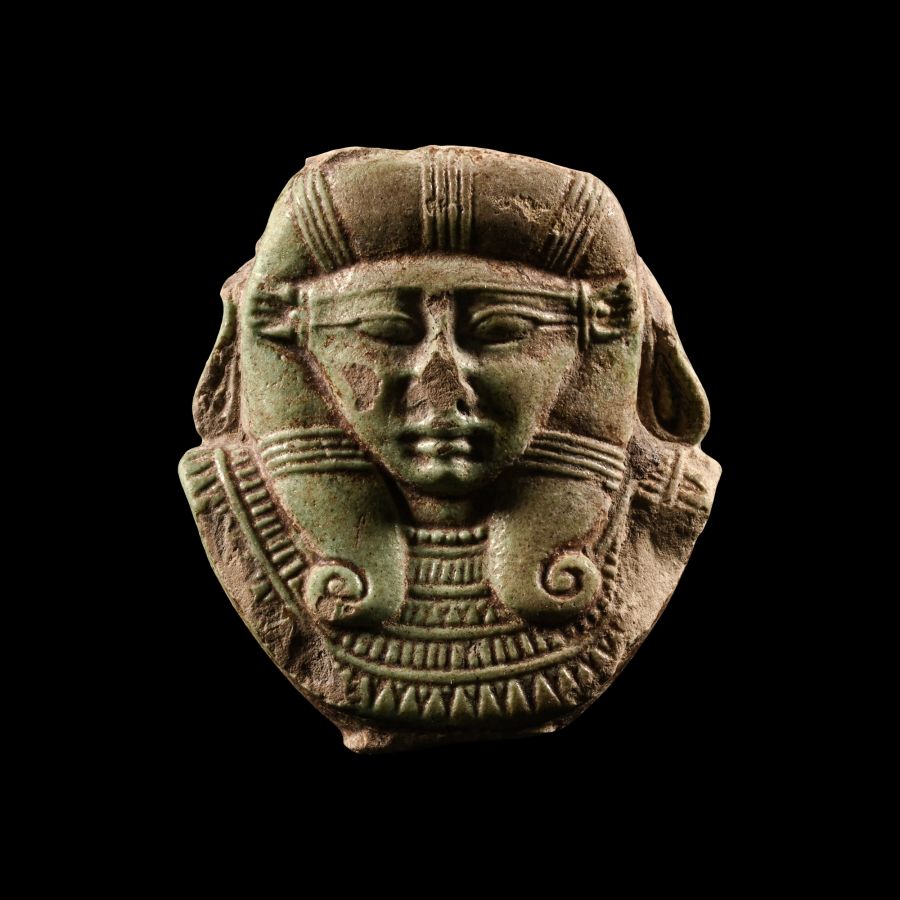
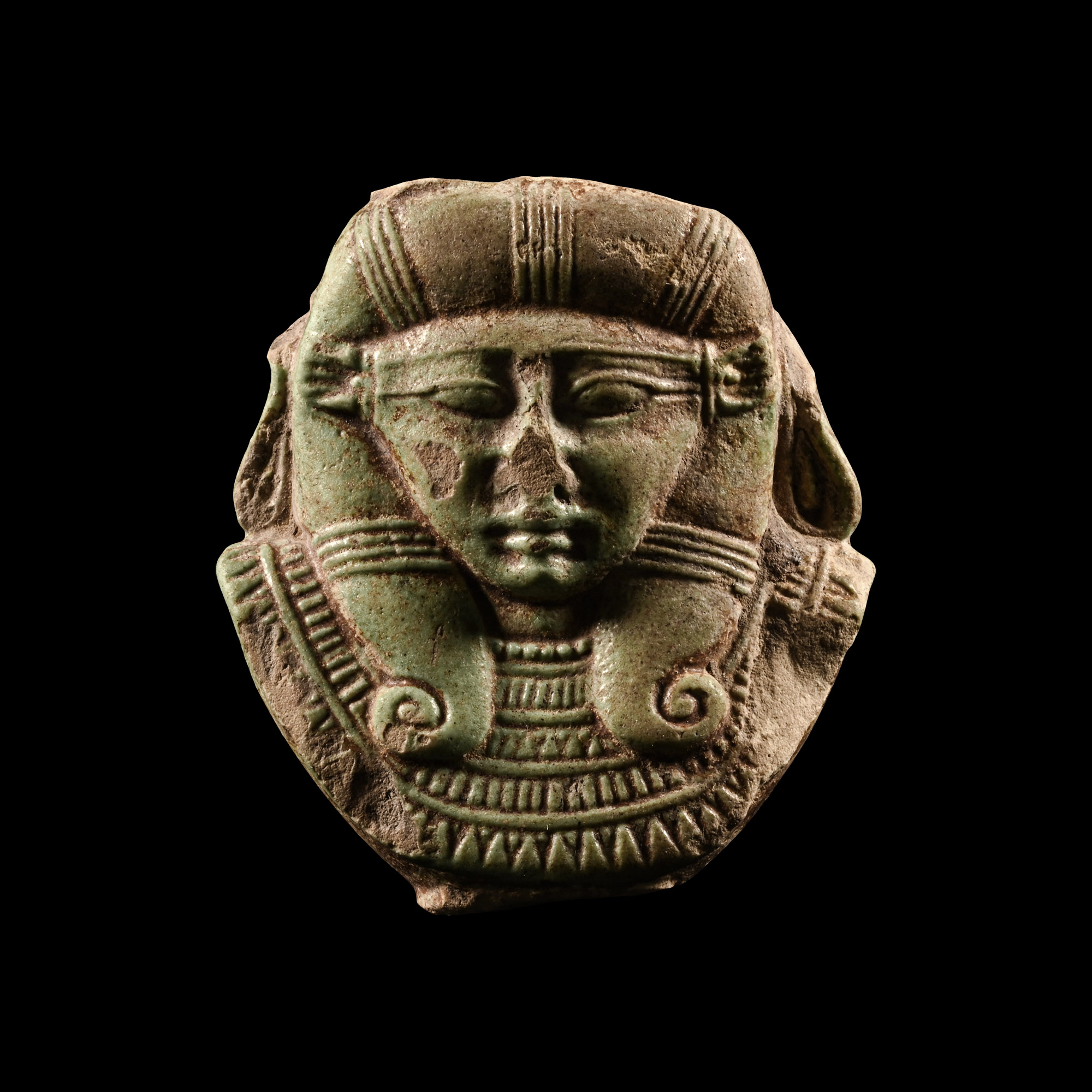
Egyptian Faience Sistrum Fragment with Hathor Head
LATE PERIOD, 664-332 B.C.
2 in. (44.4 grams, 50 mm).
Pale blue-green bifacial bust of Hathor with D-shaped face, characteristic banded hair with curled ends, cow's ears, broad collar of radiating segments; circular attachment point beneath for handle.
ProvenanceAcquired in the 1970s.
European private collection.
Cf. Schoske, S., Schönheit - Abglanz der Göttlichkeit. Kosmetik im Alten Ägypten, Munich, 1990, p.142, no.127, for a similar Hathor head element on a near complete sistrum.
FootnotesThis fragment is the central element of a highly decorative sistrum. The sistrum was a rattle-like instrument played exclusively by women in religious ceremonies. The sound produced by the sistrum was believed to drive away evil and soothe a god's anger. Hathor is the daughter of the sun god Re, and in her role as a mother goddess is often depicted as a cow or with bovine characteristics as here. Hathor is also associated with love, music and dancing, and the sistrum is one of her sacred symbols.
CONDITIONTimeLine Auctions follows a vetting process to ensure the authenticity and legality of all items, reinforcing our commitment to integrity and responsible trading. Each antiquity, antique, and coin lot undergoes thorough examination by a vetting committee of at least ten external specialists, professional trade association members, scientists, and archaeologists: Our Vetting Process
AUCTIONS:
TimeLine is a leading auction house specialising in antiquities, ancient art, collectables, natural history, coins, medals, and books. Our auctions offer museums, collectors, historians, and enthusiasts the opportunity to acquire unique and historically significant pieces.
-
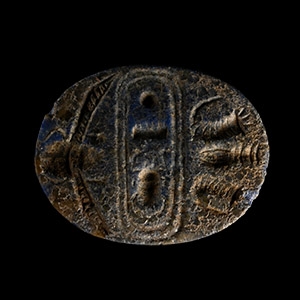
Egypto-Phoenician Lapis Lazuli Scarab with Cartouche for Thutmose III
Late 1st millennium B.C.Estimate: £3,000 - 4,000 (‡+bp*)
Opening Bid: £1,500
With carapace detailing to obverse, plaque with intaglio cartouche for the throne name of Thutmose III, winged scarab and fronds flanking. 7.4 grams, 25 mm
Private collection of Mr S.A., Switzerland, 1990s, thence by descent. This lot has been checked against the Interpol Database of stolen works of art and is accompanied by search certificate no.12127-211877. -
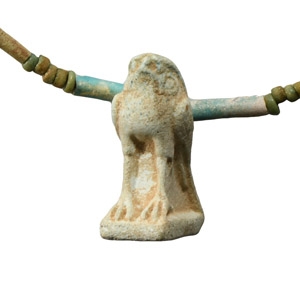
Egyptian Faience Bead Necklace String with Horus Amulet
Late Period, 664-332 B.C.Estimate: £400 - 600 (+bp*)
Opening Bid: £200
Restrung using mainly annular and tubular beads; central feature a large pendant depicting the god Horus in falcon form, intricate feather detailing to the wings and back, long talons gripping the rectangular platform. 14.6 grams, 26 cm
From the vendor's grandfather's collection, formed in the 1950s; thence by family descent circa 1974. -
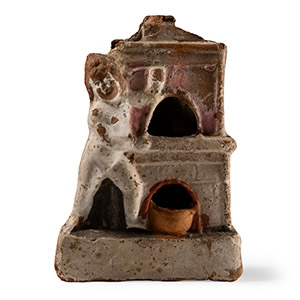
Romano-Egyptian Terracotta Figure of Eros
1st-2nd century A.D.Sold for (Inc. bp): £5,850
Depicted nude in a dynamic pose with his legs apart and the weight of the body upon his right leg, standing in front of a two storey structure, probably an oven; his left arm raised and right arm extended in front of his torso and resting on the edge of the structure; the oven painted pink at the top and white at the bottom with an offering receptacle at floor level. 232 grams, 15 cm
Ex Dr Daniel Marie Fouquet (1859-1914), Cairo. with Pierre Berge & Associes, Auction, Archaeology 29 November 2014, no.193. Accompanied by a French cultural export permit, no.161028. Accompanied by an academic report by Dr Raffaele D'Amato. Accompanied by a copy of the relevant pages in: Perdrizet, P., Les Terres Cuites Grecques d'Egypt de la Collection Fouquet, Nancy, 1921, where it is published. This lot has been checked against the Interpol Database of stolen works of art and is accompanied by search certificate no.12000-211884.
The image of the ‘Eros Baker’ is part of a wide production of Roman terracotta imitating Greek models, although in somewhat crude way. In the Roman age, designs tended to be commonplace and were often indifferent copies of Greek originals. However, the production of terracotta in Hellenistic Egypt continued without interruption and the most subjects of these votive statuettes (in this case probably a baker invoking the blessing of the god upon his activity) were religious, Eros being one of the favourites.
