
Loading, please wait...
LOT 0469
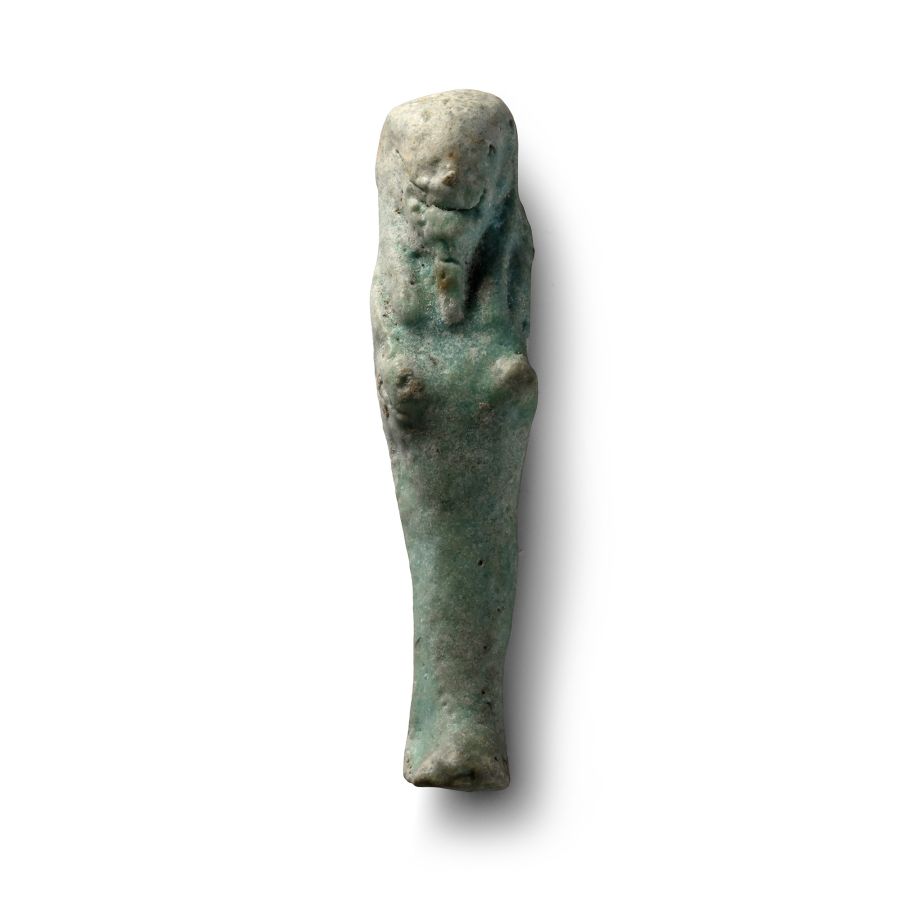
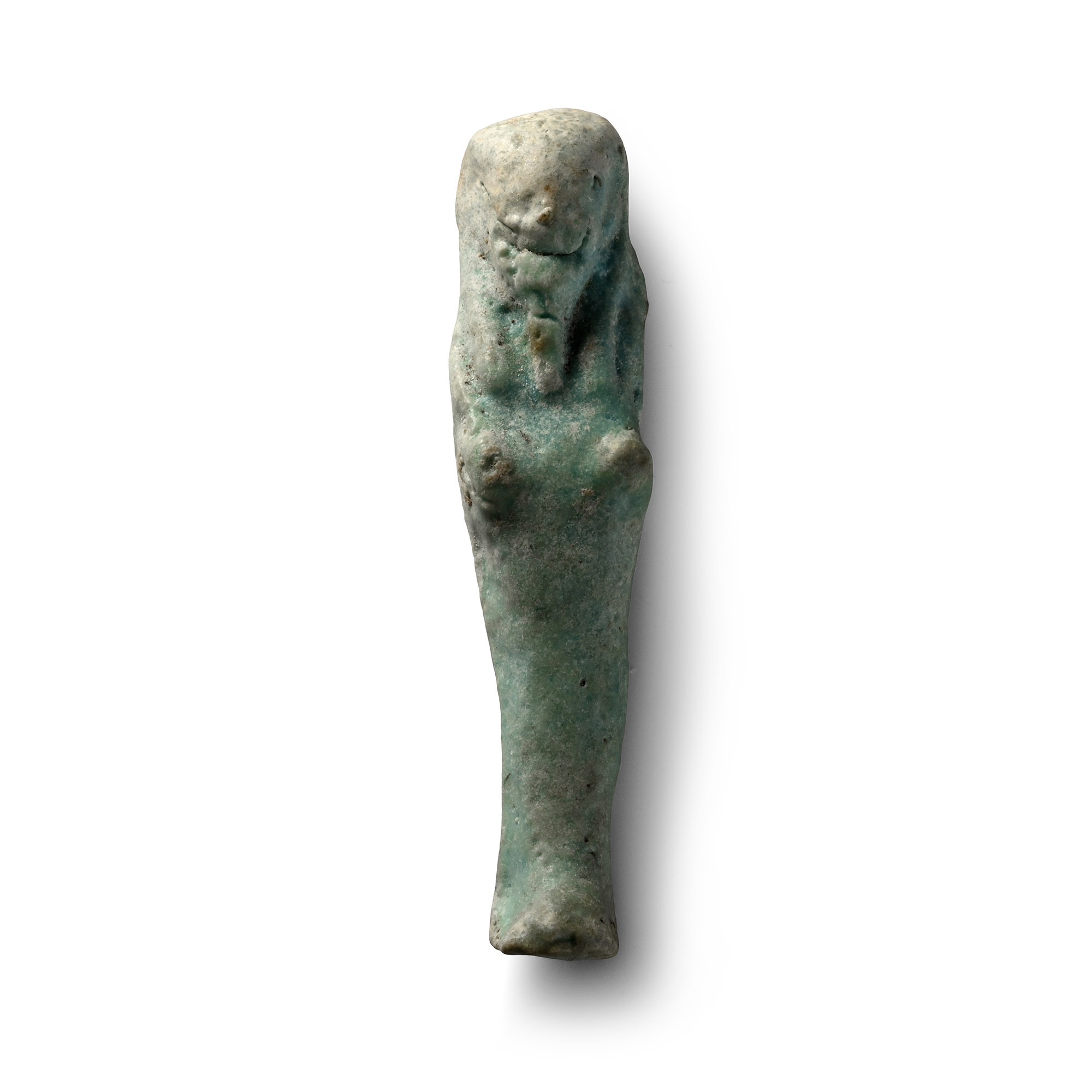
Egyptian Faience Shabti
PTOLEMAIC PERIOD, 332-30 B.C.
2 3/8 in. (6.6 grams, 60 mm).
D-shaped in section with tripartite wig and arms crossed at the chest. [No Reserve]
ProvenanceEx London, UK, collection, 1990s.
LiteratureCf. Janes, G., The Shabti Collections 6: A Selection from the World Museum, Liverpool, Lymm, 2016, p. 519, no. 273, for similar examples from Abydos.
CONDITIONTimeLine Auctions follows a vetting process to ensure the authenticity and legality of all items, reinforcing our commitment to integrity and responsible trading. Each antiquity, antique, and coin lot undergoes thorough examination by a vetting committee of at least ten external specialists, professional trade association members, scientists, and archaeologists: Our Vetting Process
AUCTIONS:
TimeLine is a leading auction house specialising in antiquities, ancient art, collectables, natural history, coins, medals, and books. Our auctions offer museums, collectors, historians, and enthusiasts the opportunity to acquire unique and historically significant pieces.
-
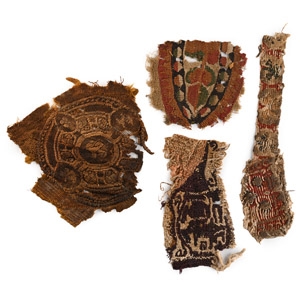
Egyptian Coptic Textile Fragment Group
Circa 4th-5th century A.D.Sold for (Inc. bp): £104
Comprising: a fragment of a clavus in coarse linen and dark brown wool, tapestry, with remains of a medallion embroidered with a lion running right; fragment of an orbiculus in linen and yellow and blue wool, S torsion, embroidered with vegetal and geometric patterns; two terminal fragments of a clavi, in red, green, dark blue and white wool. 58 grams total including package, 8.6-19.5 cm
Acquired 1970s-1996. Property of a North American collector. London collection, 2016.
These are decorative parts of tunics. The lion orbiculus in particular stands out for its delicate design and hunting theme. Dionysus and his entourage were often depicted on these tunics, despite the fact that these fabrics were produced in a by then heavily Christianised empire. -
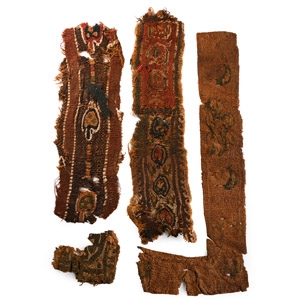
Egyptian Coptic Textile Fragment Group
Circa 7th-8th century A.D.Sold for (Inc. bp): £208
Comprising: a fragment of a segmentum in linen and red, brown, yellow and blue wool, S torsion, embroidered with a series of heads alternating with a flying putto holding a melograne; a fragment of another segmentum in linen and red, brown, yellow and blue wool, S torsion, embroidered with vegetal patterns, borders decorated with meanders; a fragment of a segmentum in linen and red, brown, white, yellow and blue wool, S torsion, embroidered with floral buds; a small fragment of a tablion with geometric decoration, purple wool on linen. 44 grams total including package, 4.3-20.5 cm
Acquired 1970s-1996. Property of a North American collector. London collection, 2016.
Some of these pieces are fragments from a tunic decoration, usually belonging to bands on red background, decorated with a series of motifs related to the Dionysian cult: usually these depict cherubs, fish, heads, palmettes, vegetal and floral ornaments, as well as figures of dancing puttoes within the orbiculi. The decorative motifs on these tunics were usually arranged vertically and horizontally. -
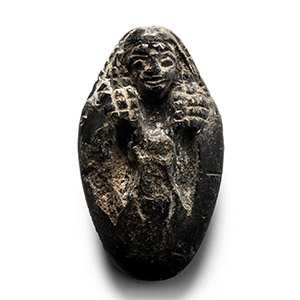
Egyptian Black Stone Heart Amulet
New Kingdom, circa 1500-1200 B.C.Sold for (Inc. bp): £312
Carved in the half-round, lentoid in plan, with a human head wearing a hatched wig, remains of a scarab beetle in the centre, pierced to reverse for suspension. 13.3 grams, 41.6 mm
with Archaeologia, Switzerland, before 1983. Ex private North American collection. London private collection, 2016.
