
Loading, please wait...
LOT 0001
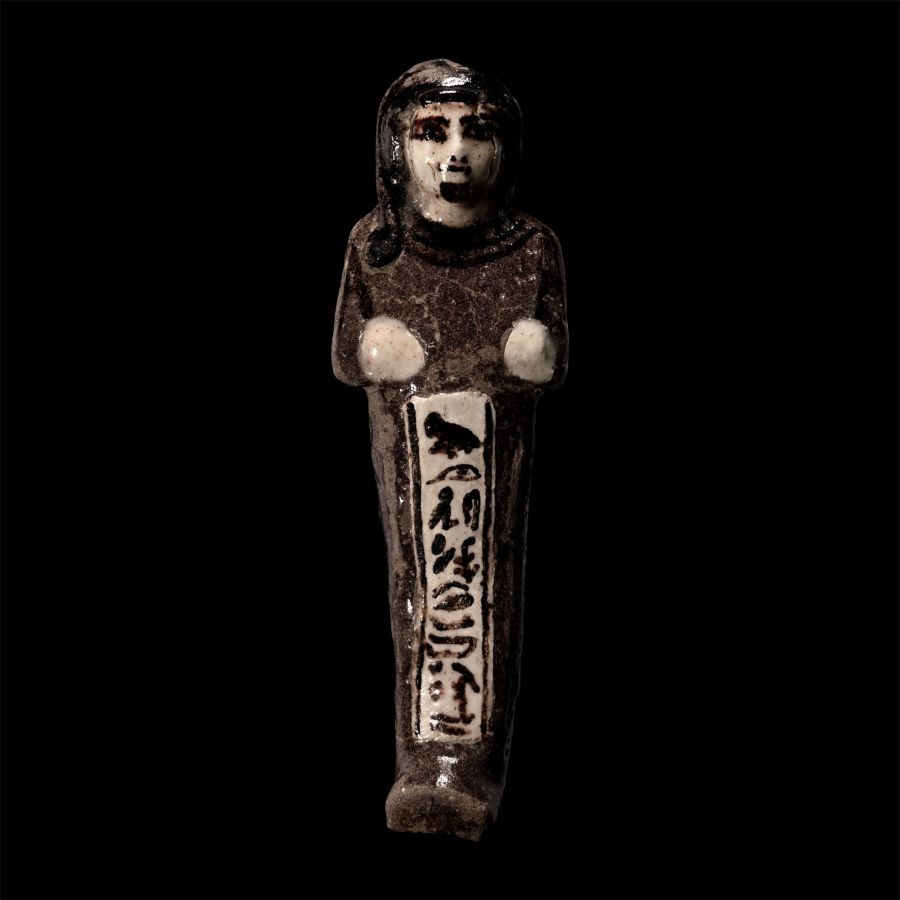
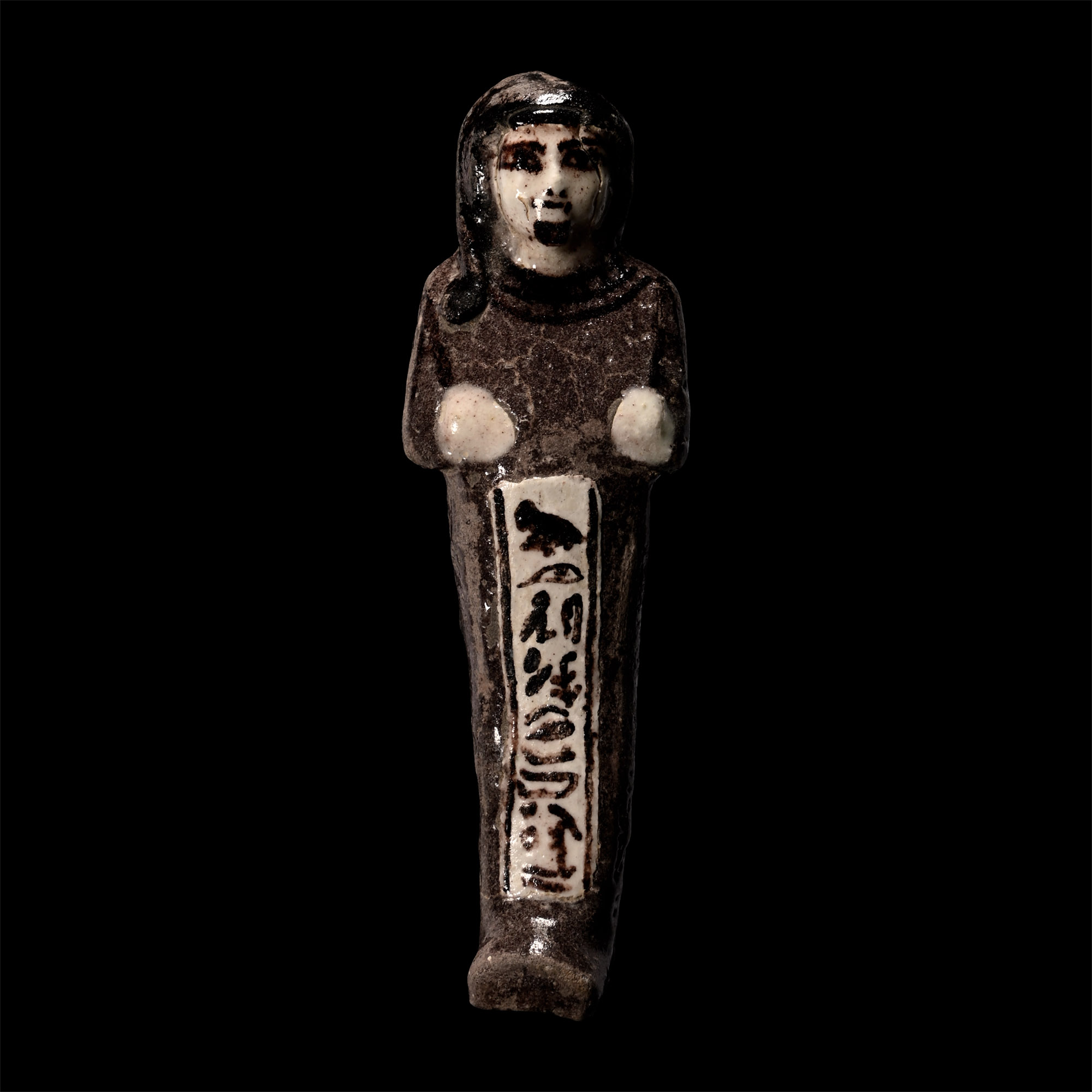
Egyptian Faience Shabti for the Fourth Son of Ramesses II, Prince Khaemwaset
NEW KINGDOM, 19TH DYNASTY, 1279-1213 B.C.
4 5/8 in. (82.4 grams, 11.8 cm).
The mummiform figure in brownish-black and white faience with black detailing, wearing a round wig featuring a side-lock and a broad collar, the white face displaying eyes, eyebrows, nostrils, and a short beard in black; the arms crossed, and the white-glazed hands holding hoes; a slightly raised white-glazed frontal panel containing a column of hieroglyphic text reads: 'The Osiris, the Sem-Priest, the King's Son, Khaemwaset, True of Voice'.
ProvenanceFrom the private collection of George Ortiz, Geneva, Switzerland, since before 1981.
Received by gift from George Ortiz to the current owner at Mr Ortiz's Geneva home in the summer of 1981.
From the private collection of a UK gentleman since the early 1980s.
Identified by Professor A.M. Dodson BA, MPhil, PhD, FSA, Department of Anthropology & Archaeology, University of Bristol.
This lot has been cleared against the Art Loss Register database, and is accompanied by an illustrated lot declaration signed by the Head of the Antiquities Department, Dr Raffaele D'Amato.
Cf. Bovot, J-L., Les serviteurs funéraires royaux et princiers de l’Ancienne Égypte, Paris, 2003, pp.230-301, for the Louvre collection of Khaemwaset shabtis.
FootnotesKhaemwaset was the fourth son of Ramesses II, born to Queen Iset-Nofret. In addition to serving as the Sem-priest of Ptah at Memphis from an early age, he held various titles related to the Memphite cult, including High Priest of Ptah. The side-lock featured on all of Khaemwaset's shabtis is associated with his priestly role. Many shabtis of the prince are known, with the largest single group coming from the Serapeum at Saqqara; however, others have been found in numerous other locations. Since Khaemwaset's tomb has yet to be discovered, it appears that most of the known shabtis may have served as votive offerings in the sacred areas of the Memphite necropolis. His faience shabtis come in various colours, including green, blue, white, and black, and range in size from just under 10 cm to 15 cm in height. The distinctive glaze combination of this example, featuring a raised white-glazed panel contrasting with the darker body colour, is also found on some other 19th Dynasty shabtis (Cf. Janes, G., The Shabti Collections 3: Rochdale Arts & Heritage Service, Cheshire, 2011, pp.1-5 for those of Userhat from Sedment).
CONDITIONTimeLine Auctions follows a vetting process to ensure the authenticity and legality of all items, reinforcing our commitment to integrity and responsible trading. Each antiquity, antique, and coin lot undergoes thorough examination by a vetting committee of at least ten external specialists, professional trade association members, scientists, and archaeologists: Our Vetting Process
AUCTIONS:
TimeLine is a leading auction house specialising in antiquities, ancient art, collectables, natural history, coins, medals, and books. Our auctions offer museums, collectors, historians, and enthusiasts the opportunity to acquire unique and historically significant pieces.
LOT 0001
Egyptian Faience Shabti for the Fourth Son of Ramesses II, Prince Khaemwaset
Sold for (Inc. bp): £2,015
-
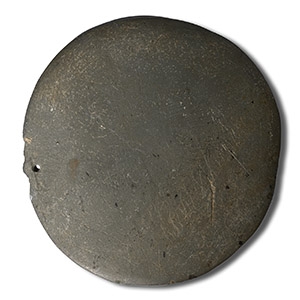
Egyptian Pre-Dynastic Greywacke Palette
Predynastic Period, Naqada III, circa 3300–2960 B.C.Sold for (Inc. bp): £468
Circular in plan with smoothed faces, pierced through the edge. 238 grams, 13.3 cm
Acquired in the mid 1980s-1990s. Private collection, Switzerland, thence by descent. Private collection, since the late 1990s. This lot is accompanied by an illustrated lot declaration signed by the Head of the Antiquities Department, Dr Raffaele D'Amato.
Palettes were utilitarian objects used in the Predynastic Period to grind and mix mineral-based eye pigments (including ochre, malachite, and haematite). Greywacke cosmetic palettes were easily carved in various shapes and sizes, including zoomorphic representations and geometric forms. The symbolism of this circular palette may be connected to the sun disc, which featured prominently in ancient Egyptian culture. The palette was so significant in Predynastic society that purely ceremonial versions, often impractically large for their original purpose, were produced for use in temple rituals. The most famous is the highly decorated Narmer Palette discovered at Hierakonpolis. -
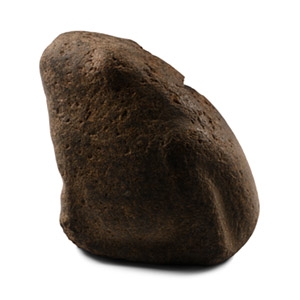
Egyptian Pre-Dynastic Stone Frog
4th millennium B.C.Estimate: £1,800 - 2,400 (‡+bp*)
Opening Bid: £810
Pyramidal in form with shallow-carved hip and facial detailing. 537 grams, 81 mm
with Artemis Gallery, Munich, Germany, 2001. Private collection, Europe. This lot has been checked against the Interpol Database of stolen works of art and is accompanied by a search certificate number no.12580-232124. This lot has been cleared against the Art Loss Register database, and is accompanied by an illustrated lot declaration signed by the Head of the Antiquities Department, Dr Raffaele D'Amato.
The frog had a great role in ancient Egyptian mythology and was connected with the mythology of creation. A number of gods and goddesses were connected with the frog such as Heqet, Ptah, and Heh. The connection with the god Ptah as a god of creation was probably due to the idea that Ptah was the only god who created the world in ancient Egypt through his heart and his tongue. Every work of the god came about through what his heart devised and his tongue commanded. Frogs were often associated with Hekat, deity of birth and fecundity. Amulets of frogs were frequent votive gifts at such Predynastic and Archaic sites at Abydos, Naqada, and Saqqara. -
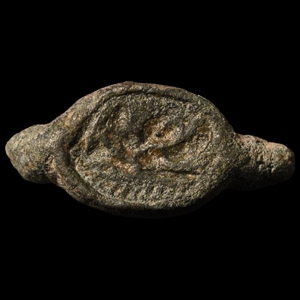
Phoenician Inscribed Bronze Scaraboid Seal
Late 1st millennium B.C.Estimate: £100 - 140 (+bp*)
Opening Bid: £50
With ribbed loop and ellipsoid face, gryphon motif. 10.9 grams, 26 mm wide
Ex London, UK, gentleman, 1990. This lot is accompanied by an illustrated lot declaration signed by the Head of the Antiquities Department, Dr Raffaele D'Amato.
