
Loading, please wait...
_900x900.jpg "Egyptian Faience Shabti for Nesy-Amun")
_200x200.jpg "Egyptian Faience Shabti for Nesy-Amun")
.jpg "Egyptian Faience Shabti for Nesy-Amun")
LOT 0025
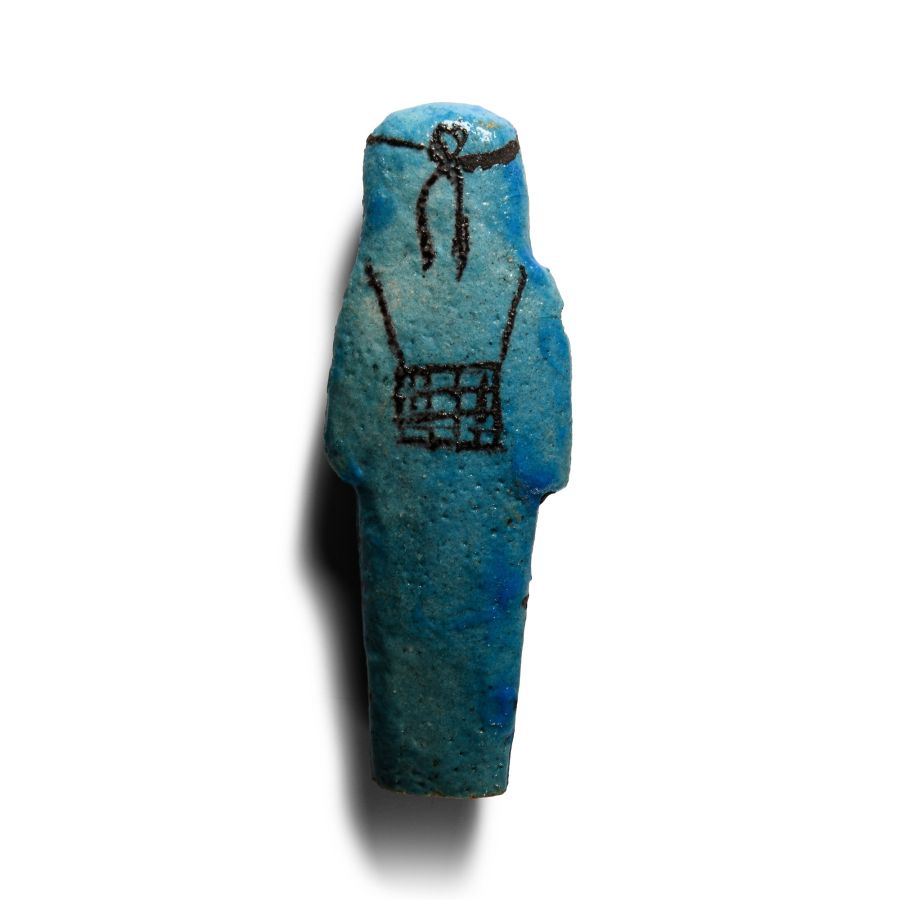
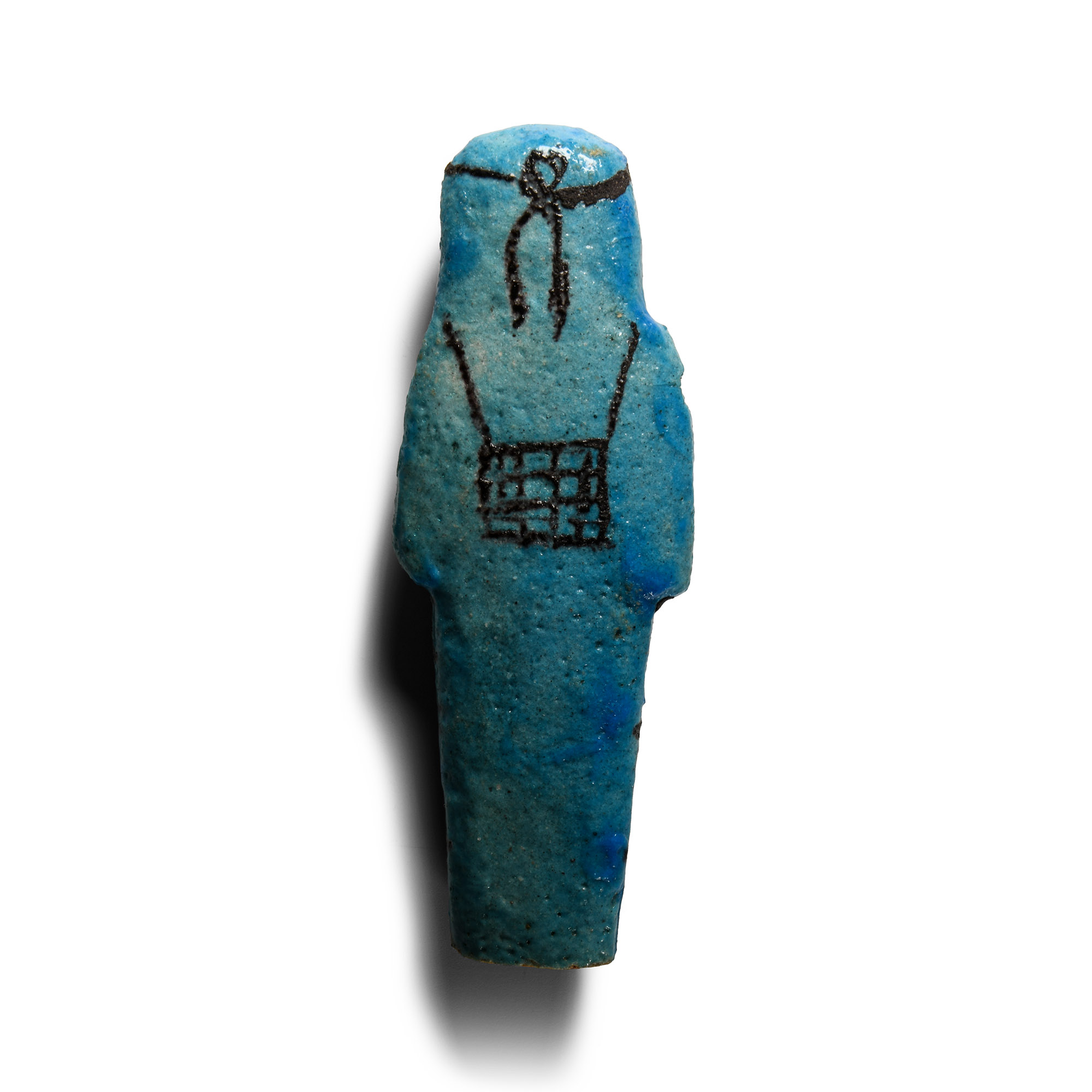
Egyptian Faience Shabti for Nesy-Amun
THIRD INTERMEDIATE PERIOD, 21ST DYNASTY, 1069-943 B.C.
3/8 in. (75 grams, 11.1 cm).
Modelled in deep blue faience with applied black detailing to the hair, eyes, seed bag, agricultural tools and three bands of hieroglyphs to the lower body reading giving the title and name of 'Nesy-Amun, Justified'; very rare.
ProvenanceEuropean collection, latterly in private UK collection, 1990.
Read by John Taylor at the British Museum on 27 February 2009.
Accompanied by a copy of a handwritten information card and a print out of the Christie's example.
Cf. Christie's New York, 11 December 2014, lot 64, for another example, which sold for US $7,500.00; Aubert, L., Les statuettes funéraires de la Deuxième Cachette à Deir el-Bahari, Paris, 1998, p. 71, no. 19 and pl. X, for discussion and examples of Nesy-Amun's shabtis.
FootnotesNesy-Amun was the Fourth Prophet of Amun in the 21st Dynasty. The mummy was recovered from the priest's hole, cache II, Deir el-Bahari.
CONDITIONTimeLine Auctions follows a vetting process to ensure the authenticity and legality of all items, reinforcing our commitment to integrity and responsible trading. Each antiquity, antique, and coin lot undergoes thorough examination by a vetting committee of at least ten external specialists, professional trade association members, scientists, and archaeologists: Our Vetting Process
AUCTIONS:
TimeLine is a leading auction house specialising in antiquities, ancient art, collectables, natural history, coins, medals, and books. Our auctions offer museums, collectors, historians, and enthusiasts the opportunity to acquire unique and historically significant pieces.
-
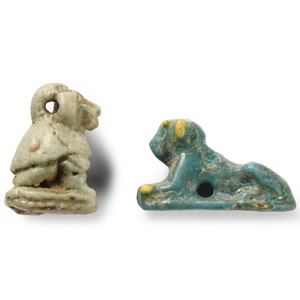
Egyptian Faience Amulet Group
Late Period, 664-332 B.C.Sold for (Inc. bp): £247
Comprising a resting lioness on a rectangular base and the god Thoth in baboon form. 1.30 grams total, 12-15 mm
From the collection of Doctor Girard, a collector for over 60 years. with Hotel des Ventes de Clermont-Ferrand, 22 May 2017. Property of a French collector.
Throughout ancient Egyptian mythology, lioness goddesses played a significant role in the religious beliefs of the people. These goddesses, including Sekhmet, Bastet, and Wadjet were revered as powerful and fierce protectors. Their presence was believed to ward off evil and safeguard the people from harm. The baboon was an animal manifestation of the god Thoth. Thoth was revered for his association with knowledge, writing, and healing. It is likely that the popularity of Thoth amulets as mummy amulets is linked to his role as the recorder of the final judgment, which determined whether the deceased had lived a life of virtue. -
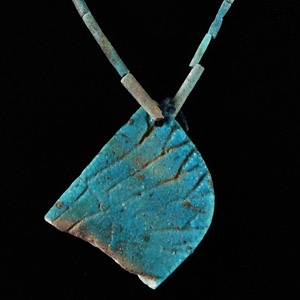
Egyptian Faience Mummy Bead Necklace
Late Period, 664-332 B.C.Sold for (Inc. bp): £52
Restrung group of mainly tubular beads with centrepiece a fragment of the extended wing from a pectoral. 11.9 grams, 94 cm long
From an old English deceased estate. Acquired on the London art market in the early 1990s. Property of a London, UK, collector. -
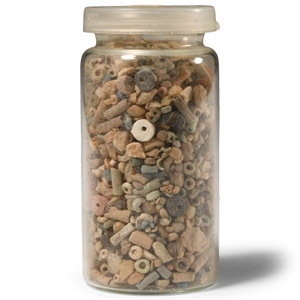
Egyptian Faience Bead Collection
New Kingdom-Late Period, circa 1550-332 B.C.Sold for (Inc. bp): £52
Mainly tubular, annular and oblate types in various colours. 61 grams total, 64 mm
Acquired from Ancient & Oriental, circa 1987. Ian Wilkinson collection, Nottinghamshire, UK, formed since 1985.
The faience of the New Kingdom period is frequently decorated with an expanded palette of red, black, and yellow. This polychrome decoration was often accomplished by inlaying one colour of paste onto another.
