
Loading, please wait...
_900x900.jpg "Egyptian Faience Mummy Bead Necklace")
_200x200.jpg "Egyptian Faience Mummy Bead Necklace")
.jpg "Egyptian Faience Mummy Bead Necklace")
LOT 0461
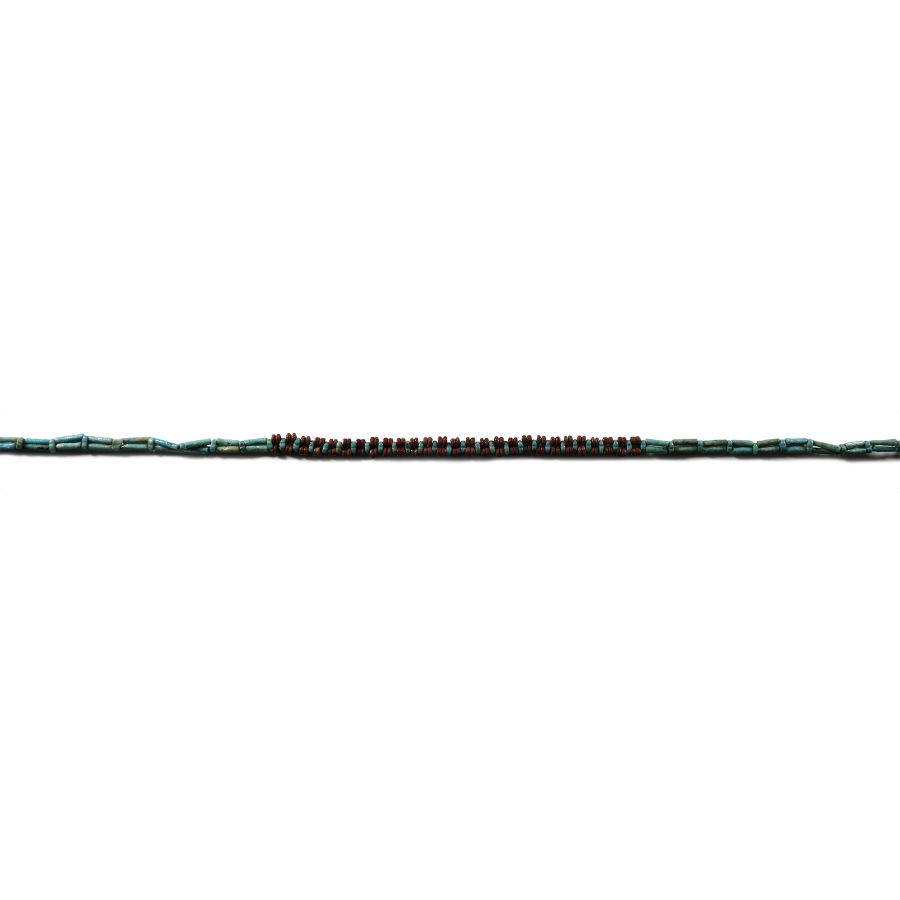
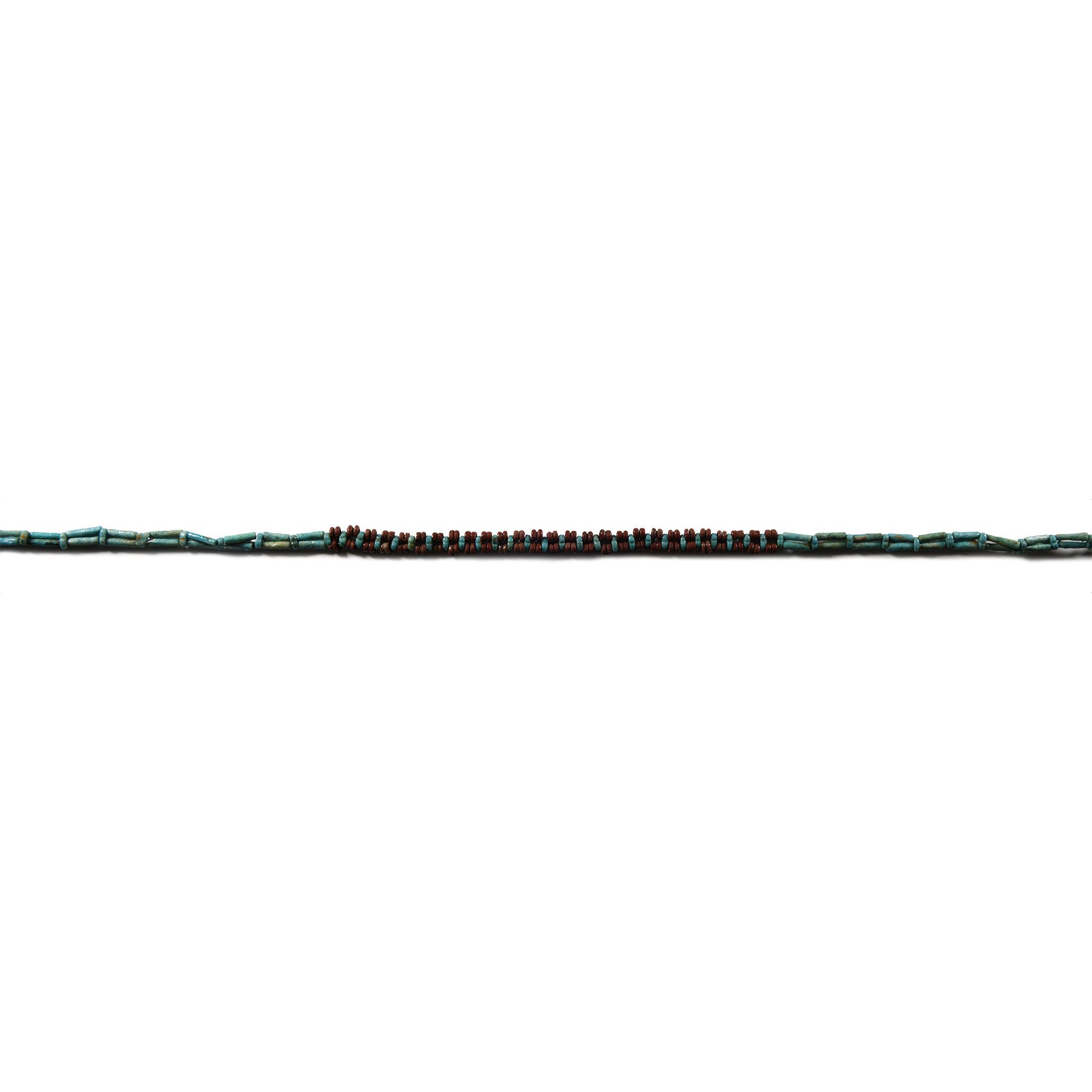
Egyptian Faience Mummy Bead Necklace
LATE NEW KINGDOM, 1295-1069 B.C.
18 1/8 in. (9.54 grams, 46 cm long).
Restrung designer necklace using tubular green-glazed beads in a double row, interspersed with small two-holed beads; the central feature a net-like composition of small brown and blue-glazed ring-shaped beads.
ProvenanceBy repute, 'Excavated at Gurob by Prof. Flinders Petrie. From a quantity of beadwork taken from the neck of a mummy'.
Ex 1920s UK collection.
Cf. faience necklaces and pendants with similar typology in Boyce, A., ‘Chapter II, Collar and necklace designs at Amarna: a preliminary study of fayence pendants’ in Kemp, B.J. (ed), Amarna Reports 6, pp.336-371, figs.11 lett.4a-b and 5, lett.a,g, p.338.
CONDITIONTimeLine Auctions follows a vetting process to ensure the authenticity and legality of all items, reinforcing our commitment to integrity and responsible trading. Each antiquity, antique, and coin lot undergoes thorough examination by a vetting committee of at least ten external specialists, professional trade association members, scientists, and archaeologists: Our Vetting Process
AUCTIONS:
TimeLine is a leading auction house specialising in antiquities, ancient art, collectables, natural history, coins, medals, and books. Our auctions offer museums, collectors, historians, and enthusiasts the opportunity to acquire unique and historically significant pieces.
LOT 0461
Egyptian Faience Mummy Bead Necklace
Estimate £400 - 600€460 - 700 (for guidance only)$540 - 810 (for guidance only)
-
Egyptian Rock Crystal Scarab
Late Period, 664-332 B.C.Estimate: £200 - 300 (+bp*)
Opening Bid: £111
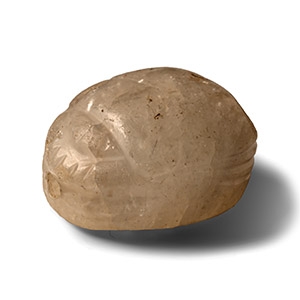
With segmented carapace, plain underside. 4.45 grams, 18 mm
From the property of the late Mr SM, London, UK, 1969-1999. -
.jpg)
Greek Marble Head of Dionysus
3rd-1st century B.C.Sold for (Inc. bp): £23,400
Carved in the half-round in three-quarter view, youthful male head with stern features, hair gathered in a browband, horns to the brow; from a frieze or relief; mounted on a custom-made stand. 1.59 kg total, 18.7 cm high including stand
Private European collection. Acquired on the Swiss art market, October 2013. European private collection. Accompanied by a copy of the 2013 invoice. Accompanied by an academic report by Dr Raffaele D'Amato. This lot has been checked against the Interpol Database of stolen works of art and is accompanied by a search certificate number no.12085-218192. -
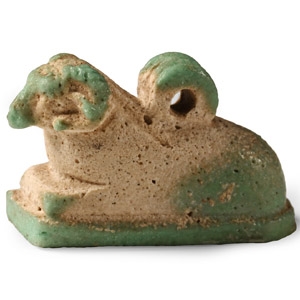
Egyptian Blue Faience Ram Amulet
Late Period, 664-332 B.C.Sold for (Inc. bp): £143
Modelled resting on a tongue-shaped base with ribbed suspension loop. 2.15 grams, 23 mm
From the collection of Doctor Girard, a collector for over 60 years. with Hotel des Ventes de Clermont-Ferrand, 22 May 2017. Property of a French collector.
Various gods were depicted in the form of rams. The downturned horns on this amulet indicate that the ram is a representation of Amun. The ram was symbolically linked to concepts of revival and fecundity. Eventually, it became associated with Osiris and was recognised as the god's soul or ba.
