
Loading, please wait...
LOT 0498
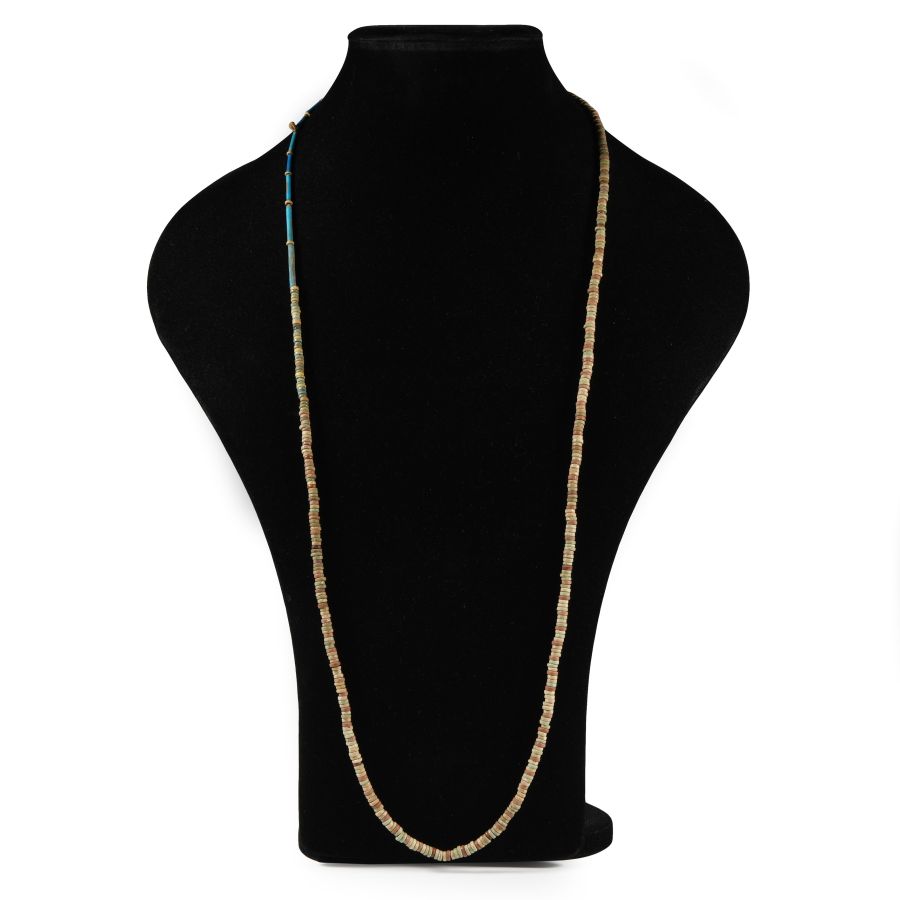
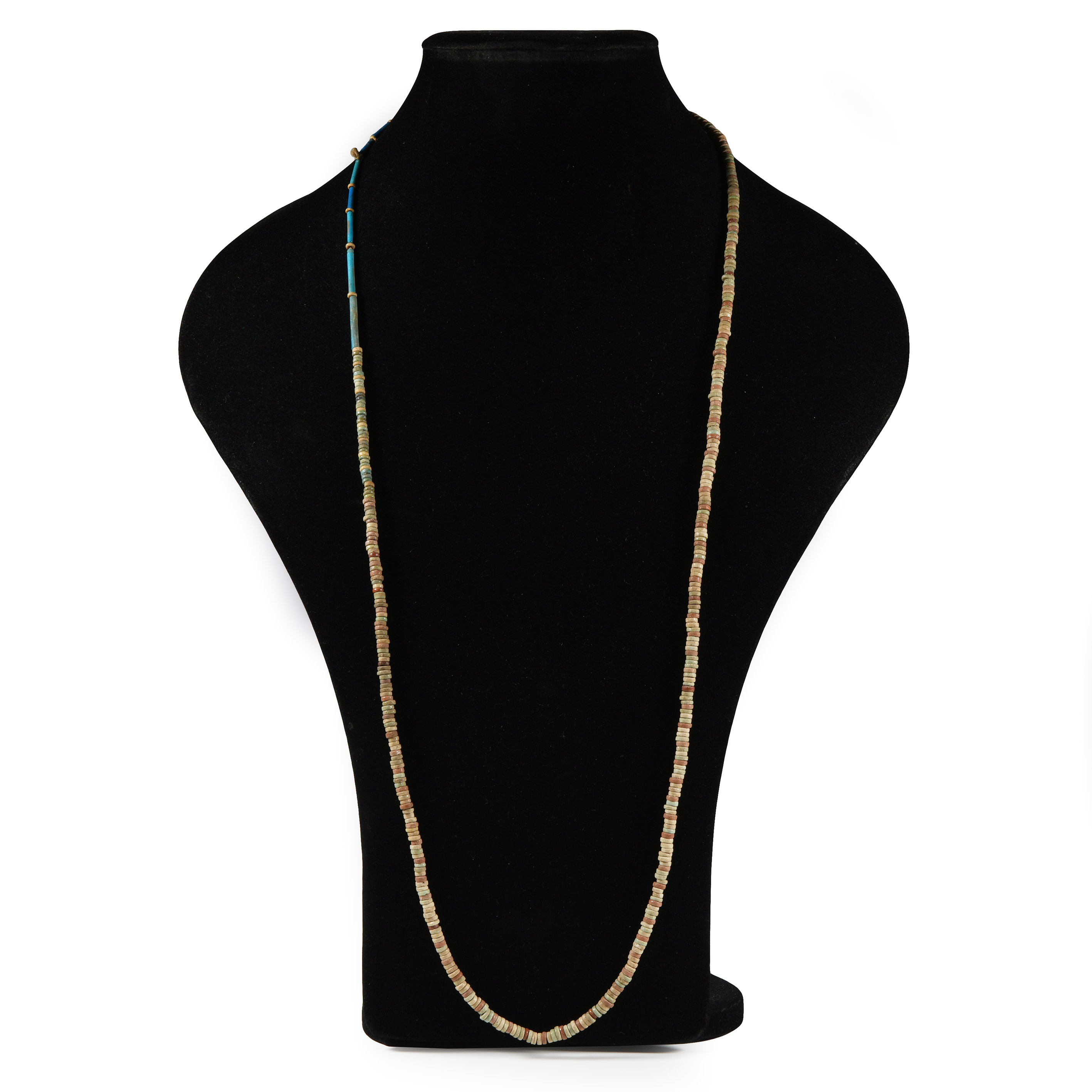
Egyptian Faience Mummy Bead Necklace
LATE PERIOD, 664-332 B.C.
37 3/8 in. (17.9 grams, 95 cm long).
Restrung group of annular and tubular beads. [No Reserve]
ProvenanceFrom an old English deceased estate.
Acquired on the London art market in the early 1990s.
Property of a London, UK, collector.
TimeLine Auctions follows a vetting process to ensure the authenticity and legality of all items, reinforcing our commitment to integrity and responsible trading. Each antiquity, antique, and coin lot undergoes thorough examination by a vetting committee of at least ten external specialists, professional trade association members, scientists, and archaeologists: Our Vetting Process
AUCTIONS:
TimeLine is a leading auction house specialising in antiquities, ancient art, collectables, natural history, coins, medals, and books. Our auctions offer museums, collectors, historians, and enthusiasts the opportunity to acquire unique and historically significant pieces.
-
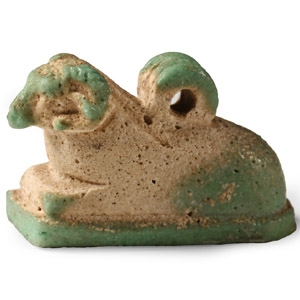
Egyptian Blue Faience Ram Amulet
Late Period, 664-332 B.C.Sold for (Inc. bp): £143
Modelled resting on a tongue-shaped base with ribbed suspension loop. 2.15 grams, 23 mm
From the collection of Doctor Girard, a collector for over 60 years. with Hotel des Ventes de Clermont-Ferrand, 22 May 2017. Property of a French collector.
Various gods were depicted in the form of rams. The downturned horns on this amulet indicate that the ram is a representation of Amun. The ram was symbolically linked to concepts of revival and fecundity. Eventually, it became associated with Osiris and was recognised as the god's soul or ba. -

Egyptian Steatite Scaraboid for Pharaoh Shabaka
Late 8th-early 9th century B.C.Estimate: £2,000 - 3,000 (+bp*)
Opening Bid: £1,000
Bifacial carved scaraboid; reverse with royal cartouche for Pharaoh Shabaka, flanked by the uraeus of Lower and Upper Egypt, surmounted by the Pharaonic epithet “King of the Upper and Lower Egypt” (“king of the reed” and “king of the bee”) and by the title “the son of Ra” and below, the sign of neb (damaged) “lord”; obverse with on the left, wedjat (winged cobra with the red crown – Lower Egypt), embracing with his wings shen (solar symbol) and in the centre, a lion with a ram's head, crowned and on the right, wedjat with the white crown of the Upper Egypt; on the upper section, a scarab with opened wings, instead of a lotus flower is depicted on the lower section. 7.65 grams, 27 mm
UK private collection before 2000. On the UK art market. Property of a London gentleman. This lot has been checked against the Interpol Database of stolen works of art and is accompanied by a search certificate number no.12081-217354. -
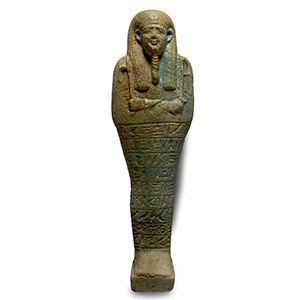
Large Egyptian Blue Glazed Hieroglyphic Shabti for a Sem Priest
Saite Period, 26th Dynasty, 664-525 B.C.Sold for (Inc. bp): £1,950
Pale blue composition with moulded detail to the wig, beard, tools and seed bag; nine horizontal bands of hieroglyphic text to the lower half of the body; dorsal pillar. 230 grams, 18.2 cm
Acquired on the German art market, 1989-1995. with The Museum Gallery, 19 Bury Place, London, WC1, UK, 1998-2003. Property of a London based academic, 2003-present.
