
Loading, please wait...
LOT 0459
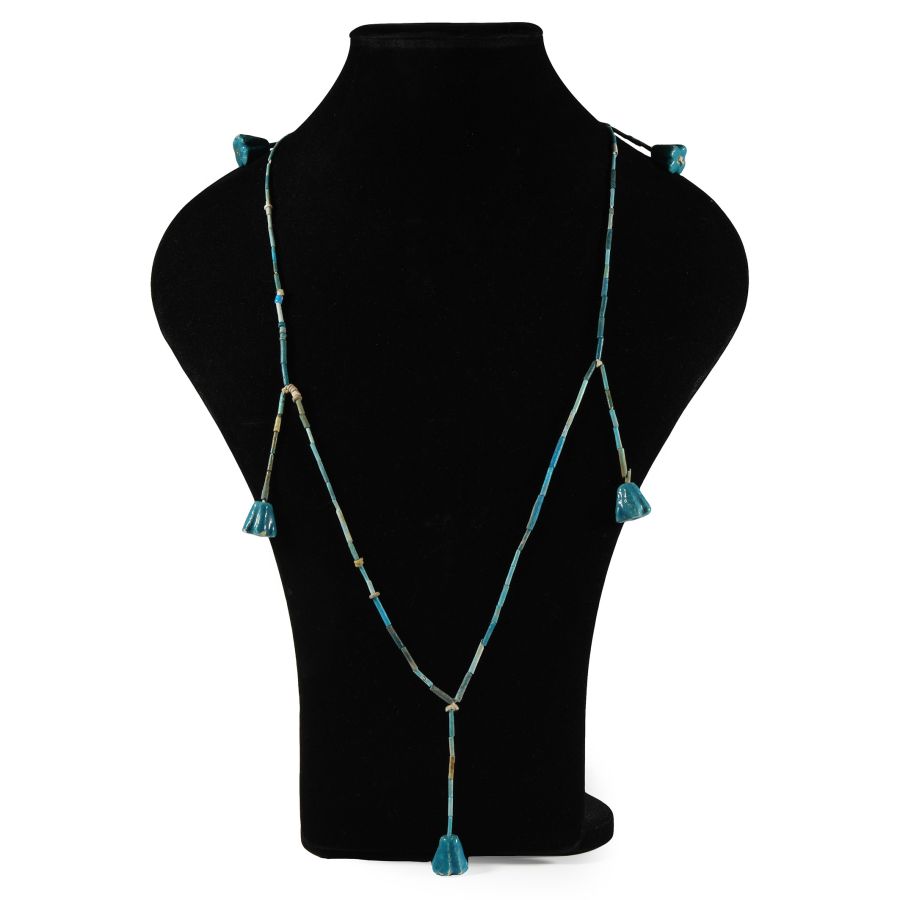
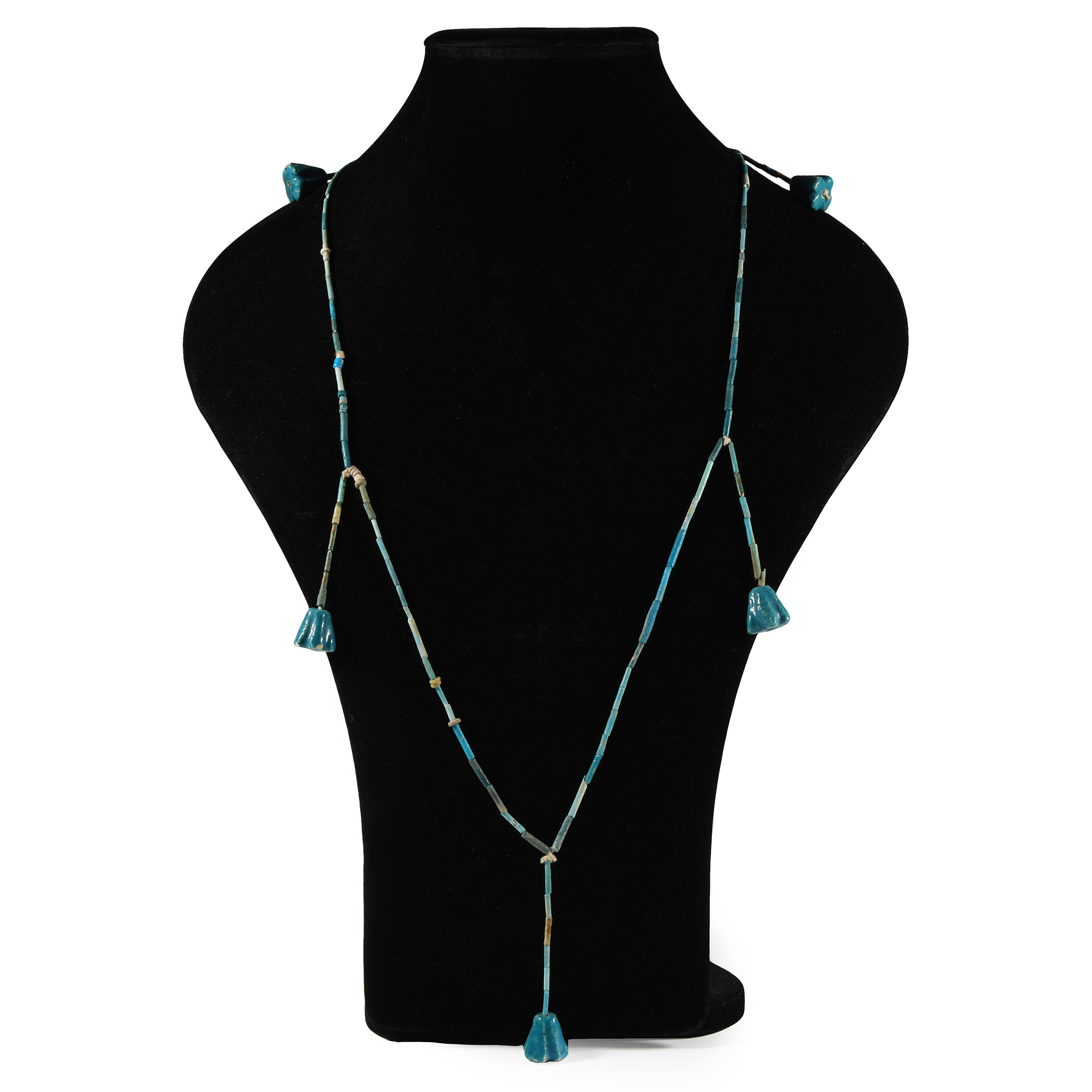
Egyptian Faience Mummy Bead Necklace with Papyrus Flower Amulets
LATE PERIOD, 664-332 B.C.
40 1/8 in. (25 grams, 102 cm long).
Restrung group of mainly tubular beads with five faience papyrus-flower pendants. [No Reserve]
ProvenanceFrom an old English deceased estate.
Acquired on the London art market in the early 1990s.
Property of a London, UK, collector.
TimeLine Auctions follows a vetting process to ensure the authenticity and legality of all items, reinforcing our commitment to integrity and responsible trading. Each antiquity, antique, and coin lot undergoes thorough examination by a vetting committee of at least ten external specialists, professional trade association members, scientists, and archaeologists: Our Vetting Process
AUCTIONS:
TimeLine is a leading auction house specialising in antiquities, ancient art, collectables, natural history, coins, medals, and books. Our auctions offer museums, collectors, historians, and enthusiasts the opportunity to acquire unique and historically significant pieces.
LOT 0459
Egyptian Faience Mummy Bead Necklace with Papyrus Flower Amulets
Sold for (Inc. bp): £208
-
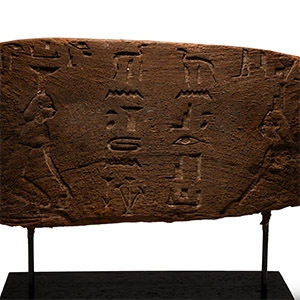
Egyptian Wood Panel with Hieroglyphs for Padi-Wsir
Late Period, 664-332 B.C.Sold for (Inc. bp): £2,340
Foot panel from a cedarwood sarcophagus with carved socket to the inner face to accept the feet and mortices for attaching to sides; the outer face in low relief, a figural scene depicting the sisters of Osiris (Nephthys to the left and Isis to the right) with their arms extended; text translatable as 'Words spoken for Neftis, which surrounds ...Words spoken for Osiris, Padi-Wsir. I have come into existence as [...] Osiris, Padi-Wsir, the righteous [...]'. 652 grams total, 31 cm wide including stand
From a Dutch private collection, acquired in the 1970s. Acquired from J. Bagot Ancient Art, Barcelona, Spain, in 2016. From the Keane private collection, Kent, UK. Accompanied by a copy of the J. Bagot certificate of authenticity and invoice (2,800 euros). This lot has been checked against the Interpol Database of stolen works of art and is accompanied by a search certificate number no.12078-216769.
'Padi Wsir' is probably the name of the owner of the sarcophagus; the same name was elsewhere transliterated as 'Padiusir' and Hellenised as 'Petosiris'', a familiar name in the Late Period. -
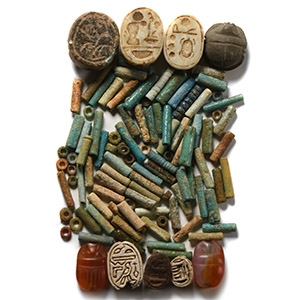
Egyptian Faience Bead and Scarab Collection
New Kingdom-Late Period, circa 1400-332 B.C.Sold for (Inc. bp): £624
Including tubular and annular beads, scarabs and scaraboids with inscriptions, including the prenomen of Amenhotep III (Neb-Maat-Re) and the nomen of Amenhotep II (A-Kheperu-Re). 22.4 grams total, 3-18 mm
From an early to mid 20th century collection, West country, UK. -
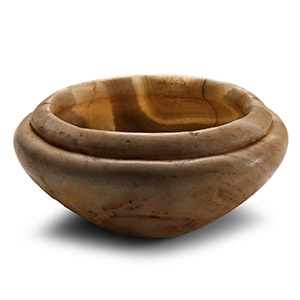
Egyptian Alabaster Bowl
1st Dynasty, circa 3000 B.C.Estimate: £1,800 - 2,400 (‡+bp*)
Opening Bid: £1,000
Of conical profile with flattened base, carinated shoulder and stepped rounded rim, possibly for accepting a lid. 380 grams, 11.6 cm wide
Property from an American deceased estate, acquired between 19770-1989. with Bonhams, London, 28 October 2009, no.16 (Part). Private European collection. Accompanied by copies of the relevant Bonhams catalogue pages. This lot has been checked against the Interpol Database of stolen works of art and is accompanied by a search certificate number no.12071-215259.
