
Loading, please wait...
LOT 0466
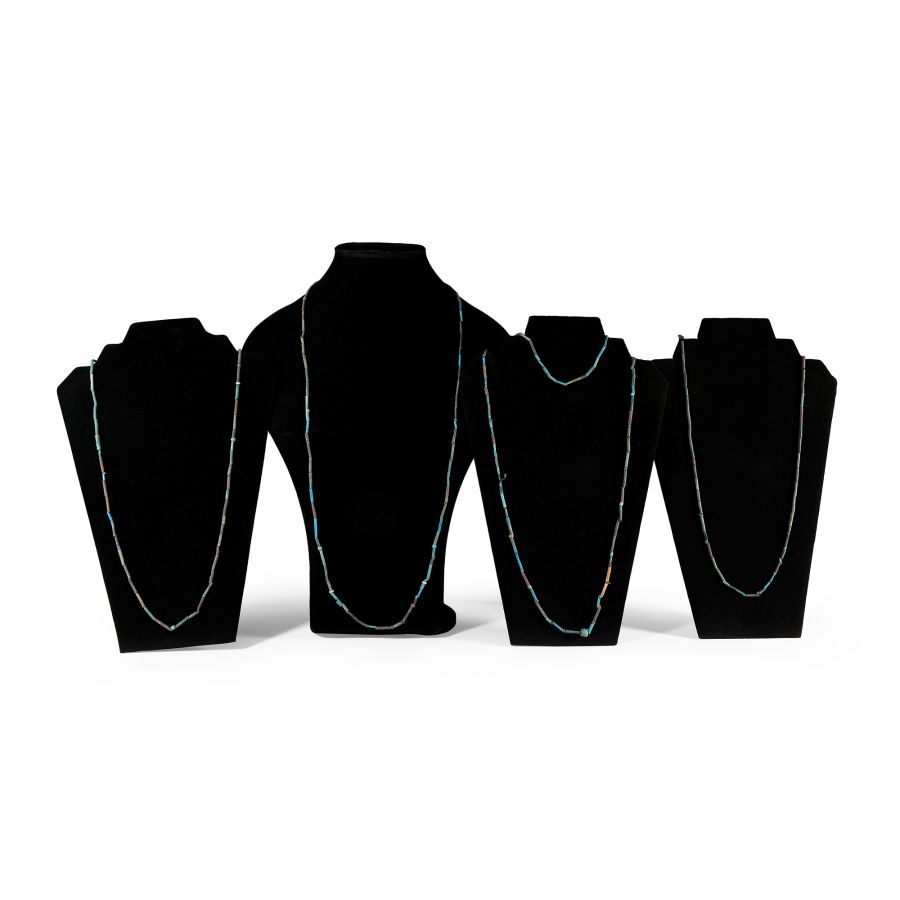
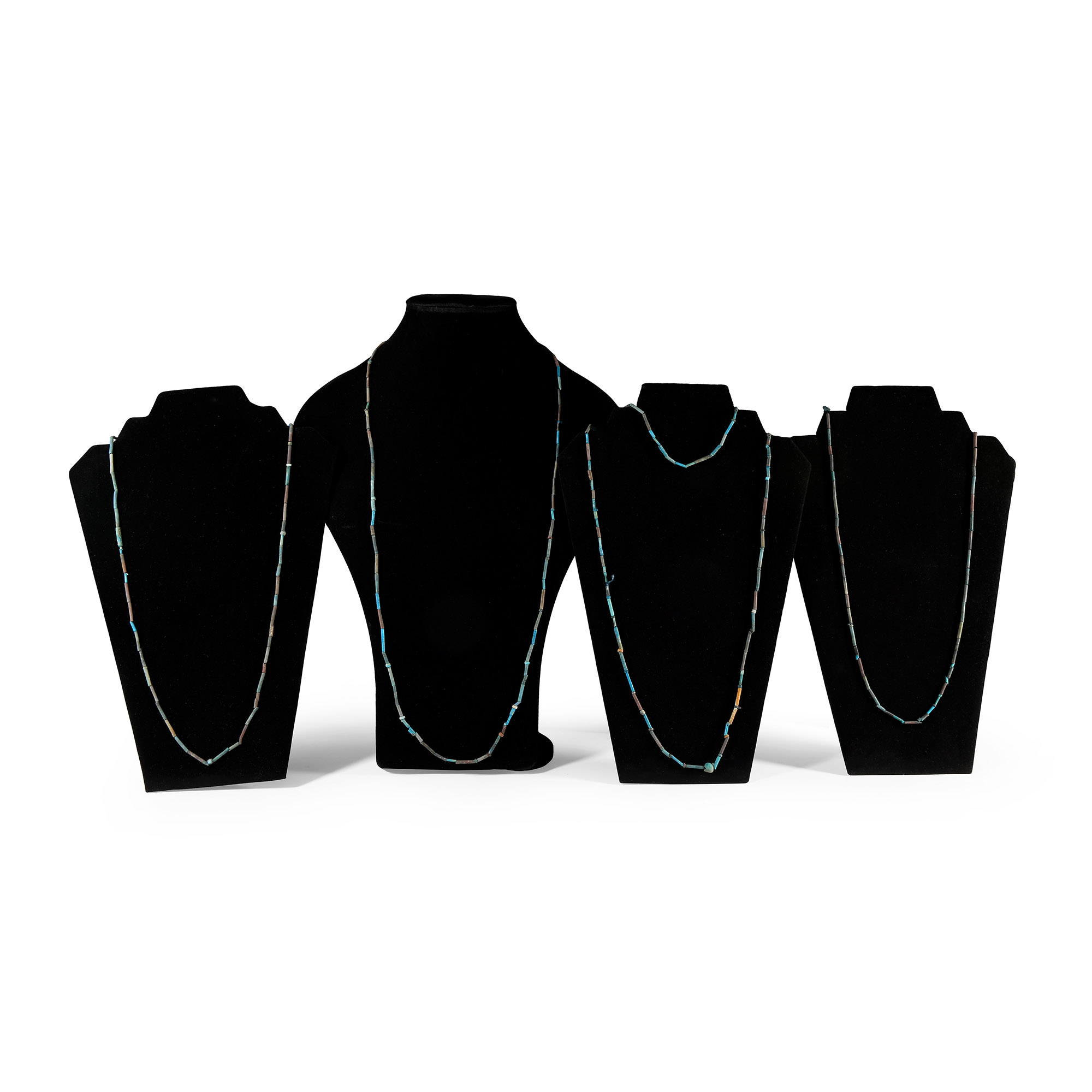
Egyptian Faience Mummy Bead Necklace Group
LATE PERIOD, 664-332 B.C.
29 3/8 - 37 3/8 in. (23 grams total, 72-95 cm long).
Comprising four necklace strings with tubular and annular beads. [4, No Reserve]
ProvenanceFrom an old English deceased estate.
Acquired on the London art market in the early 1990s.
Property of a London, UK, collector.
TimeLine Auctions follows a vetting process to ensure the authenticity and legality of all items, reinforcing our commitment to integrity and responsible trading. Each antiquity, antique, and coin lot undergoes thorough examination by a vetting committee of at least ten external specialists, professional trade association members, scientists, and archaeologists: Our Vetting Process
AUCTIONS:
TimeLine is a leading auction house specialising in antiquities, ancient art, collectables, natural history, coins, medals, and books. Our auctions offer museums, collectors, historians, and enthusiasts the opportunity to acquire unique and historically significant pieces.
-
.jpg)
'Egyptian Blue' Counter Weight Menat Amulet
Late Period, 664-525 B.C.Estimate: £800 - 1,000 (+bp*)
Opening Bid: £400
Amuletic pendant with broad bale, keyhole-shaped plaque with gusset to the rim. 14 grams, 67 mm
Acquired on the German art market, 1989-1995. with The Museum Gallery, 19 Bury Place, London, WC1A 2JB, 1998-2003. Property of a London based academic, 2003-present.
The menat necklace was a sacred item of great importance to female Egyptian goddesses, particularly Hathor. Priestesses of Hathor and other powerful goddesses used the necklace as a rattle, holding it in their hand by the counterpoise and evoking protection from the sound of the shaken beads. The amuletic menat counterweight symbolised the whole elaborate necklace. The menat was considered a powerful magical amulet throughout Egyptian history, offering good luck and protection against evil spirits. It was often buried with the dead for protection in the afterlife and was believed to promote fertility and good health for women while signifying virility for men. -
.jpg)
Egyptian Basalt Torso of Naophoros
Late Period, 664-332 B.C.Sold for (Inc. bp): £1,690
Carved in the round, depicting a male carrying a rectangular shrine intended to hold a figure of a goddess; arms and upper chest bare, strap to the chest to support an apron, dorsal pillar to the reverse; accompanied by a custom-made stand. 4.6 kg, 19.3 cm (5.18 kg total, 25 cm including stand)
From the collection of Danish furniture designer Ole Wanscher (1903-1985). Accompanied by an academic report by Egyptologist Paul Whelan. Accompanied by a copy of a photo of Wanscher in his office, circa 1960. This lot has been checked against the Interpol Database of stolen works of art and is accompanied by search certificate number no.11843-207728.
Ole Wanscher was a leading figure of the Scandinavian Design movement. Wanscher was inspired by ancient designs, and one of his most famous creations, the 'Egyptian Stool', was based on folding chairs from Egypt's New Kingdom. This piece is visible in the background of a photo of Wanscher in his office, circa 1960. -
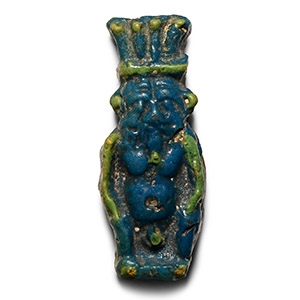
Egyptian Blue-Glazed Amulet of Bes
Ptolemaic Period, 332-30 B.C.Estimate: £200 - 300 (+bp*)
Opening Bid: £100
Faience amulet of the god Bes with his body of a dwarf, leonine head, and feather headdress; with a bright blue satin glaze and raised accents in yellow, modelled similarly on both sides; pierced through the neck for suspension 8.2 grams, 46 mm
From the P.C. collection, 1990s. Ex London gallery. Property of a Bristol, UK, gentleman.
Bes became one of ancient Egypt's most popular apotropaic deities from the New Kingdom onwards. Despite his somewhat fearful appearance, Bes was the patron and protector of pregnant women and children. He was also believed to protect from snakes.
