
Loading, please wait...


LOT 0476
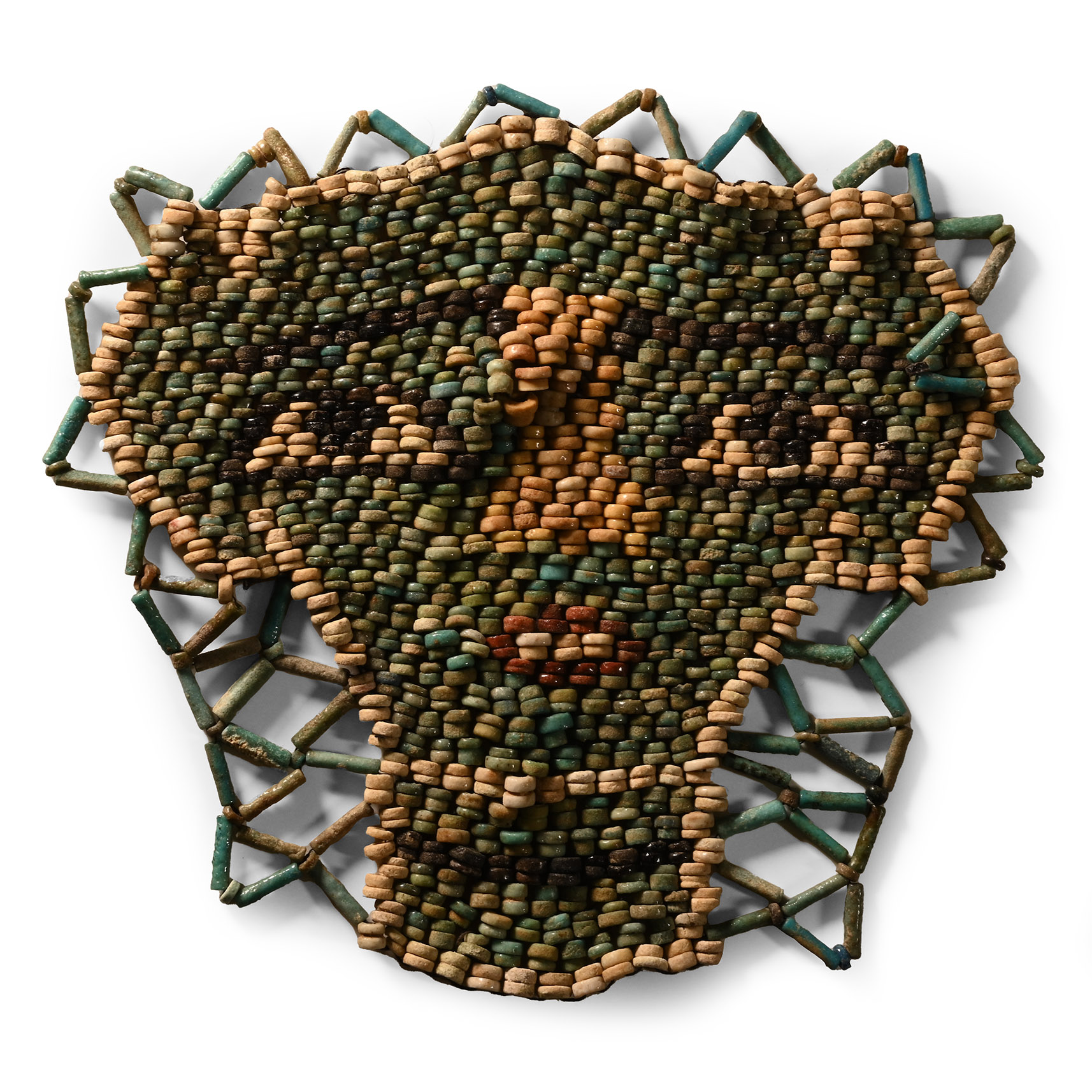
Egyptian Faience Mummy Bead Mask with Netting
PTOLEMAIC PERIOD, 332-30 B.C.
5 3/4 in. (52.7 grams, 14.5 cm wide).
A netted beadwork panel of annular and tubular glazed composition beads in blues, greens, black, cream and red-brown colours, depicting a mummy face-mask with false beard; restrung with some later beads.
ProvenanceEx Mariaud de Serres, Paris, France, 1980-1990s.
From a London, UK, collection.
Cf. Bienkowski, P., Tooley, A., Gifts of The Nile: Ancient Egyptian Arts and Crafts in Liverpool Museum, Liverpool, 1995, p.68 and pl.103, for an example still attached to a mummy.
CONDITIONTimeLine Auctions follows a vetting process to ensure the authenticity and legality of all items, reinforcing our commitment to integrity and responsible trading. Each antiquity, antique, and coin lot undergoes thorough examination by a vetting committee of at least ten external specialists, professional trade association members, scientists, and archaeologists: Our Vetting Process
AUCTIONS:
TimeLine is a leading auction house specialising in antiquities, ancient art, collectables, natural history, coins, medals, and books. Our auctions offer museums, collectors, historians, and enthusiasts the opportunity to acquire unique and historically significant pieces.
-
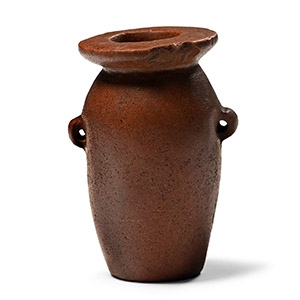
Egyptian Red Limestone Jar
New Kingdom, 1550-1069 B.C.Estimate: £800 - 1,000 (+bp*)
Opening Bid: £400
With everted disc rim and flat base, twin lug handles at the shoulder. 57 grams, 51 mm
Pino Donati collection, Lugano-Breganzona, formed in the 1960s-early 1970s. with Arte Classica, Stefano Donati, Lugano. Private collection, Europe, acquired November 2011 from the above. with Bonhams, New Bond Street, 28 November 2019, no.163.
Red limestone vessels have a limited chronological range and are particularly characteristic of the Predynastic Period. See Aston, B.G., Ancient Egyptian Stone Vessels: Materials and Forms, SAGA 5, Heidelberg, 1994, p.170, fig. 21, for the chronological range of the stone used for vessels. -
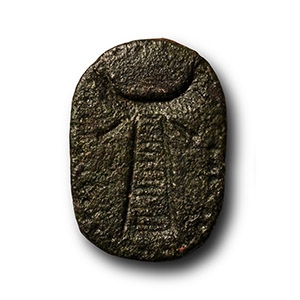
Phoenicio-Egyptian Dark Green Stone Scarab
Circa 6th-4th century B.C.Estimate: £300 - 400 (+bp*)
Opening Bid: £150
With textured carapace, bull-horned column to the reverse. 3.94 grams, 15 mm
From the property of the late Mr SM, London, UK, 1969-1999.
The very frequent discovery of scarabs in Eastern and Western Phoenician and Punic tombs is the most notable and evident document of the prestige that Egyptian magic had in the Phoenician world. The generalized adoption of the scarab, both in its symbolic language linked to the regenerative form of earthly or otherworldly life and in its function as a seal, identifies the extent of Egyptian influence on the Phoenician culture since its Syro-Palestinian origins. -
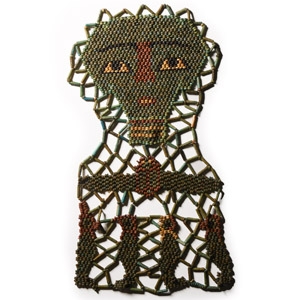
Egyptian Faience Beaded Mummy Mask with Sons of Horus
Ptolemaic Period, 332-30 B.C.Sold for (Inc. bp): £358
Restrung netted beadwork panel of annular and tubular glazed composition beads in blues, greens, black, cream and red-brown colours, depicting a mummy face-mask with false beard, a scarab with extended wings below, the 'Four Sons of Horus’ beneath the scarab, joined together with areas of open netting of tubular beads; restrung with some later beads. 72 grams, 26 cm
Ex Mariaud de Serres, Paris, France, 1990s. From a London, UK, collection.
The Four Sons of Horus were deities responsible for protecting the internal organs of the deceased. Here, on the left, we can see the jackal-headed Duamutef, who protected the stomach, followed by the falcon-headed Qebehsenuef, protector of the intestines, then the human-headed Imsety, who protected the liver and, finally, the baboon-headed Hapy, protected the lungs, on the right.
