
Loading, please wait...
LOT 0436
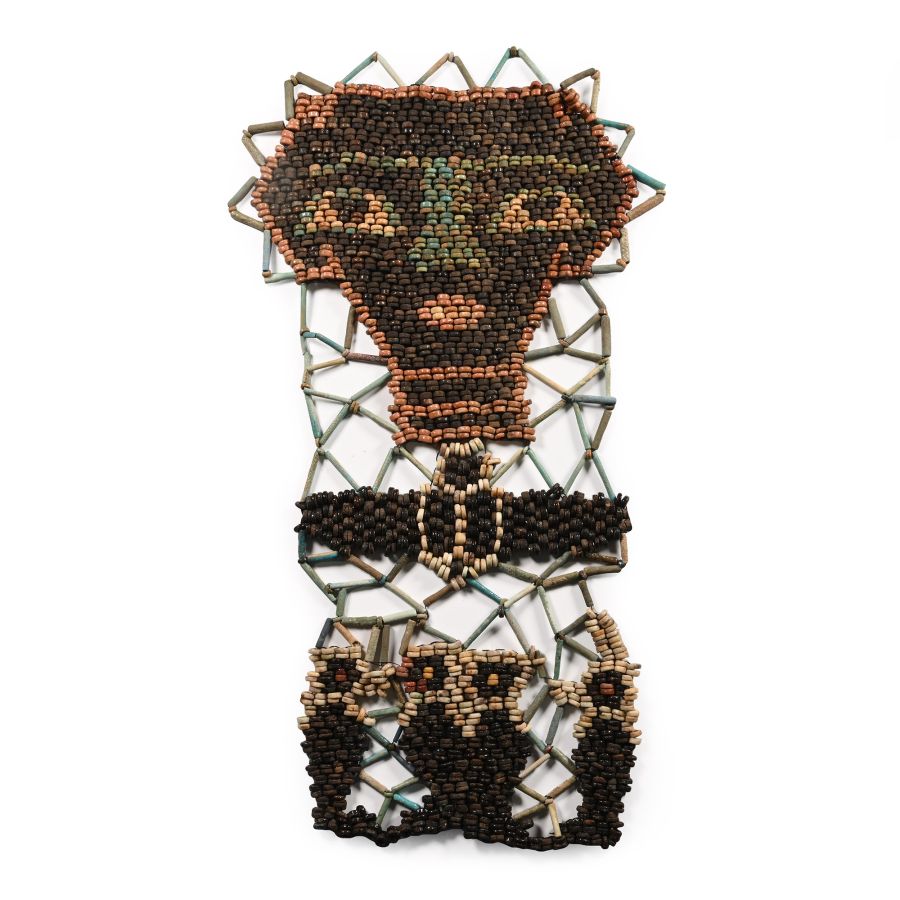
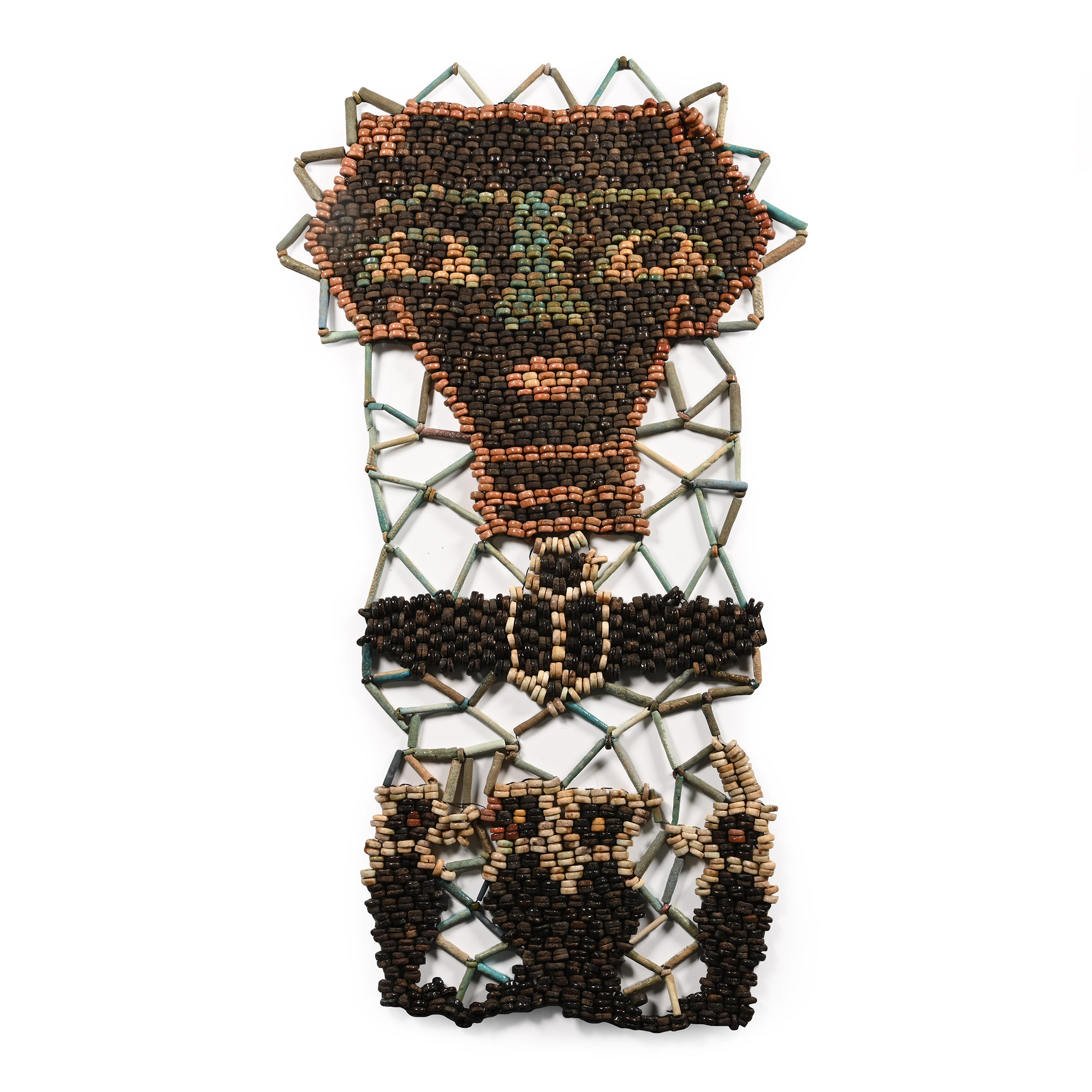
Egyptian Faience Mummy Bead Face Mask with Sons of Horus
PTOLEMAIC PERIOD, 332-30 B.C.
12 5/8 in. (145 grams, 32 cm high).
Restrung; a netted beadwork panel of annular and tubular glazed composition beads in blues, greens, black, cream and red-brown colours, depicting a mummy face mask with false beard, a scarab with extended wings below, the 'Four Sons of Horus’ beneath the scarab, joined together with areas of open netting of tubular beads.
ProvenanceAcquired 1990s.
Ex Mariaud des Serres, Paris, France.
This lot is accompanied by an illustrated lot declaration signed by the Head of the Antiquities Department, Dr Raffaele D'Amato.
See Manley, B. and Dodson, A., Life Everlasting. National Museums Scotland Collection of Ancient Egyptian Coffins, Edinburgh, 2010, p.114, no. 43, for an example with similar elements.
FootnotesThe 'Four Sons of Horus' protected the internal organs of the deceased. Depicted from left to right: the falcon-headed Qebhesenuef protected the intestines; human-headed Imsety, the liver; baboon-headed Hapi, the lungs; jackal-headed Duamutef, the stomach.
CONDITIONTimeLine Auctions follows a vetting process to ensure the authenticity and legality of all items, reinforcing our commitment to integrity and responsible trading. Each antiquity, antique, and coin lot undergoes thorough examination by a vetting committee of at least ten external specialists, professional trade association members, scientists, and archaeologists: Our Vetting Process
AUCTIONS:
TimeLine is a leading auction house specialising in antiquities, ancient art, collectables, natural history, coins, medals, and books. Our auctions offer museums, collectors, historians, and enthusiasts the opportunity to acquire unique and historically significant pieces.
LOT 0436
Egyptian Faience Mummy Bead Face Mask with Sons of Horus
Sold for (Inc. bp): £312
-
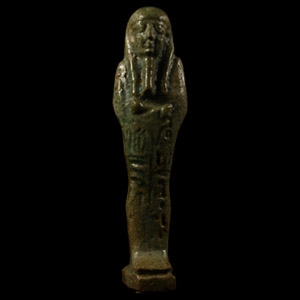
Egyptian Faience Shabti for Hor-sa-Iset
Late Period, circa 4th century B.C.Sold for (Inc. bp): £975
Of mummiform type, wearing a tripartite wig and long plaited divine beard; holding a pick in the left hand, a hoe in the right, and the cord of a seed bag hanging over his left shoulder; standing on an integral plinth, a plain back pillar terminating at the base of the wig; two vertical panels of hieroglyphic inscription to the front, including dedication: sḥḏ wsỉr ḥr sꜢ Ꜣst, ‘The illuminated, the Osiris, Hor-sa-Iset’; mounted on a custom-made display stand. 124 grams, 15.2 cm
Jacques René Fiechter, Switzerland (1920-1950). with Auction Martin, Egyptian collection of André Bircher, 1949. with Cahn Auktionen AG, Basel, 5 November 2011, no.20. Private collection, Europe. Accompanied by copies of the relevant Cahn catalogue pages. This lot is accompanied by an illustrated lot declaration signed by the Head of the Antiquities Department, Dr Raffaele D'Amato. -
.jpg)
Egyptian Silver Bezel for the 'Treasurer of the god, chief keeper (of) the House of Gold'
25th Dynasty, 754-656 B.C.Sold for (Inc. bp): £2,080
Rectangular with sloping faces on the underside, the upper face with two lines of hieroglyphic inscription reading: ‘Treasurer of the god, chief keeper (of) the House of Gold, great (of) Ra, Pa-di-Ra son of Pa-khered-tawy (or Pa-shery-tawy)’. 2.56 grams, 12 mm
with Bonhams, London, 27 April 2006. with Galerie Rhéa, Zurich, Switzerland. This lot is accompanied by an illustrated lot declaration signed by the Head of the Antiquities Department, Dr Raffaele D'Amato.
The ‘Treasurer of the god’ is a long-attested title known since the Old Kingdom (Jones, D., An Index of Ancient Egyptian Titles, Epithets and Phrases of the Old Kingdom, vol. II, Oxford, 2000, p. 767, no. 2791). The ‘Chief keeper’ title is known from the New Kingdom (for a similar writing of the title, see Al-Ayedi, A.R., Index of Egyptian Administrative, Religious and Military Titles of the New Kingdom, Ismailia, 2006, p. 395, no. 1236). The last part of the title is somewhat curious; the determinative at the end, previously interpreted as ‘Ra’, does not match the determinative for this god in the second line. An alternative tentative interpretation could be ‘Chief keeper, of the gold of the Pharaoh’, treating the pr and ꜤꜢ signs, which are shown side-by-side, as writing ‘Pharaoh’, with the seated figure wearing the Dual Crown symbolising the ruler. -
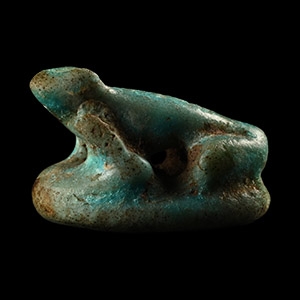
Egyptian Faience Frog Scaraboid
Ptolemaic Period, circa 300 B.C.Sold for (Inc. bp): £260
Discoid base with crouching frog pierced longitudinally for threading; underside with a solar disc and unidentified symbol. 0.56 grams, 13 mm
Ex R. Liechti (1934-2010) Geneva, Switzerland, formed between 1950-1990s. Accompanied by a copy of an old collection inventory note. This lot is accompanied by an illustrated lot declaration signed by the Head of the Antiquities Department, Dr Raffaele D'Amato.
