
Loading, please wait...
_900x900.jpg "Egyptian Faience Fish Plaque Amulet")
_200x200.jpg "Egyptian Faience Fish Plaque Amulet")
_900x900.jpg "Egyptian Faience Fish Plaque Amulet")
_200x200.jpg "Egyptian Faience Fish Plaque Amulet")
.jpg "Egyptian Faience Fish Plaque Amulet")
.jpg "Egyptian Faience Fish Plaque Amulet")
LOT 0002
Egyptian Faience Fish Plaque Amulet
NEW KINGDOM, 1550-1070 B.C.
5/8 in. (2.12 grams, 17 mm).
Rectangular plaque with raised Tilapia fish motif on the top and six ring-and-dot motifs on the underside.
ProvenanceMrs Allinson to Mrs Foster, 1867 and thence by descent to the current owner, Stanley Crescent, London, UK.
LiteratureCf. Andrews, C., Amulets of Ancient Egypt, London, 1994, p. 53, fig. 54h, for a close parallel.
FootnotesAmulets depicting the Tilapia fish served as symbols of regeneration.
CONDITIONTimeLine Auctions follows a vetting process to ensure the authenticity and legality of all items, reinforcing our commitment to integrity and responsible trading. Each antiquity, antique, and coin lot undergoes thorough examination by a vetting committee of at least ten external specialists, professional trade association members, scientists, and archaeologists: Our Vetting Process
AUCTIONS:
TimeLine is a leading auction house specialising in antiquities, ancient art, collectables, natural history, coins, medals, and books. Our auctions offer museums, collectors, historians, and enthusiasts the opportunity to acquire unique and historically significant pieces.
-
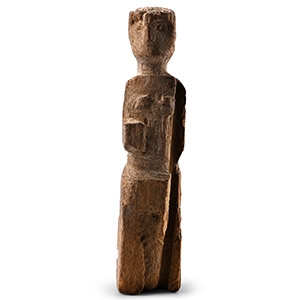
Coptic Wooden Standing Figure
Circa 4th-5th century A.D.Sold for (Inc. bp): £208
With drum-shaped head and incised eyes, slender neck, reserved breasts, right arm bent with hand extended, trim waist, full hips, seated on a rectangular throne(?); deep vertical slot to the left side. 214 grams, 25cm
Fair condition, usage wear.
From an important central London collection formed since the mid 1960s; thence by descent. From the private collection of John Meredith, acquired since the 1990s; thence by descent. -
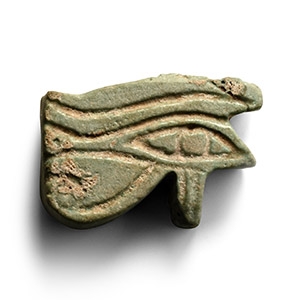
Egyptian Eye of Horus Amulet
Late Period, 664-332 B.C.Sold for (Inc. bp): £286
Large wedjat-eye amulet with incised human and falcon elements. 7.64 grams, 33.6 mm
with Archaeologia, Switzerland, before 1983. Ex private North American collection. London private collection, 2016. This lot has been checked against the Interpol Database of stolen works of art and is accompanied by search certificate number no.13162-242767. -
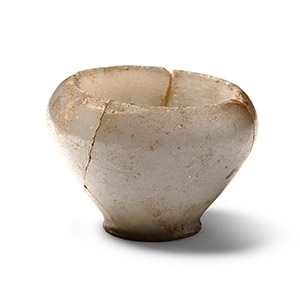
Egyptian Anhydrite Cosmetic Bowl
Middle Kingdom, circa 2040-1780 B.C.Estimate: £150 - 200 (+bp*)
Opening Bid: £75
Conical in profile with rounded rim, narrow disc base; repaired; a rare stone. 33.68 grams, 39 mm
Ex William Ohly, 1883-1955. Ex Abbey Museum, Barnet, by descent.
Anhydrite, incorrectly called "blue marble" by early excavators, was a stone favoured by the ancient Egyptians from the Middle Kingdom to the Second Intermediate Period. This particular example follows a Middle Kingdom-style cosmetic kohl jar that could be modelled with or without an integral rim.
