
Loading, please wait...
_900x900.jpg "Egyptian Faience Eye of Horus")
_200x200.jpg "Egyptian Faience Eye of Horus")
.jpg "Egyptian Faience Eye of Horus")
LOT 0499
Egyptian Faience Eye of Horus
LATE NEW KINGDOM, CIRCA 1300-1075 B.C.
3/4 in. (0.78 grams, 21 mm).
Openwork wedjat eye pendant with suspension loop above and slender frame.
ProvenanceAcquired 1970s onwards.
Private collection of Michael O'Hara, Cambridgeshire, UK.
Cf. Kalloniatis, F., The Egyptian Collection at Norwich Castle Museum, Oxford, 2019, pl.17 no.117, for a similar openwork example.
FootnotesThe wedjat eye amulet symbolised the eye of the falcon god Horus. According to ancient Egyptian mythology, Horus’ eye was gouged out by his treacherous uncle Seth and then healed by Thoth. While these amulets could be worn for protection in daily life, they also played a significant role in the funerary sphere. Wedjat eye amulets were believed to offer protection to the deceased’s mummy and could serve as substitutes for daily food offerings.
CONDITIONTimeLine Auctions follows a vetting process to ensure the authenticity and legality of all items, reinforcing our commitment to integrity and responsible trading. Each antiquity, antique, and coin lot undergoes thorough examination by a vetting committee of at least ten external specialists, professional trade association members, scientists, and archaeologists: Our Vetting Process
AUCTIONS:
TimeLine is a leading auction house specialising in antiquities, ancient art, collectables, natural history, coins, medals, and books. Our auctions offer museums, collectors, historians, and enthusiasts the opportunity to acquire unique and historically significant pieces.
-
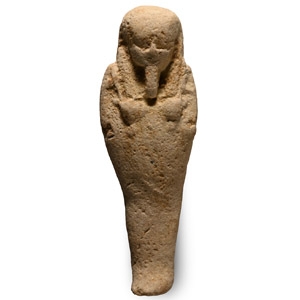
Egyptian White Faience Shabti
Ptolemaic Period, 332-30 B.C.Sold for (Inc. bp): £111
Modelled in the half-round with rounded facial features, lappet wig, false beard and crossed arms holding a pick and a hoe. 18 grams, 78 mm
Ex H. Norry collection, 1980s-1990s.
One of the primary purposes of shabti figures was to carry out heavy manual tasks on behalf of a person in the afterlife, and they were often depicted with necessary implements in their hands, such as baskets, picks, and hoes. Over time, the number of shabtis in a standard elite burial increased, from one in the Eighteenth Dynasty to several in the Nineteenth Dynasty, to one for every day of the year by the Third Intermediate Period. The high number of shabtis remained a feature in the Late and Ptolemaic Periods. -
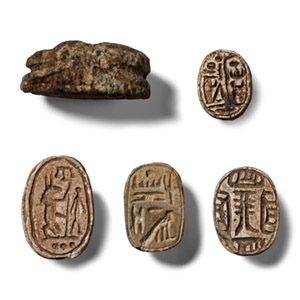
Egypto-Phoenician Hardstone Scarab Group
Late 1st millennium B.C.Sold for (Inc. bp): £650
Comprising five scarabs: one with a djed pillar surrounded by nwb signs; one with a jackal-headed Anubis holding a staff before a figure, with the scales of Maat above; one with a seated baboon sporting a crescent and sun disc headdress facing a royal cartouche of Thutmose III men-kheper-Re; one with a standing bird and other hieroglyphs; the largest one with worn underside. 1.97 grams total, 14-26 mm
From an early 20th century Home Counties, UK, collection.
The scarab, which represented the dung beetle, was the most popular amulet in ancient Egypt for approximately two thousand years until the Ptolemaic Period when it gradually fell out of favour. The popularity of scarabs extended beyond the borders of Egypt, and they were also distributed and produced in other regions, such as Phoenicia and Israel. The beetle is named khepri, derived from the verb 'to come into existence', and was considered the embodiment of the creator god Khepri, who was self-engendered. The ancient Egyptians mistakenly believed that the young beetle emerging from the dung ball was the result of an act of self-creation. -
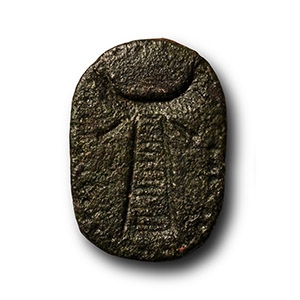
Phoenicio-Egyptian Dark Green Stone Scarab
Circa 6th-4th century B.C.Estimate: £300 - 400 (+bp*)
Opening Bid: £150
With textured carapace, bull-horned column to the reverse. 3.94 grams, 15 mm
From the property of the late Mr SM, London, UK, 1969-1999.
The very frequent discovery of scarabs in Eastern and Western Phoenician and Punic tombs is the most notable and evident document of the prestige that Egyptian magic had in the Phoenician world. The generalized adoption of the scarab, both in its symbolic language linked to the regenerative form of earthly or otherworldly life and in its function as a seal, identifies the extent of Egyptian influence on the Phoenician culture since its Syro-Palestinian origins.
