
Loading, please wait...
LOT 0495
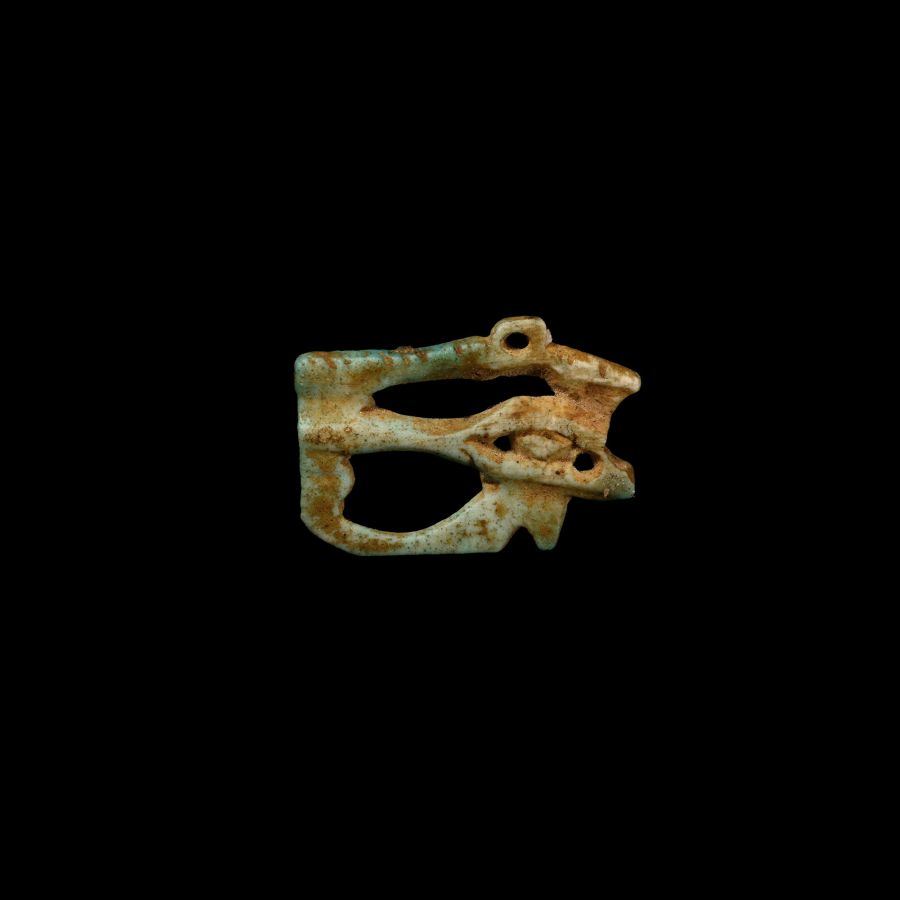
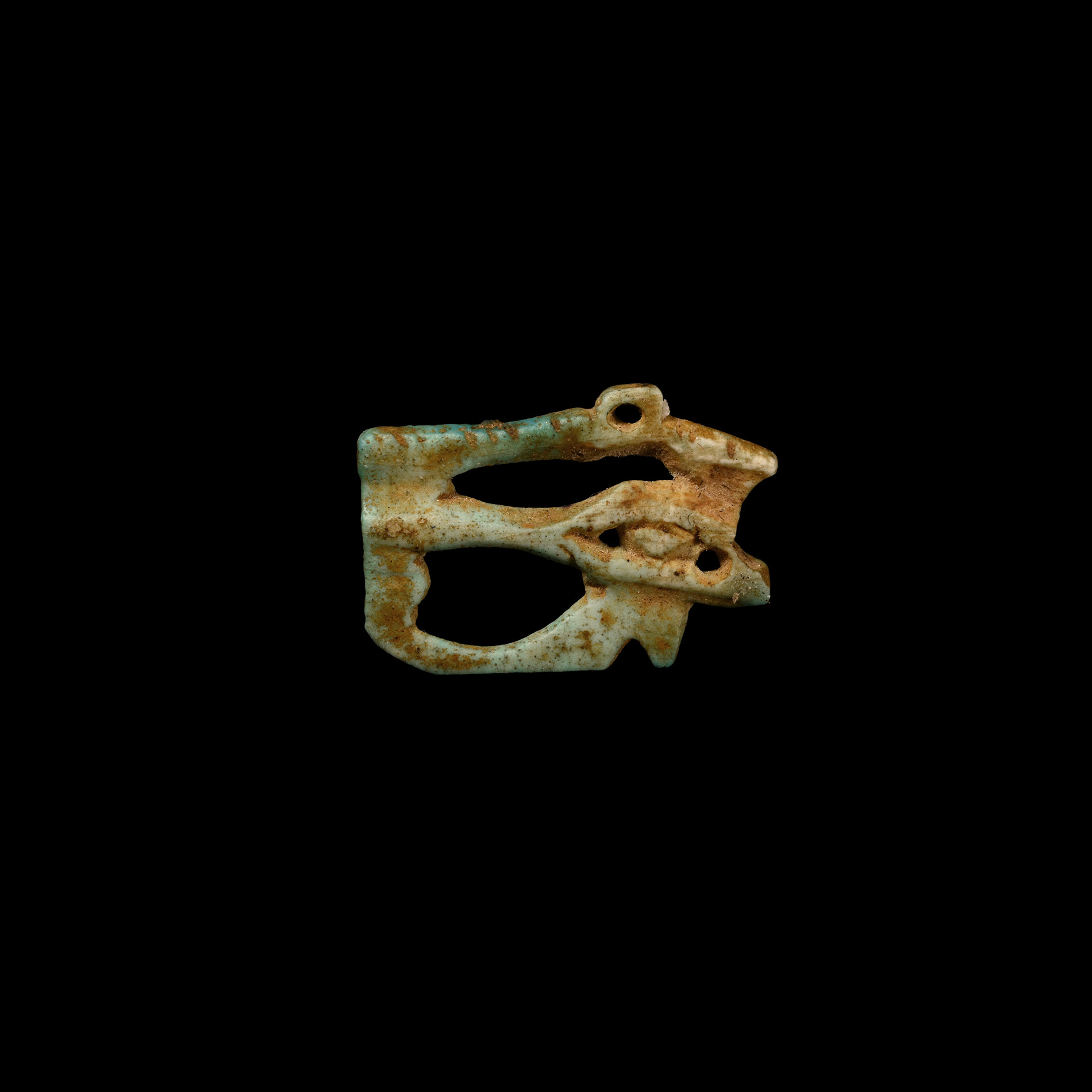
Egyptian Faience Eye of Horus
LATE NEW KINGDOM, CIRCA 1570-1075 B.C.
3/4 in. (0.78 grams, 21 mm).
Openwork faience wedjat pendant with suspension loop above and slender frame.
ProvenanceAcquired 1970s onwards.
Private collection of Michael O'Hara, Cambridgeshire, UK.
Cf. Andrews, C., Amulets of Ancient Egypt, London, 1994, pl.46 (j).
CONDITIONTimeLine Auctions follows a vetting process to ensure the authenticity and legality of all items, reinforcing our commitment to integrity and responsible trading. Each antiquity, antique, and coin lot undergoes thorough examination by a vetting committee of at least ten external specialists, professional trade association members, scientists, and archaeologists: Our Vetting Process
AUCTIONS:
TimeLine is a leading auction house specialising in antiquities, ancient art, collectables, natural history, coins, medals, and books. Our auctions offer museums, collectors, historians, and enthusiasts the opportunity to acquire unique and historically significant pieces.
LOT 0495
Egyptian Faience Eye of Horus
Estimate £200 - 300€230 - 350 (for guidance only)$270 - 410 (for guidance only)
-
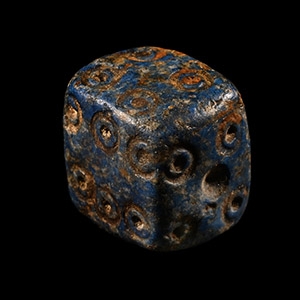
Romano-Egyptian Lapis Lazuli Dice
Roman Period, 30 B.C.-323 A.D.Sold for (Inc. bp): £247
Ring-and-dot markings disposed 1:6, 2:5, 3:4. 4 grams, 12 mm
Rare.
From an early 20th century UK collection. -
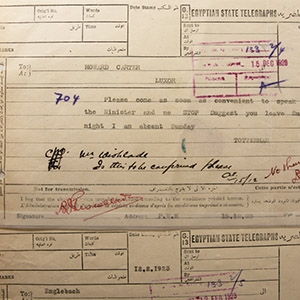
Collection of Egyptology Letters, Documents and Photographs
Early 20th century A.D.Sold for (Inc. bp): £845
Comprising: original typescript (some carbon copies) and manuscript documents in Arabic, French and English relating to Egyptian archaeological sites and matters, including requests for permits to visit sites, together with several telegraph forms including a permission for a visit to the tomb of Tutankhamen on 13 February 1923 and requests for similar permission; together with seven monochrome photographic prints depicting Egyptian sites. 245 grams total, 9.5-30 cm
Ex Hans Nilson collection.
The names of numerous luminaries of Egyptology of the late 19th and early 20th century found in these documents, besides their significant contributions to our knowledge of ancient Egypt, also held important administrative roles in Egypt's Antiquities Service and the Cairo Museum. They include: Victor Loret (1859-1946), who served as Director General of the Egyptian Antiquities Service from 1897-1899; Émile Brugsch (1842-1930) served as Keeper in the Cairo Museum from 1883-1914; Reginald Engelbach (1888-1946) served as Chief Inspector of Upper Egypt for the Antiquities Service in 1920 and Keeper in the Cairo Museum from 1931-1941; Gustave Lefebvre (1879-1957) served as Inspector of Middle Egypt for the Antiquities Service from 1905-1914 and Keeper in the Cairo Museum from 1926-1928; James Quibell (1867-1935) served as Inspector of the Delta and Middle Egypt for the Antiquities Service from 1899-1904, Luxor 1904-1905, and Saqqara also in 1905. He was Keeper in the Cairo Museum from 1914-1923 and Secretary-General of the Antiquities Department from 1923-1925; Pierre Lacau (1873-1963) served as Director of the Antiquities Service from 1914-1936. When the tomb of Tutankhamun was discovered in 1922, Lacau ensured that its entire contents were secured for the Cairo Museum (much to the chagrin of Howard Carter and the Earl of Carnarvon); Howard Carter (1874-1939), although famous for discovering the tomb of Tutankhamun in 1922, earlier served as Chief Inspector of Antiquities of Upper Egypt from 1899-1905. The name most frequently occurring in the documents is that of Paul Tottenham who served as Advisor to the Ministry of Public Works in Egypt, including a telegram he sent to Howard Carter on 15th February 1923 requesting that he attend a meeting with the Minister (of Public Works), presumably on matters concerning the tomb of Tutankhamun. -
.jpg)
Large Romano-Egyptian Silver Snake Mount
Roman Period, 30 B.C.-323 A.D.Estimate: £600 - 800 (+bp*)
Opening Bid: £333
Modelled slithering, its body forming meandering loops, with stylised detailing to the head and tail; remains of mounting lug to reverse of head. 40.6 grams, 73 mm
‘The Ancient Menagerie Collection’ formerly the property of a Cambridgeshire lady, collected since the 1990s and acquired from auctions and dealers throughout Europe and the USA, now ex London collection.
