
Loading, please wait...
LOT 0452
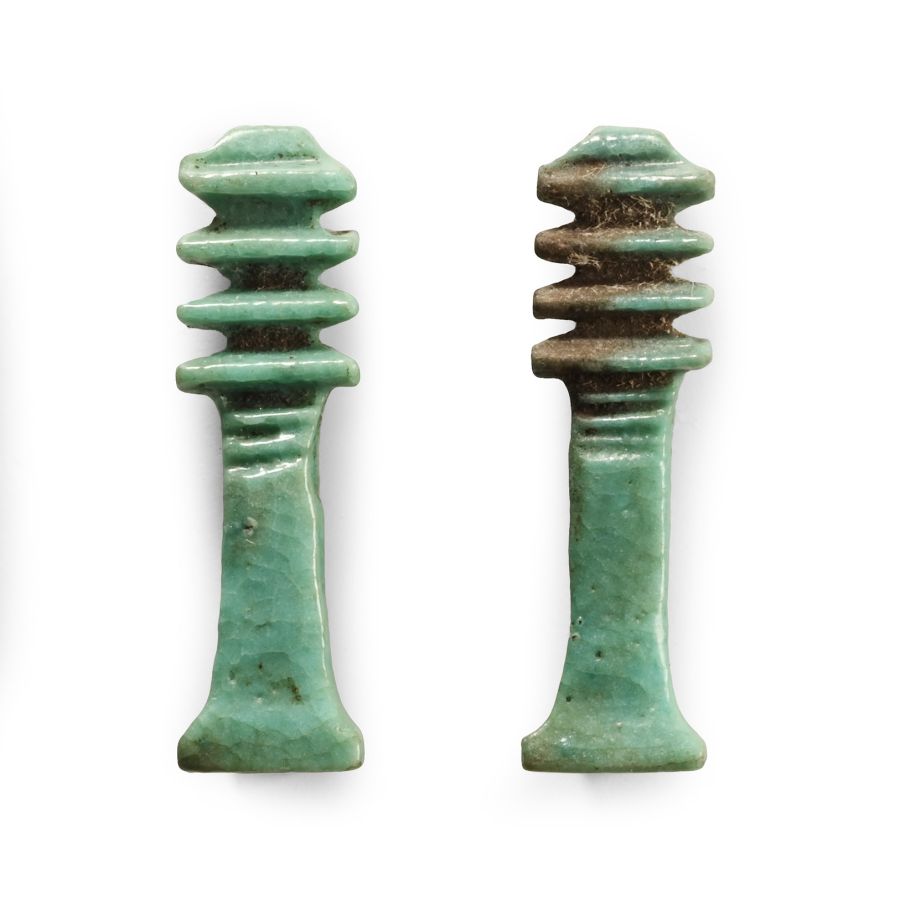
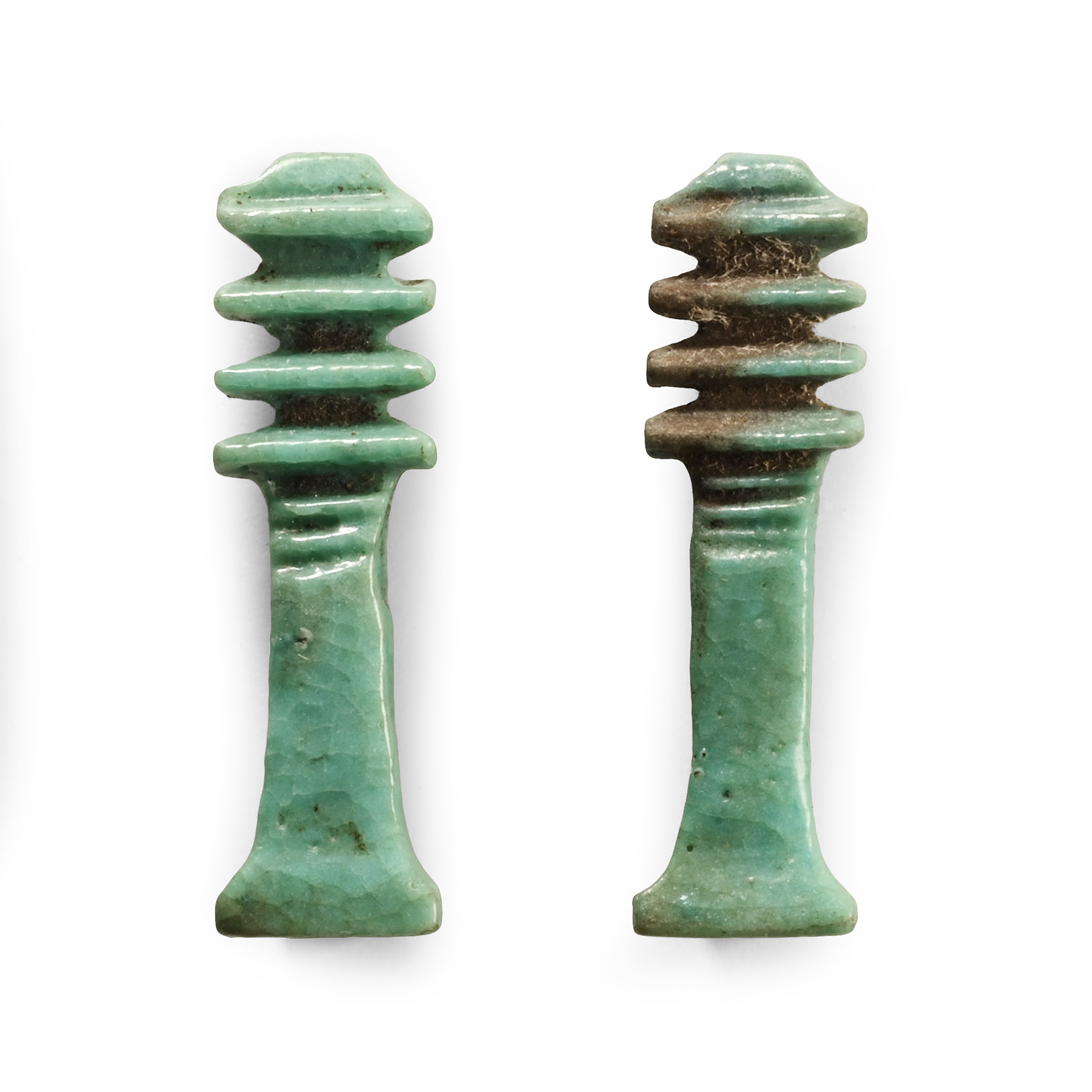
Egyptian Faience Djed Pillar Amulet Group
LATE PERIOD, 664-332 B.C.
1 in. (1.29 grams total, 23 mm each).
Each a square-section column with flared base, transverse ribs, pierced at the top. [2, No Reserve]
ProvenanceFrom the collection of Doctor Girard, a collector for over 60 years.
with Hotel des Ventes de Clermont-Ferrand, 22 May 2017.
Property of a French collector.
Cf. Tinius, I., Altägypten in Braunschweig. Die Sammlungen des Herzog Anton Ulrich-Museums und des Städtischen Museums, Wiesbaden, 2011, p.166, no. 322, for similar.
FootnotesThe djed pillar signifies the concepts of 'enduring' and 'stability' and was a common funerary amulet from the Old Kingdom onwards. It was first associated with the gods Ptah and Sokar but later became a symbol of Osiris, representing the god's backbone. In this context, the djed pillar appears in Chapter 155 of the Book of the Dead, concerned with the deceased's resurrection.
CONDITIONTimeLine Auctions follows a vetting process to ensure the authenticity and legality of all items, reinforcing our commitment to integrity and responsible trading. Each antiquity, antique, and coin lot undergoes thorough examination by a vetting committee of at least ten external specialists, professional trade association members, scientists, and archaeologists: Our Vetting Process
AUCTIONS:
TimeLine is a leading auction house specialising in antiquities, ancient art, collectables, natural history, coins, medals, and books. Our auctions offer museums, collectors, historians, and enthusiasts the opportunity to acquire unique and historically significant pieces.
-
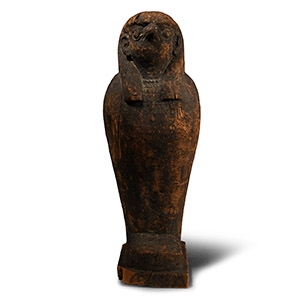
Egyptian Wooden Sarcophagus with Falcon Mummy
Late Period-Ptolemaic Period, 664-31 B.C.Estimate: £8,000 - 10,000 (‡+bp*)
Opening Bid: £3,500
Two-part wooden (sycamore?) falcon-headed mummiform coffin carved from a single piece of wood, with a tripartite wig and human ears, painted detailing to the eyes, and broad decorative collar; the whole covered with black paint with traces of yellow decoration and inscriptions; inside a mummified falcon wrapped in linen strips. 2.3 kg, 49.5 cm
Ex R. Liechti (1934-2010) Geneva, Switzerland, formed between 1950-1990s. Accompanied by a copy of an old collection inventory note. Accompanied by an academic report by Egyptologist Paul Whelan. This lot has been checked against the Interpol Database of stolen works of art and is accompanied by a search certificate number no.12074-218220.
This falcon-headed coffin once contained a so-called 'corn mummy' - a mummiform effigy impregnated with grain, which germinated. Such 'corn mummies' were associated with Osirian regeneration, fertility, and rebirth concepts. The falcon-headed coffin was associated with the powerful funerary deity Sokar-Osiris or Ptah-Sokar-Osiris. It seems that the original contents of this coffin were either lost or discarded and replaced with a mummified bird (falcon?). Interestingly, the most significant number of falcon-headed coffins come from Tuna el-Gebel, the site of an extensive animal mummy necropolis. -
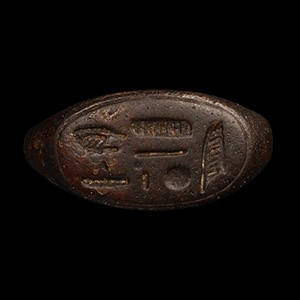
Egyptian Bronze Ring with Hieroglyphs
1st millennium B.C.Sold for (Inc. bp): £4,550
Ellipsoid bezel with a group of incuse hieroglyphs to the plaque naming Amun-Re. 9.62 grams, 24.22 mm overall, 18.25 mm internal diameter (approximate size British O, USA 7, Europe 14.98, Japan 14)
Acquired in the mid 1980s-1990s. From the family collection of Mr S.A., Switzerland, thence by descent. Private collection since the late 1990s. -
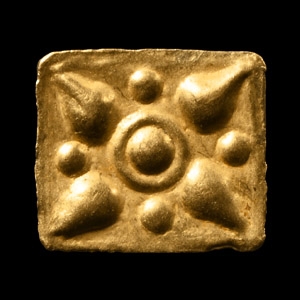
Egyptian Gold Setting with Glass Inlay
Late Period, 664-332 B.C.Sold for (Inc. bp): £169
Square sheet gold cell with repoussé quatrefoil to the underside, inset glass panel in red glass and pale turquoise faience. 1.18 grams, 10 mm
From a late Japanese specialist collector, 1970-2000s.
