
Loading, please wait...
LOT 0474
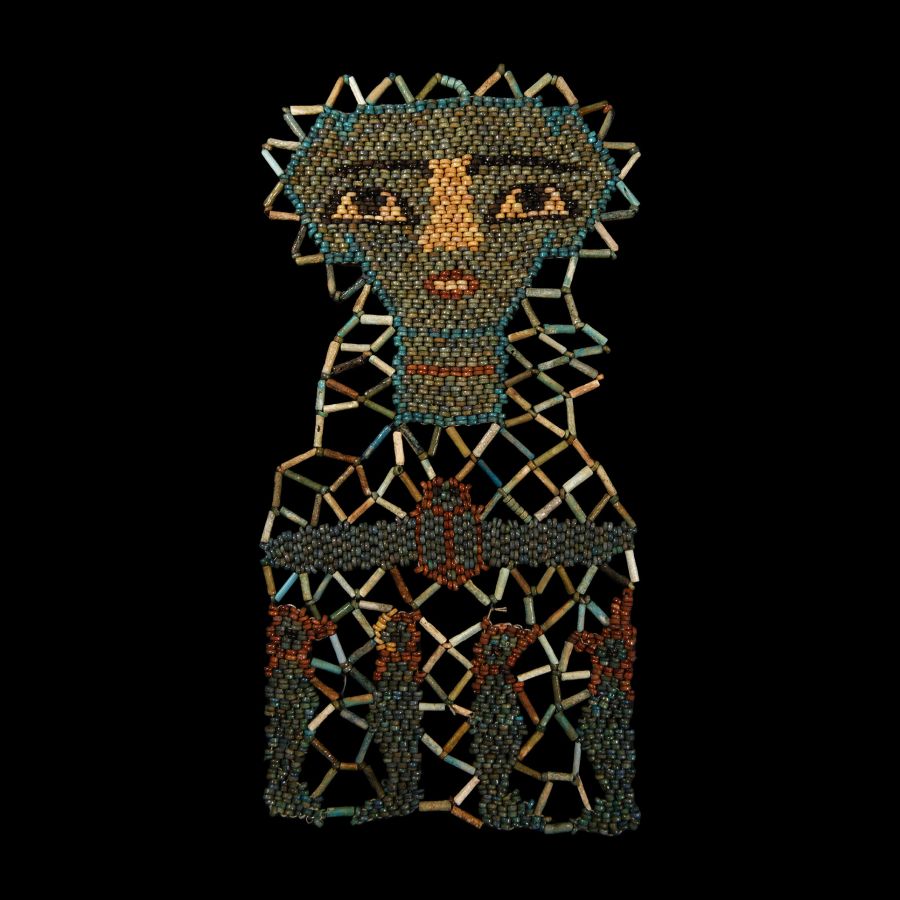
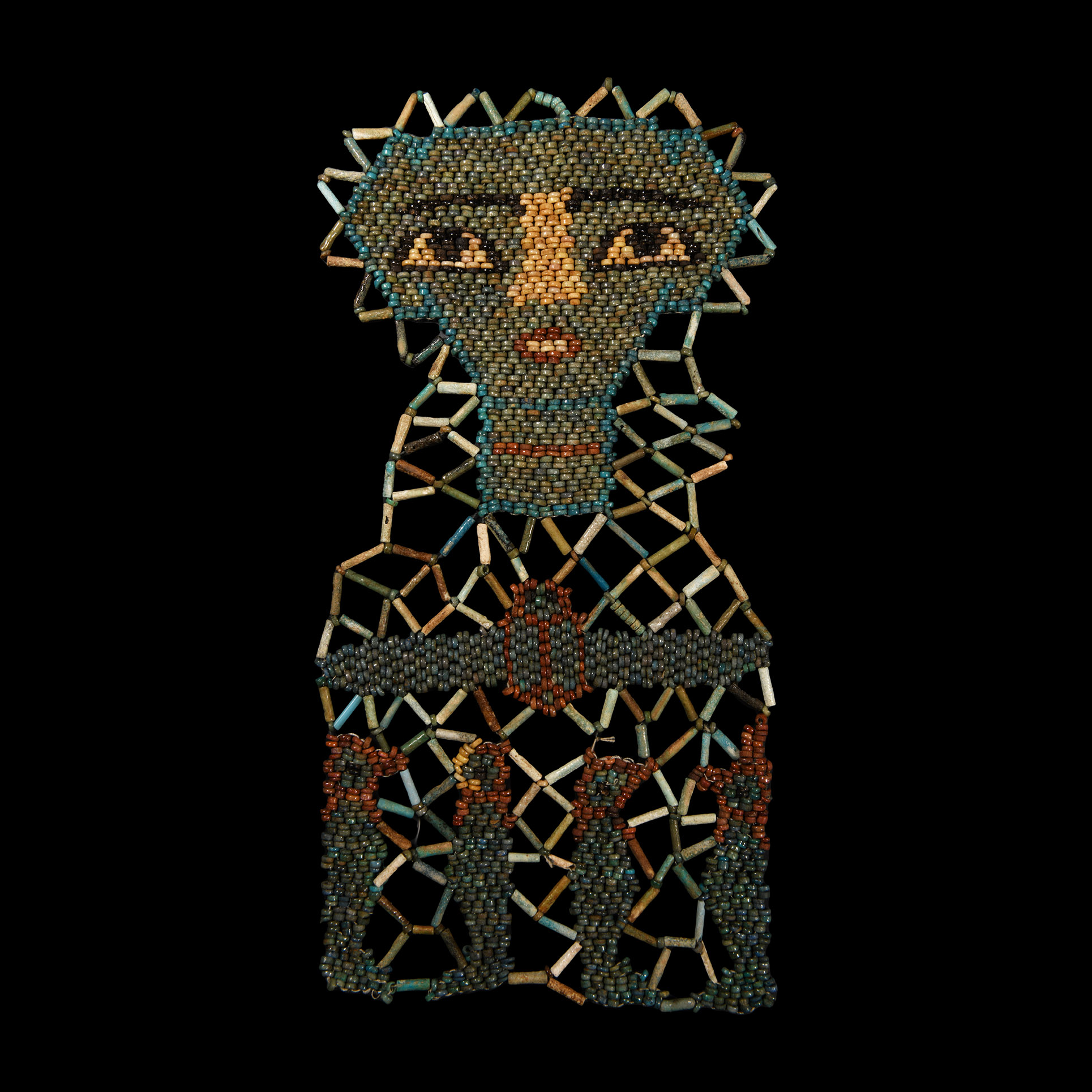
Egyptian Faience Bead Mummy Face Mask
PTOLEMAIC PERIOD, 332-30 B.C.
9 1/2 in. (67 grams, 24 cm high).
Restrung; a netted beadwork panel of annular and tubular glazed composition beads in blues, greens, black, cream and red-brown colours, depicting a mummy face mask with false beard, a scarab with extended wings below, the 'Four Sons of Horus’ beneath the scarab, joined together with areas of open netting of tubular beads.
ProvenanceAcquired 1990s.
Ex Mariaud des Serres, Paris, France.
See Manley, B. and Dodson, A., Life Everlasting. National Museums Scotland Collection of Ancient Egyptian Coffins, Edinburgh, 2010, p.114, no. 43, for an example with similar elements.
FootnotesThe 'Four Sons of Horus' protected the internal organs of the deceased. Depicted from left to right: the falcon-headed Qebhesenuef protected the intestines; human-headed Imsety, the liver; baboon-headed Hapi, the lungs; jackal-headed Duamutef, the stomach.
CONDITIONTimeLine Auctions follows a vetting process to ensure the authenticity and legality of all items, reinforcing our commitment to integrity and responsible trading. Each antiquity, antique, and coin lot undergoes thorough examination by a vetting committee of at least ten external specialists, professional trade association members, scientists, and archaeologists: Our Vetting Process
AUCTIONS:
TimeLine is a leading auction house specialising in antiquities, ancient art, collectables, natural history, coins, medals, and books. Our auctions offer museums, collectors, historians, and enthusiasts the opportunity to acquire unique and historically significant pieces.
-
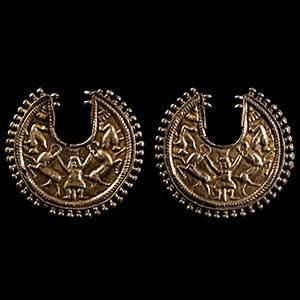
Egypto-Persian Silver-Gilt Earring Pair with Bes Holding Two Ibexes
Circa 530-330 B.C.Sold for (Inc. bp): £2,340
Each with bifacial repoussé decoration depicting the Egyptian god Bes controlling two ibexes, above them two geese or storks facing stylised lotus flowers, projecting knops to the perimeter, four loops to the inner edge. 26.73 grams total, 4.7 cm each
with Riyahi Gallery, London, prior to 1996. Private collection, Switzerland, acquired from the above, 1 July 1996. Acquired from the above, 23 December 2010. Accompanied by a copy of an Art Loss Register certificate, no 5068.C.V. -
.jpg)
Egyptian Black Hardstone Scarab with Ankh
Late New Kingdom, circa 1070 B.C.Sold for (Inc. bp): £845
Carved with stylised features and the base carved with a scarab beetle flanked by two ankh symbols and a ra sign beneath; drilled for suspension. 2.71 grams, 18 mm
Acquired 1969-1999. From the private collection of the late Mr S.M., London, UK, thence by descent. -
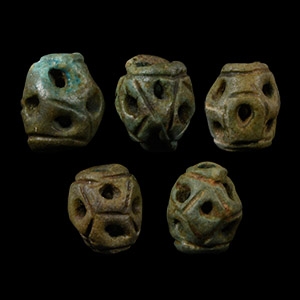
Romano-Egyptian Green Faience Bead Group
Circa 1st-2nd century A.D.Sold for (Inc. bp): £59
Comprising five broadly barrel-shaped beads with decorative piercing to each facetted face; decorative incised lines demarcating the faces. 41.7 grams total, 25-27 mm
London private collection, 1979-1983.
