
Loading, please wait...


LOT 0496
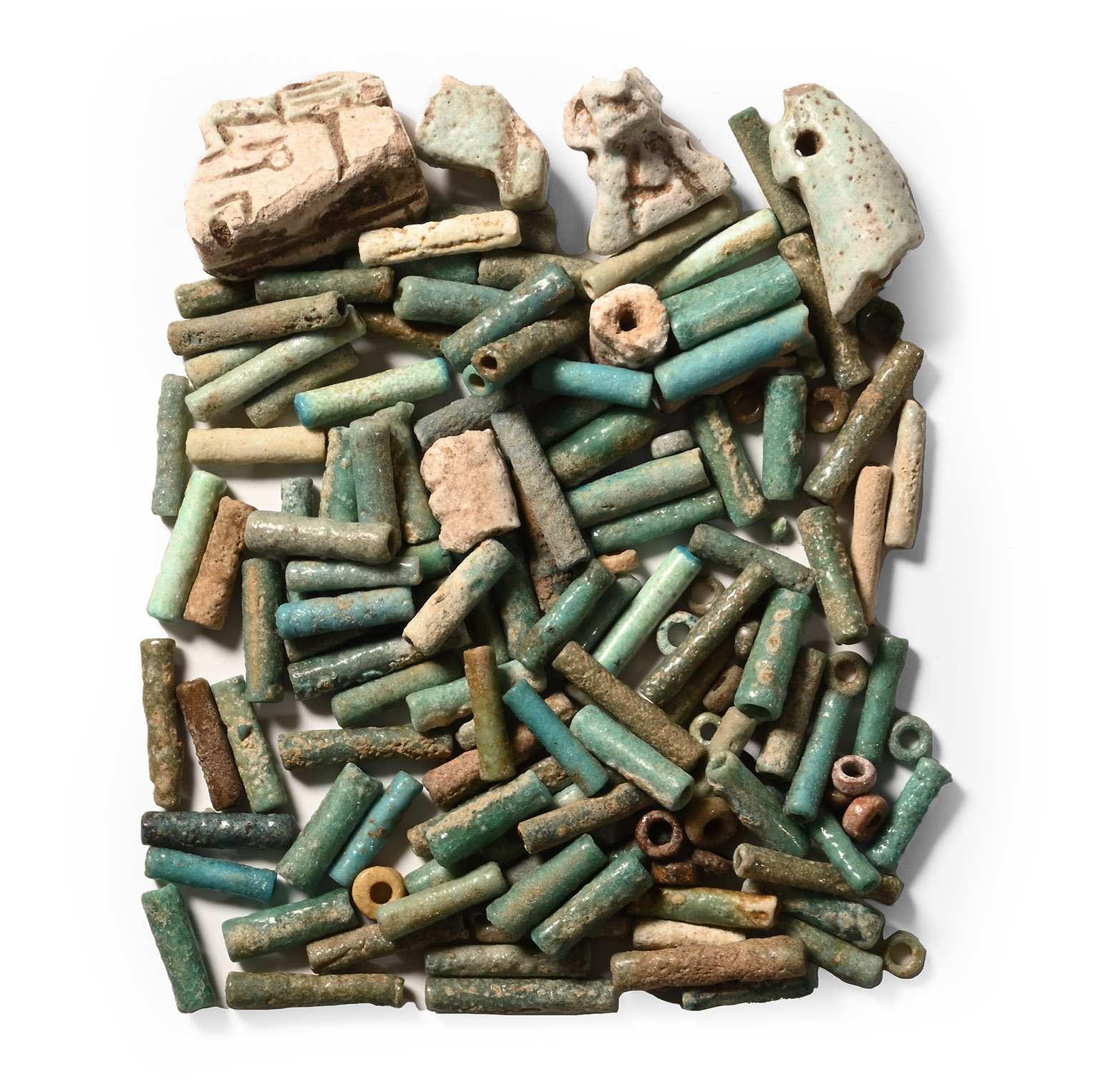
Egyptian Faience Bead and Amulet Group
LATE PERIOD, 664-332 B.C.
1/8 - 3/4 in. (19 grams total, 2-19 mm).
Comprising mainly blue and green tubular beads with some annular beads and fragmentary amulets, including the head of a hare and a portion of a hedjet crown. [140+]
ProvenanceFrom an early 20th century Home Counties, UK, collection.
CONDITIONTimeLine Auctions follows a vetting process to ensure the authenticity and legality of all items, reinforcing our commitment to integrity and responsible trading. Each antiquity, antique, and coin lot undergoes thorough examination by a vetting committee of at least ten external specialists, professional trade association members, scientists, and archaeologists: Our Vetting Process
AUCTIONS:
TimeLine is a leading auction house specialising in antiquities, ancient art, collectables, natural history, coins, medals, and books. Our auctions offer museums, collectors, historians, and enthusiasts the opportunity to acquire unique and historically significant pieces.
-
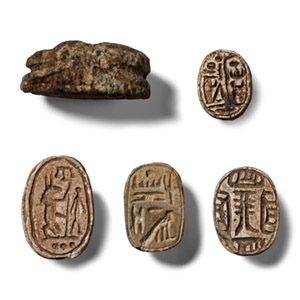
Egypto-Phoenician Hardstone Scarab Group
Late 1st millennium B.C.Sold for (Inc. bp): £650
Comprising five scarabs: one with a djed pillar surrounded by nwb signs; one with a jackal-headed Anubis holding a staff before a figure, with the scales of Maat above; one with a seated baboon sporting a crescent and sun disc headdress facing a royal cartouche of Thutmose III men-kheper-Re; one with a standing bird and other hieroglyphs; the largest one with worn underside. 1.97 grams total, 14-26 mm
From an early 20th century Home Counties, UK, collection.
The scarab, which represented the dung beetle, was the most popular amulet in ancient Egypt for approximately two thousand years until the Ptolemaic Period when it gradually fell out of favour. The popularity of scarabs extended beyond the borders of Egypt, and they were also distributed and produced in other regions, such as Phoenicia and Israel. The beetle is named khepri, derived from the verb 'to come into existence', and was considered the embodiment of the creator god Khepri, who was self-engendered. The ancient Egyptians mistakenly believed that the young beetle emerging from the dung ball was the result of an act of self-creation. -
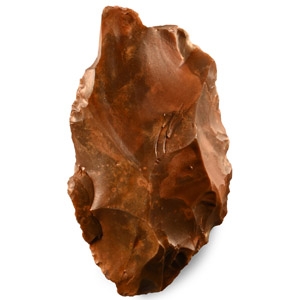
Egyptian Flint Handaxe
Lower Palaeolithic Period, circa 450,000-280,000 B.P.Sold for (Inc. bp): £33
Irregular in plan with biconvex section. 380 grams, 14 cm
Found Egypt, North Africa. From the British art market in the 1970s-1980s. Acquired via inheritance, 1988. From the collection of a South West London, UK, specialist Stone Age collector. -
Egyptian Faience Bead and Amulet Group
Late Period, 664-332 B.C.Sold for (Inc. bp): £104
Comprising tubular and annular beads in blue, green and cream colours, the upper half of two Tawaret amulets, a fragmentary wedjat eye, the lower half of a seated figure, probably Isis, and a complete amulet of the god Shu. 22 grams total, 2-21 mm
From an early 20th century Home Counties, UK, collection.
