
Loading, please wait...

LOT 0485
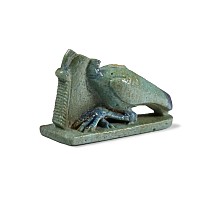
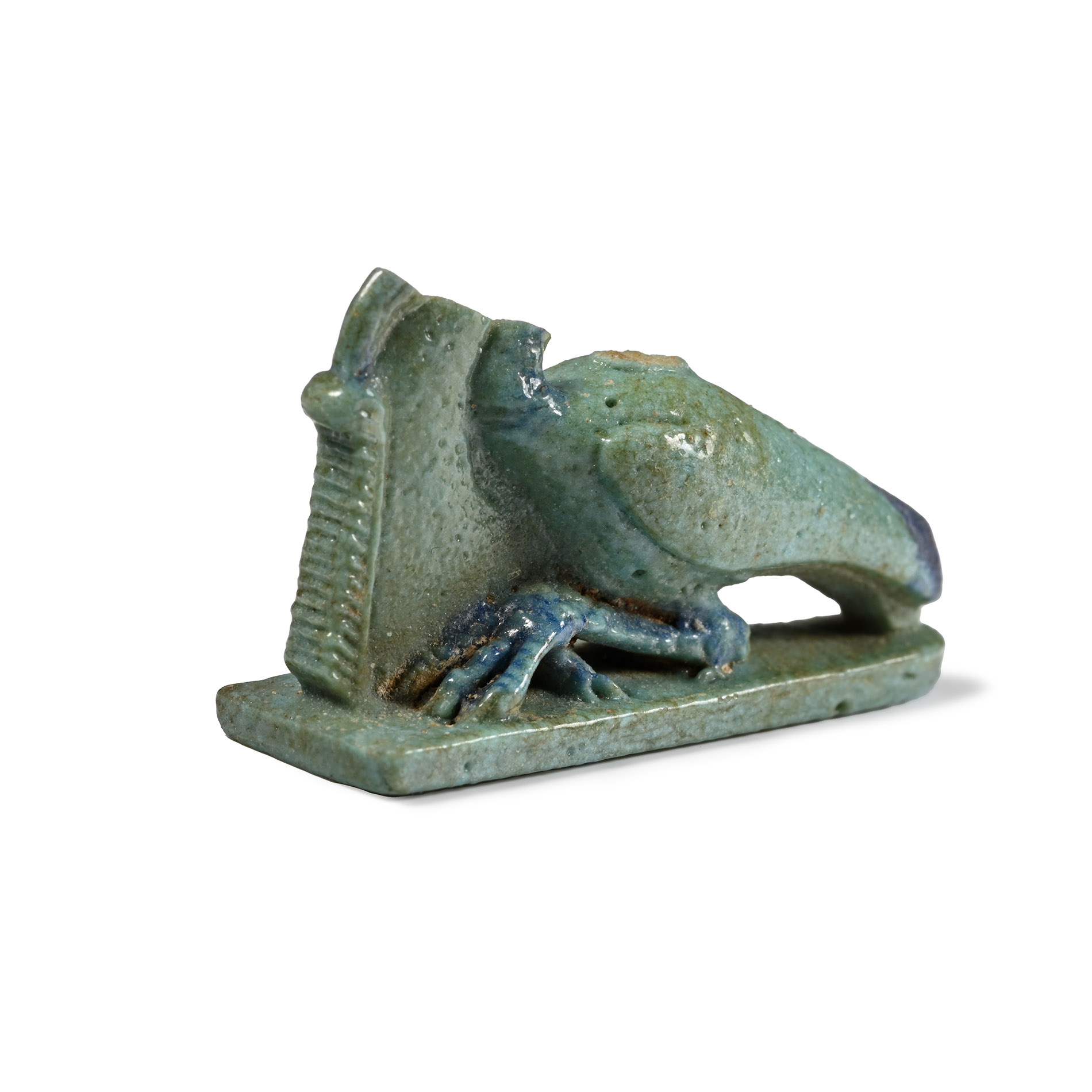
Egyptian Faience Amulet of an Ibis
LATE PERIOD, 664-332 B.C.
1 1/4 in. (3.54 grams, 31 mm).
An exquisitely modelled figure of a seated ibis on a trapezoidal-shaped plinth, with its beak resting on the slender feather of Maat; light turquoise glaze for the body, plinth, and feather; blue glaze for the tail feathers, feet and neck; head missing.
Provenancewith Bonhams, Knightsbridge, 3 October 2000, no.413.
Private collection, Europe.
Cf. Andrews, C., Amulets of Ancient Egypt, London, 1994, p.25 no. 21f, for a similar example.
FootnotesThe ibis was considered sacred to the god Thoth. It is likely that the popularity of amulets depicting an ibis resting its beak on the feather of Maat in the funerary sphere is connected to Thoth's role as the recorder of the final judgment of the deceased by the divine tribunal. This tribunal determined if the deceased had lived a virtuous life and could enter the Underworld. This was visually represented by the deceased's heart placed on scales with the feather of Maat; if the heart and feather balanced, eternity was assured.
CONDITIONTimeLine Auctions follows a vetting process to ensure the authenticity and legality of all items, reinforcing our commitment to integrity and responsible trading. Each antiquity, antique, and coin lot undergoes thorough examination by a vetting committee of at least ten external specialists, professional trade association members, scientists, and archaeologists: Our Vetting Process
AUCTIONS:
TimeLine is a leading auction house specialising in antiquities, ancient art, collectables, natural history, coins, medals, and books. Our auctions offer museums, collectors, historians, and enthusiasts the opportunity to acquire unique and historically significant pieces.
LOT 0485
Egyptian Faience Amulet of an Ibis
Estimate £500 - 700€580 - 810 (for guidance only)$680 - 950 (for guidance only)
-
.jpg)
Romano-Egyptian Terracotta Votive Figure of Eros
1st-2nd century A.D.Estimate: £4,000 - 6,000 (‡+bp*)
Opening Bid: £2,222
Depicted nude in a dynamic pose with his legs apart and the weight of the body upon his right leg, standing in front of a two storey structure, probably an oven; his left arm raised and right arm extended in front of his torso and resting on the edge of the structure; the oven painted pink at the top and white at the bottom with an offering receptacle at floor level. 232 grams, 15 cm
Ex Dr Daniel Marie Fouquet (1859-1914), Cairo. with Pierre Berge & Associes, Auction, Archaeology 29 November 2014, no.193. Accompanied by a French cultural export permit, no.161028. Accompanied by an academic report by Dr Raffaele D'Amato. Accompanied by a copy of the relevant pages in: Perdrizet, P., Les Terres Cuites Grecques d'Egypt de la Collection Fouquet, Nancy, 1921, where it is published. This lot has been checked against the Interpol Database of stolen works of art and is accompanied by search certificate no.12000-211884.
The image of the ‘Eros Baker’ is part of a wide production of Roman terracotta imitating Greek models, although in somewhat crude way. In the Roman age, designs tended to be commonplace and were often indifferent copies of Greek originals. However, the production of terracotta in Hellenistic Egypt continued without interruption and the most subjects of these votive statuettes (in this case probably a baker invoking the blessing of the god upon his activity) were religious, Eros being one of the favourites. -
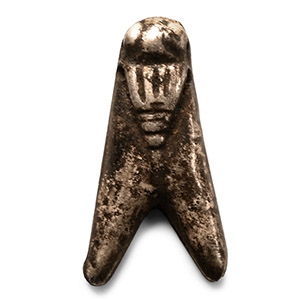
Egyptian Silver Fly Amulet
Late Period, 664-332 B.C.Sold for (Inc. bp): £124
Formed as a fly with long triangular wings and domed eyes. 0.84 grams, 16 mm
From an early 20th century collection.
Considering Egyptian artists often depicted fly whisks in the hands of pharaohs and high officials, one might assume that flies were simply a nuisance. However, the Egyptians held flies in high regard due to their quick speed, reactions, and persistence. Small fly amulets first appeared in burials during the Naqada II Period, c. 3200 B.C. These amulets grew in popularity, and the materials used to make them expanded during the New Kingdom. They are crafted from various materials such as gold, silver, lapis lazuli, carnelian, amethyst, faience, and bone. These amulets were thought to protect against insect bites and to ward off troublesome flying creatures through apotropaic magic. Some believe they may have even been intended to symbolise the fly’s fecundity. Additionally, pharaohs would bestow gold fly-shaped pendants as military awards to honour soldiers' bravery and fly-like persistence in battle. -
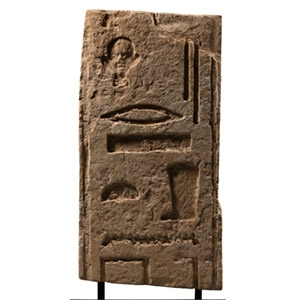
Egyptian Limestone Relief Fragment
Old Kingdom, 2686-2181 B.C.Sold for (Inc. bp): £3,380
Rectangular panel carved in sunk relief with vertical borders framing a portion of hieroglyphic inscription ...ḥry sštꜢ n..., '...keeper of secrets of...'. 6.79 kg total, 50.5 cm high including stand
Reputedly acquired by a private collector in 1936. Ex Ian Colverson Collection, UK (1940-2022). This lot has been checked against the Interpol Database of stolen works of art and is accompanied by search certificate number no.12196-222436.
The relief is most likely a fragment of a vertical inscription from a false door of an Old Kingdom tomb chapel. The complete inscription was probably an offering formula followed by a list of the tomb owner's titles. The 'keeper of secrets' is a priestly title indicating that one of his roles was as an embalmer.
