
Loading, please wait...
LOT 0501
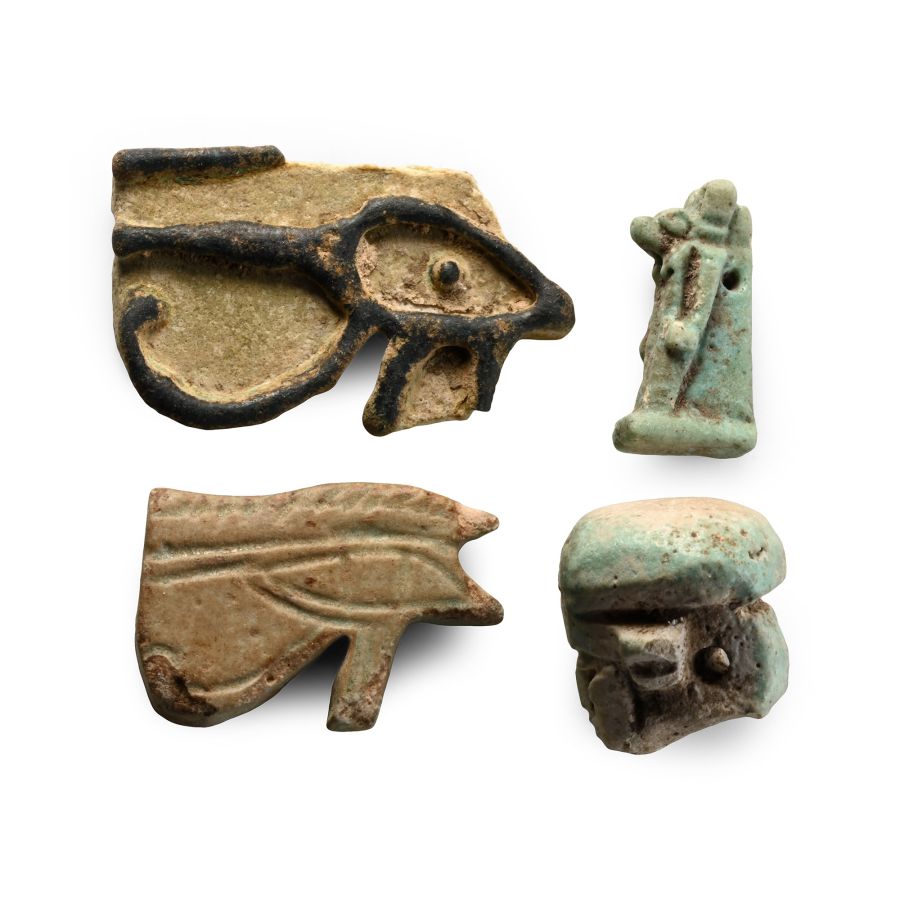
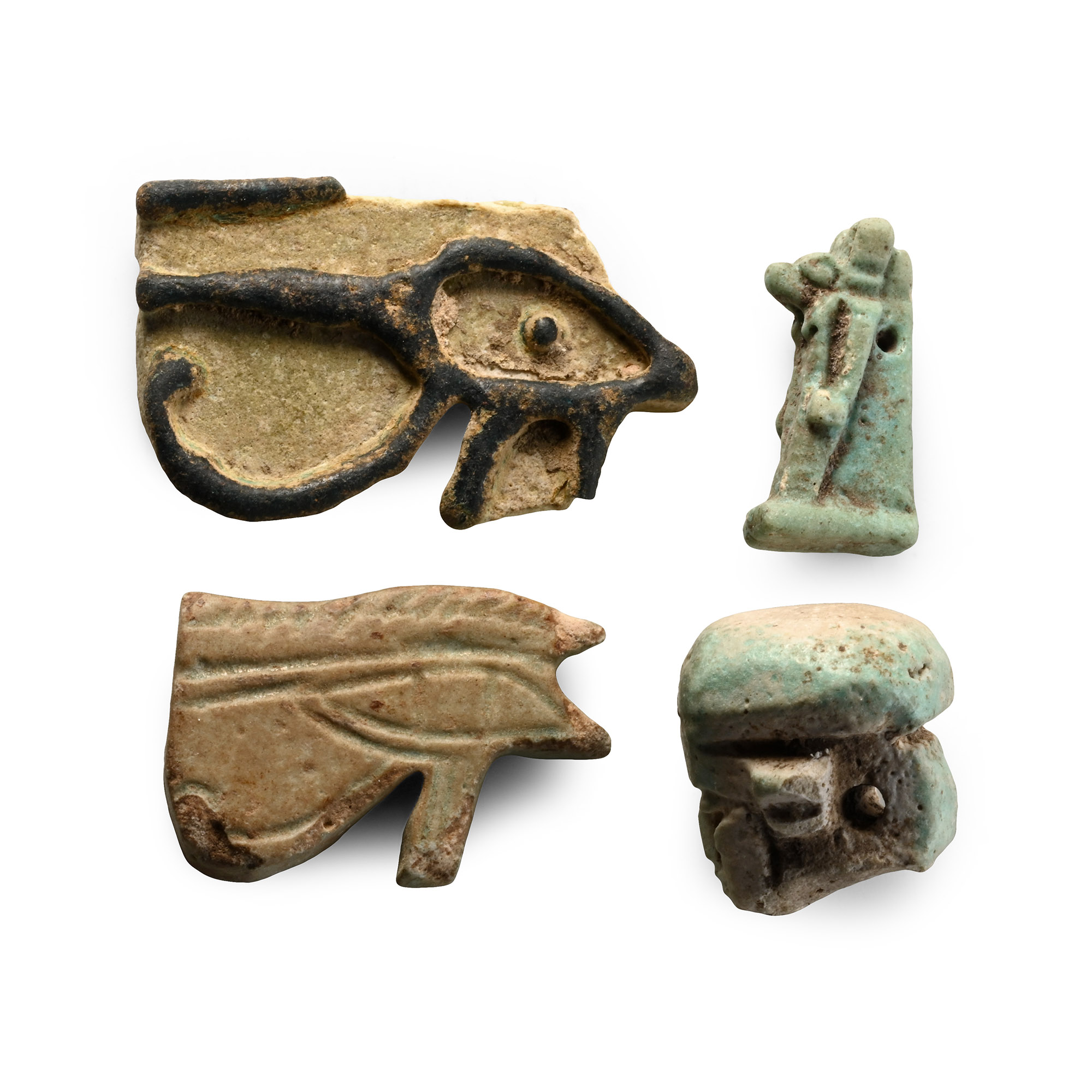
Egyptian Faience Amulet Group
MAINLY LATE PERIOD, 664-332 B.C.
3/4 - 1 1/8 in. (7.69 grams total, 18-30 mm).
Comprising two wedjat amulets, one Pataikos head amulet, and a striding Anubis amulet. [4, No Reserve]
ProvenanceFrom an important central London collection formed since the mid 1960s; thence by descent.
CONDITIONTimeLine Auctions follows a vetting process to ensure the authenticity and legality of all items, reinforcing our commitment to integrity and responsible trading. Each antiquity, antique, and coin lot undergoes thorough examination by a vetting committee of at least ten external specialists, professional trade association members, scientists, and archaeologists: Our Vetting Process
AUCTIONS:
TimeLine is a leading auction house specialising in antiquities, ancient art, collectables, natural history, coins, medals, and books. Our auctions offer museums, collectors, historians, and enthusiasts the opportunity to acquire unique and historically significant pieces.
-
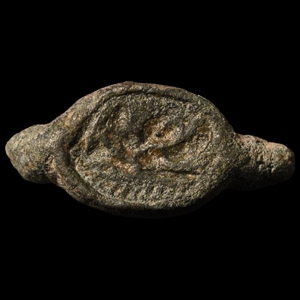
Phoenician Inscribed Bronze Scaraboid Seal
600-400 B.C.Estimate: £100 - 140 (+bp*)
Opening Bid: £40
With ribbed loop and ellipsoid face, gryphon motif. 10.9 grams, 26 mm wide
Ex London, UK, gentleman, 1990. This lot is accompanied by an illustrated lot declaration signed by the Head of the Antiquities Department, Dr Raffaele D'Amato. -
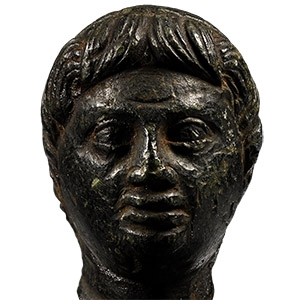
Egyptian Steatite Portrait of a Ptolemaic Prince
2nd-1st century B.C.Estimate: £2,500 - 3,500 (‡+bp*)
Opening Bid: £1,350
With a round face, large eyes, a narrow nose that broadens at the end, and full lips downturned at the corners; the forehead with a distinctive deep furrow above the brow; a narrow, twisted diadem encircling his wavy hair; mounted on a custom-made display stand. 84 grams total, 10 cm including stand
Private collection, Bern, Switzerland. with Galerie Rhéa, Zurich, Switzerland. This lot has been checked against the Interpol Database of stolen works of art and is accompanied by a search certificate number no.12631-236408.
The Greek hairstyle is a characteristic feature of Ptolemaic royal portraiture, as is the twisted diadem - a Greek interpretation of the Egyptian headband (the sšd) - which appears on several portrait heads of Ptolemaic boy-kings and princes. The distinctive furrow is intriguing, as it contrasts with the typically blemish-free physiognomy of most Ptolemaic royal sculpture. However, a similar furrow can be seen on the portrait head of a provincial governor from Dendera, dated to the 2nd century B.C. (Bothmer, B.V., Egyptian Sculpture of the Late Period 700 B.C. to A.D. 100, New York, 1960, pp. 144-143, pl. 112, nos. 301-302), which may indicate an artistic trend employed in high-status sculpture at that time. It has been suggested that small royal portrait heads, such as this example, may have served as votives. The lack of an Egyptian-style back pillar on this and similar pieces supports the possibility that they were inserted into statues made of different materials (Ashton, S.-A., Ptolemaic Royal Sculpture from Egypt, BAR International Series 923, Oxford, 2001, p.12). -
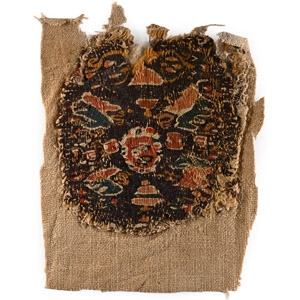
Egyptian Coptic Textile Fragment
Circa 4th-5th century A.D.Sold for (Inc. bp): £143
Orbiculus with a dark blue background, a stylised cup on the vertical axis, rendered in yellow, red and green wool, flanked by stylised plants or animals, while the lower part of the circle features branches flanked by leaves in pink, white, green and yellow; made of polychrome wool, with coarse linen and red, yellow, green and blue wool weft, tapestry woven. 38 grams total including package, 15.2 cm
Acquired 1970s-1996. Property of a North American collector. London collection, 2016.
The embroidery belonged to a tunic. These fabrics were of great decorative finesse, displaying an unusual and extremely well-preserved color palette. The plant designs recall Iranian motifs.
