
Loading, please wait...
LOT 0496
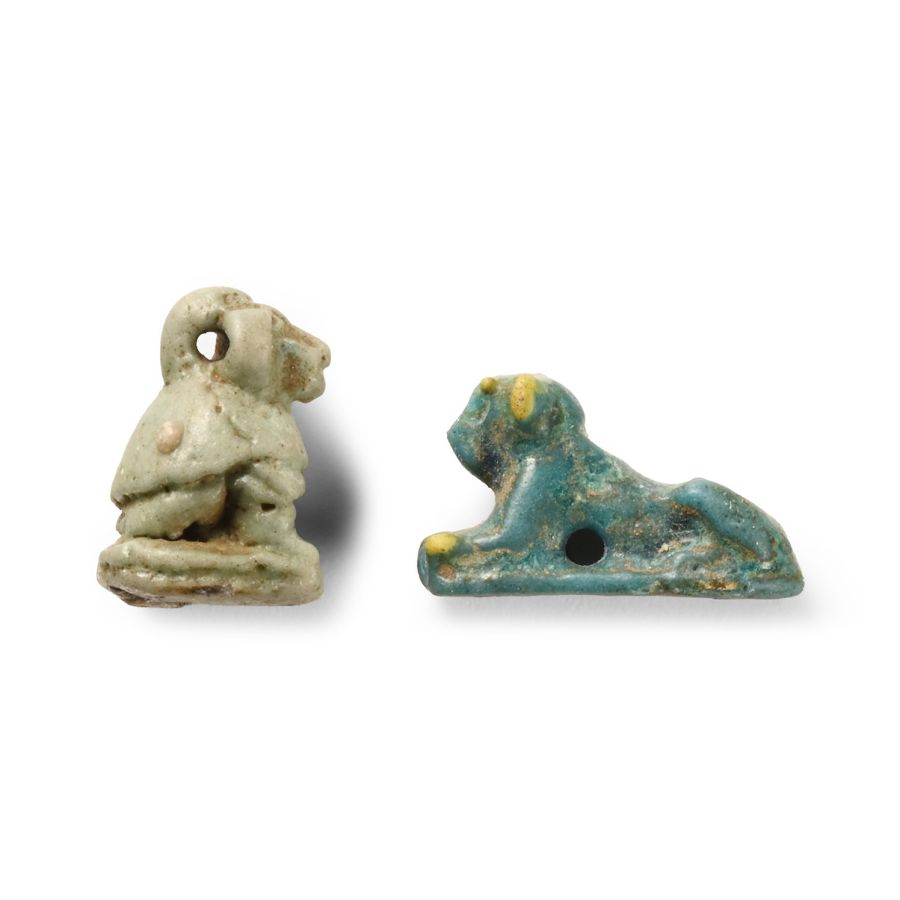
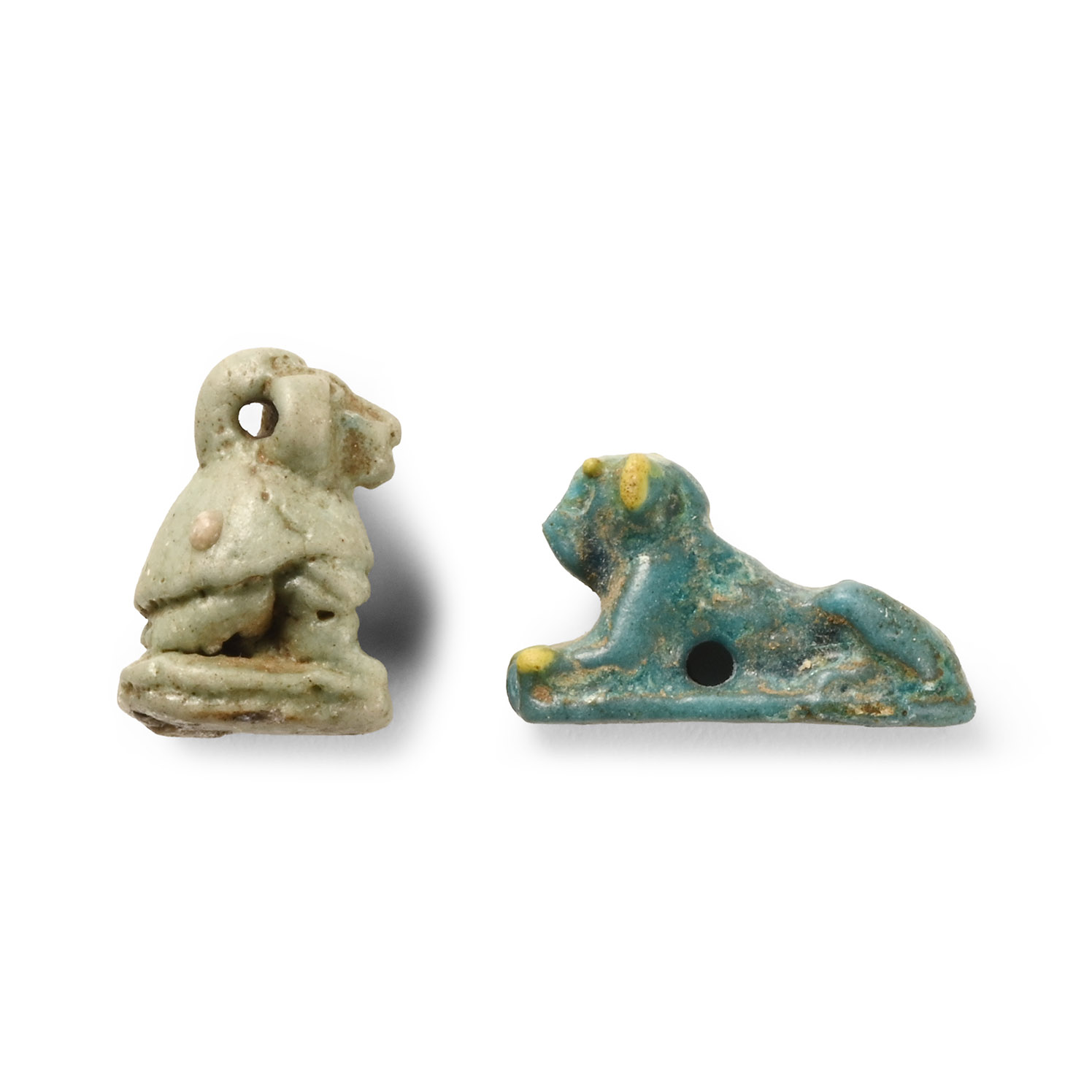
Egyptian Faience Amulet Group
LATE PERIOD, 664-332 B.C.
1/2 - 5/8 in. (1.30 grams total, 12-15 mm).
Comprising a resting lioness on a rectangular base and the god Thoth in baboon form. [2, No Reserve]
ProvenanceFrom the collection of Doctor Girard, a collector for over 60 years.
with Hotel des Ventes de Clermont-Ferrand, 22 May 2017.
Property of a French collector.
Throughout ancient Egyptian mythology, lioness goddesses played a significant role in the religious beliefs of the people. These goddesses, including Sekhmet, Bastet, and Wadjet were revered as powerful and fierce protectors. Their presence was believed to ward off evil and safeguard the people from harm.
The baboon was an animal manifestation of the god Thoth. Thoth was revered for his association with knowledge, writing, and healing. It is likely that the popularity of Thoth amulets as mummy amulets is linked to his role as the recorder of the final judgment, which determined whether the deceased had lived a life of virtue.
TimeLine Auctions follows a vetting process to ensure the authenticity and legality of all items, reinforcing our commitment to integrity and responsible trading. Each antiquity, antique, and coin lot undergoes thorough examination by a vetting committee of at least ten external specialists, professional trade association members, scientists, and archaeologists: Our Vetting Process
AUCTIONS:
TimeLine is a leading auction house specialising in antiquities, ancient art, collectables, natural history, coins, medals, and books. Our auctions offer museums, collectors, historians, and enthusiasts the opportunity to acquire unique and historically significant pieces.
-
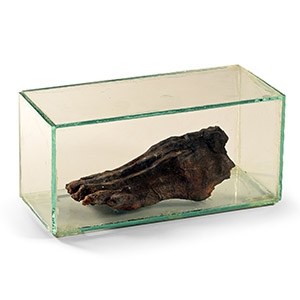
Foot of an Egyptian Mummy
Late Period, 664-332 B.C.Sold for (Inc. bp): £3,640
Preserved left foot from a mummy with bones (calcaneus and navicular) visible at the rear, phalanges; mounted in a sturdy glass display case. 753 grams total, 21.2 x 9.2 x 10 cm including box
Acquired from a licenced dealer in Cairo, Egypt, prior to 1975. On loan to Walton Primary School as an educational exhibit circa 2001. Property of a private collector, Walton on the Naze, UK.
Please note that this item is for collection only. -
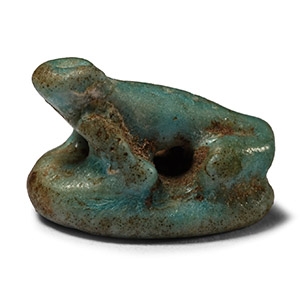
Egyptian Faience Frog Scarab
Ptolemaic Period, circa 300 B.C.Estimate: £500 - 700 (‡+bp*)
Opening Bid: £250
Discoid base with crouching frog pierced longitudinally for threading; underside with a solar disc and unidentified symbol. 0.56 grams, 13 mm
Ex R. Liechti (1934-2010) Geneva, Switzerland, formed between 1950-1990s. Accompanied by a copy of an old collection inventory note. -
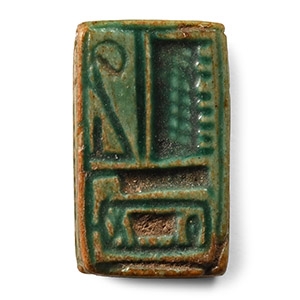
Egyptian Faience Block Bead of Thutmose III
New Kingdom, 18th Dynasty, circa 1504-1452 B.C.Sold for (Inc. bp): £442
With impressed hieroglyphs on all four faces, two sides giving the throne name of Thutmose III (Men-kheper-Re), the others mentioning the god Amun. 1.1 grams, 12 mm
From the old collection of Emile Bouillon Bey, c. 1880. Ex Gaston Maspero archaeological fund. Property of a French collector.
Thutmose III was a renowned warrior king widely revered even centuries after his reign.
