
Loading, please wait...
_900x900.jpg "Egyptian Early Dynastic Gneiss Bowl")
_200x200.jpg "Egyptian Early Dynastic Gneiss Bowl")
.jpg "Egyptian Early Dynastic Gneiss Bowl")
LOT 0028
Egyptian Early Dynastic Gneiss Bowl
2ND-3RD DYNASTY, 2860-2640 B.C.
8 5/8 in. (1.4 kg, 22 cm wide).
Material also known as 'Chephren Diorite' carved with a flattened base and flaring, slightly convex sides with inward curving rim bevelled on the inside, single groove encircling the tondo; repaired.
Provenancewith Sotheby's, 17 December 1997, no.34.
Ex Rupert Wace Ancient Art, London, 1998.
Ex AS collection, London, UK.
Accompanied by a copy of the Rupert Wace Ancient Art invoice.
This lot has been checked against the Interpol Database of stolen works of art and is accompanied by search certificate no.12129-214106.
Cf. Flinders Petrie, W. M., Stone and Metal Vases, Warminster, 1977, pl XXII, nos. 378-9, for similar; Guidotti, M.C., Vasi dall’epoca protodinastica al Nuovo Regno, Museo Egizio di Firenze, Rome, 1991, p.79 (inv. no.3541), for a a comparable example with the same interior detailing of the rim.
CONDITIONTimeLine Auctions follows a vetting process to ensure the authenticity and legality of all items, reinforcing our commitment to integrity and responsible trading. Each antiquity, antique, and coin lot undergoes thorough examination by a vetting committee of at least ten external specialists, professional trade association members, scientists, and archaeologists: Our Vetting Process
AUCTIONS:
TimeLine is a leading auction house specialising in antiquities, ancient art, collectables, natural history, coins, medals, and books. Our auctions offer museums, collectors, historians, and enthusiasts the opportunity to acquire unique and historically significant pieces.
LOT 0028
Egyptian Early Dynastic Gneiss Bowl
Estimate £3,000 - 4,000€3,480 - 4,640 (for guidance only)$4,050 - 5,400 (for guidance only)
-
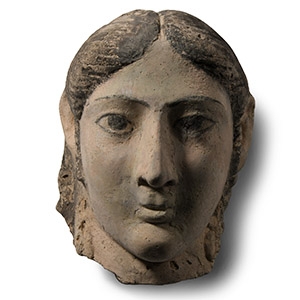
Egyptian Painted Plaster Mummy Mask of a Lady
Roman Period, 30 B.C.-323 A.D.Sold for (Inc. bp): £1,820
Hollow-formed with finely modelled facial details, dark hair parted in the middle and drawn back to each side with a ringlet before each ear; narrow brow with painted eyebrows, lentoid eyes with dark irises; narrow nose and small pursed lips; impressions of bandaging on the rear where attached to mummy. 777 grams, 20 cm high
From a London, UK, collection. Formerly with a central London auction house. -
.jpg)
Egyptian Faience Beaded Mummy Mask with Sons of Horus
Ptolemaic Period, 332-31 B.C.Sold for (Inc. bp): £445
Restrung netted beadwork panel of annular and tubular glazed composition beads in blues, greens, black, cream and red-brown colours, depicting a mummy face mask with false beard, a scarab with extended wings below, the 'Four Sons of Horus’ beneath the scarab, joined together with areas of open netting of tubular beads; mounted in a glazed frame with papyrus backing. 127 grams, 28 cm
Previously with Mariaud de Serres, Paris, France. From a Paris gallery.
The Four Sons of Horus were deities responsible for protecting the internal organs of the deceased. The human-headed Imsety protected the liver, the baboon-headed Hapy protected the lungs, the jackal-headed Duamutef protected the stomach, and the falcon-headed Qebehsenuef protected the intestines. -
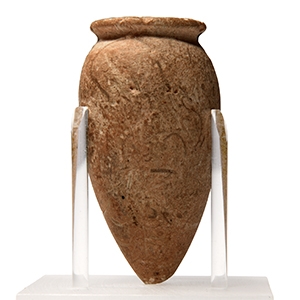
Egyptian Stone Alabastron
Late Old Kingdom, circa 2300 B.C.Estimate: £300 - 400 (‡+bp*)
Opening Bid: £150
The body with rounded shoulders, convex outer face and pointed base, everted rim; accompanied by a custom-made display base. 34.2 grams, 48 mm high (48.9 grams, 55 mm including stand)
Acquired in Europe before 1994. European collection.
