
Loading, please wait...
LOT 0424
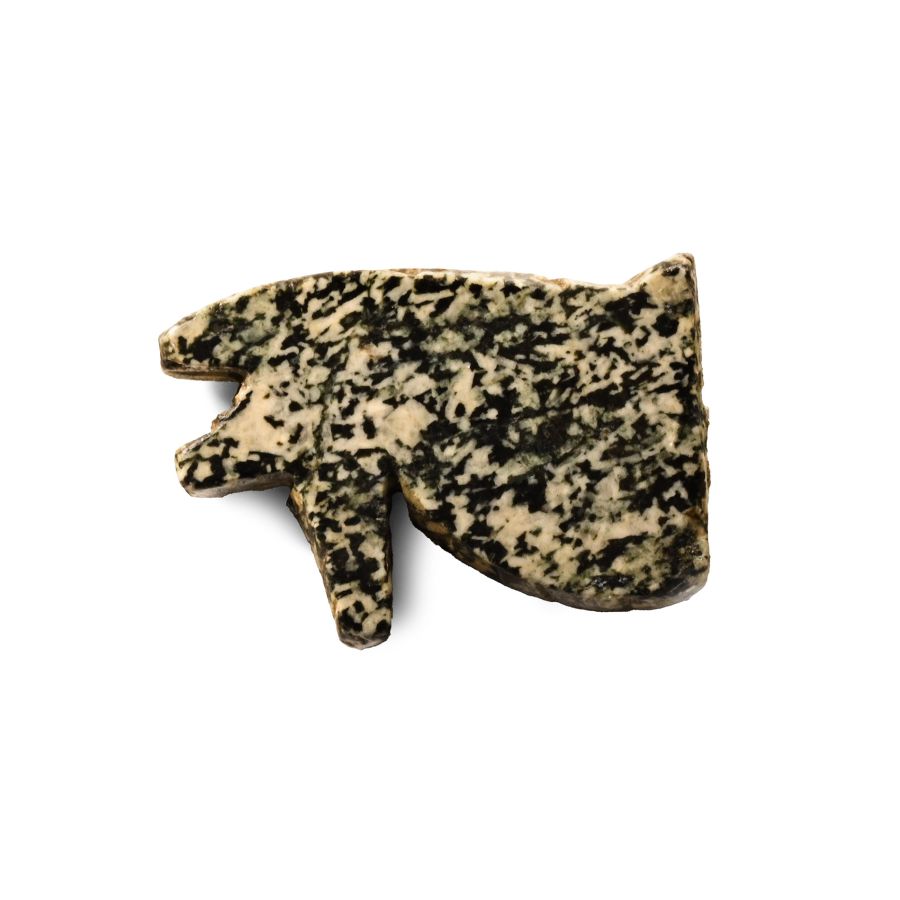
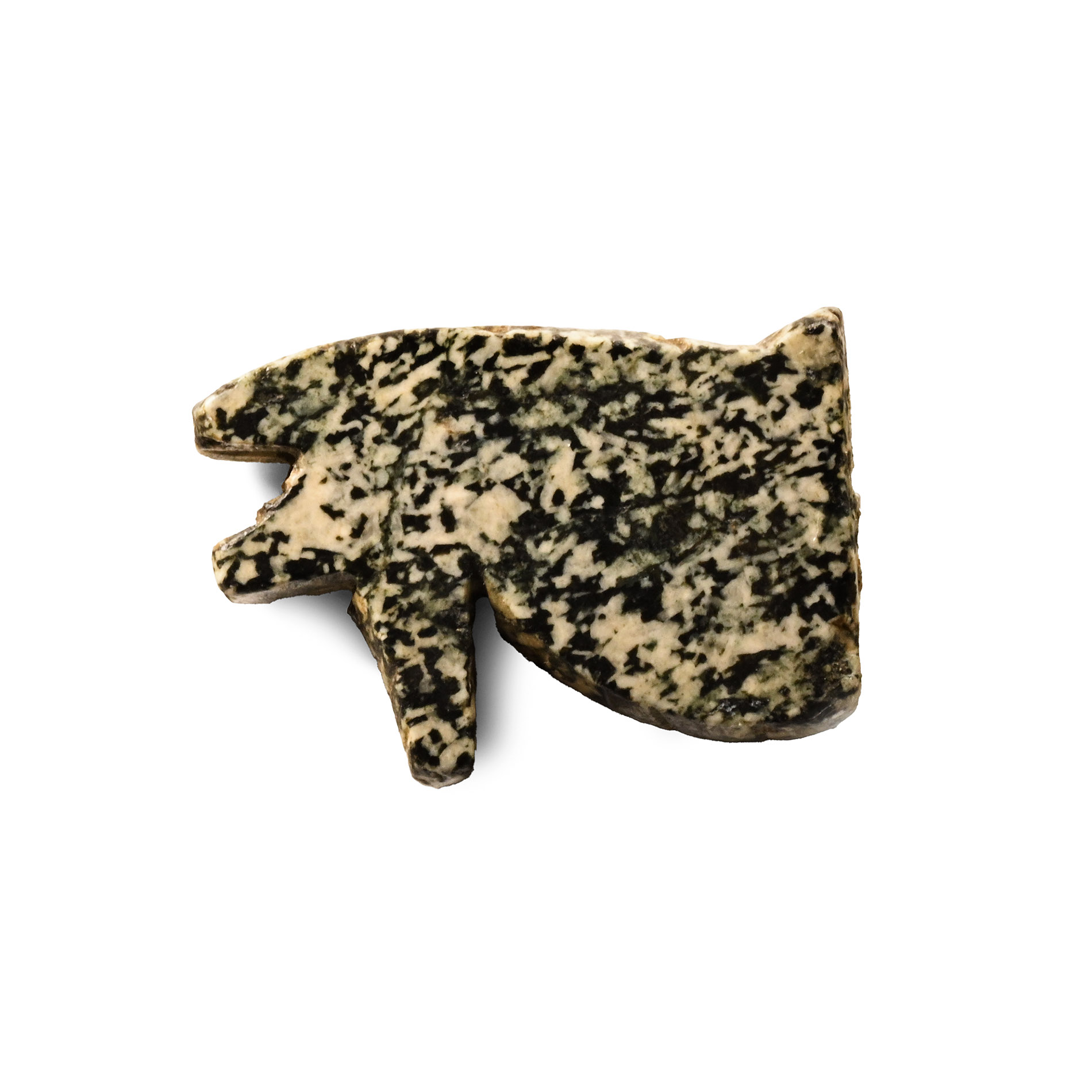
Egyptian Diorite Wedjat Eye Amulet
LATE PERIOD, 664-332 B.C.
2 1/8 in. (7.55 grams, 30 mm).
With transverse piercing for suspension. [No Reserve]
ProvenanceFrom the old Belfort collection, expert Jean Roudillon.
Ex Hotel des Ventes de Belfort.
Property of a French collector.
Cf. Andrews, C., Amulets of Ancient Egypt, London, 1994, pl.46(g); Tinius, I., Altägypten in Braunschweig. Die Sammlungen des Herzog Anton Ulrich-Museums und des Städtischen Museums, Wiesbaden, 2011, p.161, no. 305, for a similar example.
FootnotesThe wedjat-eye amulet represents the healed eye of the god Horus, featuring both human and falcon elements. The name wedjat in ancient Egyptian means ‘the one that is sound.’ According to Egyptian mythology, Horus' eye was wounded or taken by the god Seth and restored by Thoth. The wedjat-eye amulet was thought to protect its wearer and bestow the power of recovery and regeneration onto them. As such, it was used by both the living and the dead.
CONDITIONTimeLine Auctions follows a vetting process to ensure the authenticity and legality of all items, reinforcing our commitment to integrity and responsible trading. Each antiquity, antique, and coin lot undergoes thorough examination by a vetting committee of at least ten external specialists, professional trade association members, scientists, and archaeologists: Our Vetting Process
AUCTIONS:
TimeLine is a leading auction house specialising in antiquities, ancient art, collectables, natural history, coins, medals, and books. Our auctions offer museums, collectors, historians, and enthusiasts the opportunity to acquire unique and historically significant pieces.
-
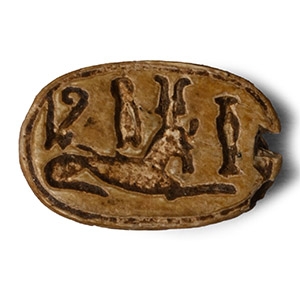
Egyptian Steatite Scarab
1st millennium B.C.Estimate: £500 - 700 (‡+bp*)
Opening Bid: £250
With detailed carapace and mouth, hieroglyphs to the underside depicting a pharaoh-headed recumbent lion, with hes-vase in front and the crowns of Lower and Upper Egypt behind. 0.80 grams, 12 mm
Ex R. Liechti (1934-2010) Geneva, Switzerland, formed between 1950-1990s. -
.jpg)
Egyptian Stone Head
Coptic, circa 6th century A.D.Sold for (Inc. bp): £975
Stylised face with broad surrounding hood with corrugated texture to the outer face; lentoid face with reserved almond eyes, D-section nose and slit mouth; with arc of drilled holes around the inner edge of the hood to accept inset ornaments, more holes to the forehead, eyes, cheeks and chin; mounted on a custom-made stand. 2.92 kg total, 29 cm wide including stand
From a collection acquired on the UK art market from various auction houses and collections mostly before 2000. From an important Cambridgeshire estate; thence by descent. -
.jpg)
Egyptian Funerary Cone for Djedher
1st millennium B.C.Sold for (Inc. bp): £2,470
Columnar terracotta cone with flattened base, five horizontal bands of reserved hieroglyphic text giving the dedication: 'Djedher, true of voice, son of Ankhhor who is the son of the hereditary noble, great mayor, great one of the Meshwesh (an ancient Libyan tribe), mayor, overseer of the priests of Banebdju, Djedher, his mother, mistress of the house, Shepensepedet, true of voice.' 895 grams, 16.5 cm
Acquired on the German art market, 1989-1995. with The Museum Gallery, 19 Bury Place, London, WC1, UK, 1998-2003. Property of a London based academic, 2003-present.
Funerary cones were used to decorate the facades of tombs. The 'tail' was pushed into the soft plaster coating so that only the disc was visible. This cone belongs to Djedher, whose tomb is likely to be in the Asasif region of the Theban necropolis, where other examples of his funerary cones have been found.
