
Loading, please wait...
LOT 0556
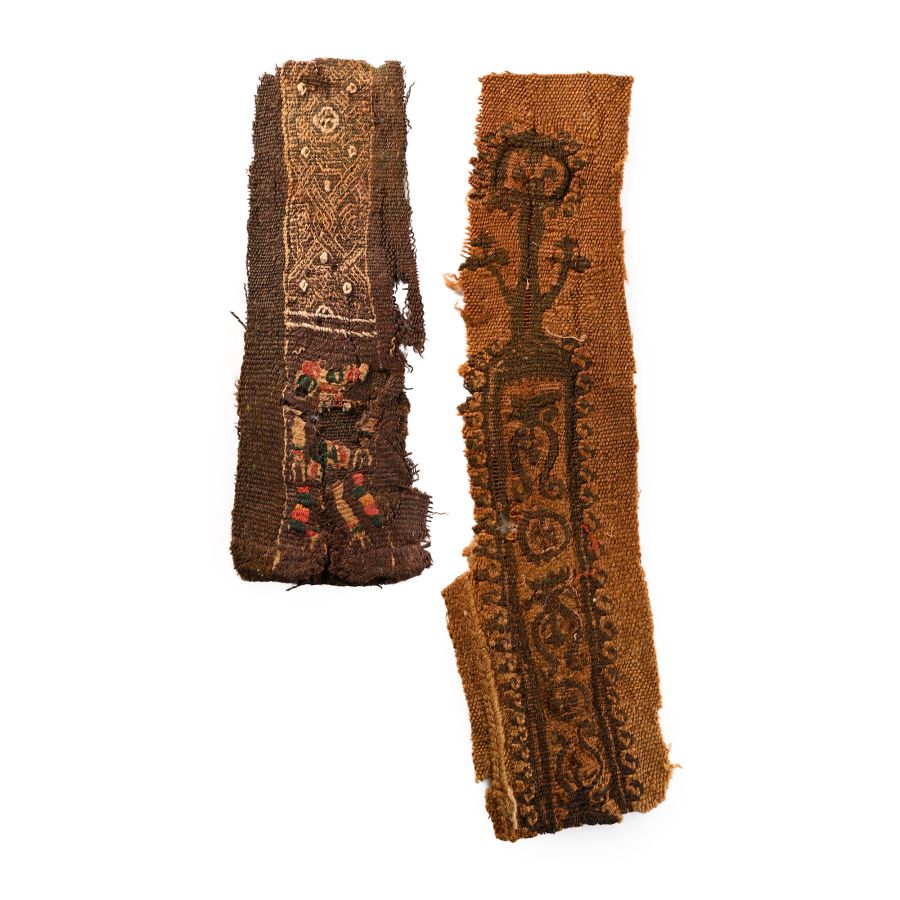
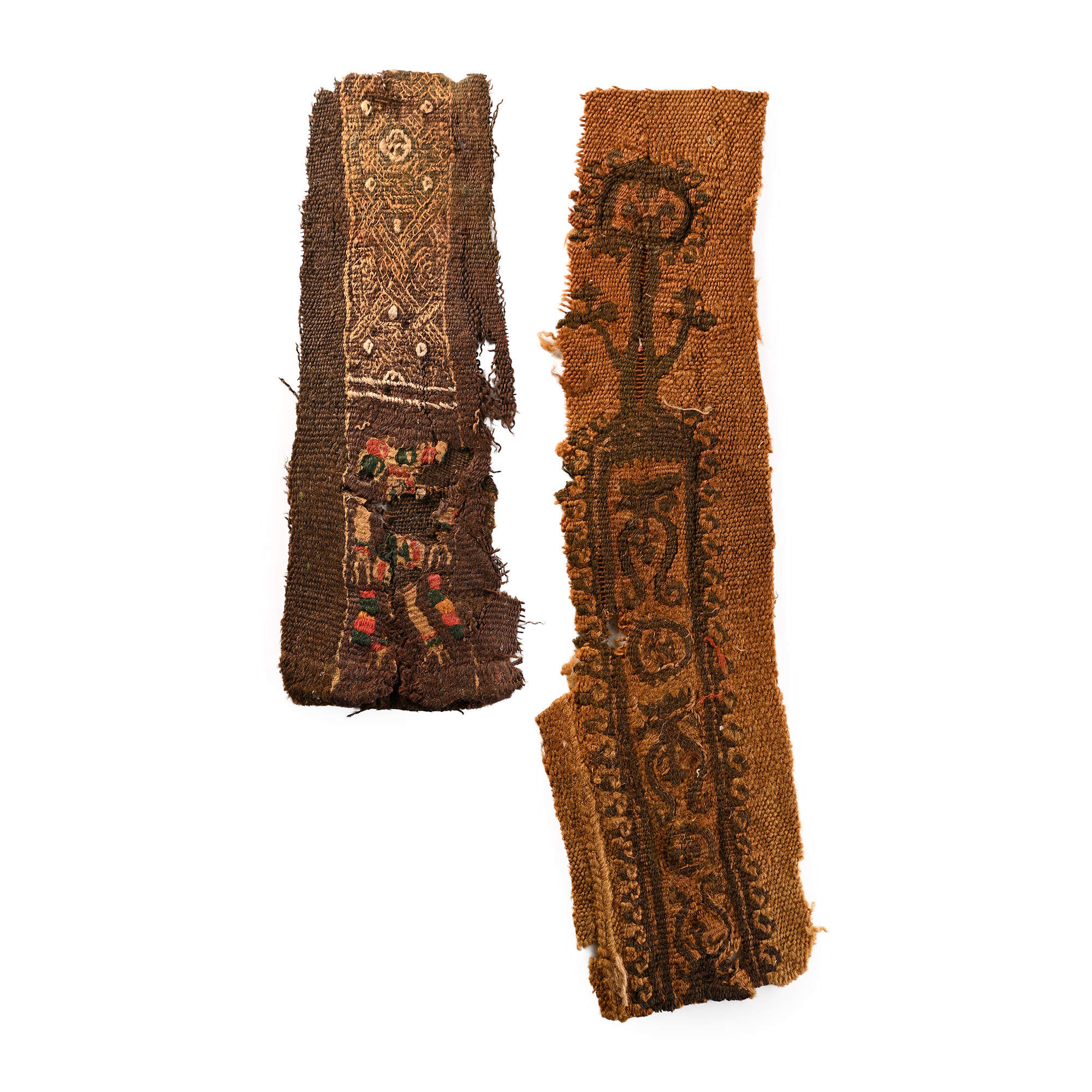
Egyptian Coptic Textile Fragment Group
CIRCA 5TH-6TH CENTURY A.D.
6 - 8 5/8 in. (41 grams total including package, 15.5-22 cm).
Comprising: a decorative tunic stripe (clavus) in purple wool over coarse linen, S-twist tapestry, embroidered with floral medallions and stylised plants, borders decorated with meanders; fragment of a segmentum, in yellow, red green and brown wool, S-twist tapestry, divided in two sections, embroidered with a stylised human figure and geometric interlacing. [2, No Reserve]
ProvenanceAcquired 1970s-1996.
Property of a North American collector.
London collection, 2016.
Cf. Gayet, M. Al., Le Costume en Egypte, du IIIe au XIIIe Siecle, Paris, 1900, no. 104, p.134, for similar style of clavus; De Moor, A., 'Radiocarbon dating of ancient textiles.State of research' in De Moor, A., Fluck, C., Methods of dating ancient textiles of the 1st Millennium AD from Egypt and neighbouring countries, Tielt, 2007, pp.99-111, fig.4.
CONDITIONTimeLine Auctions follows a vetting process to ensure the authenticity and legality of all items, reinforcing our commitment to integrity and responsible trading. Each antiquity, antique, and coin lot undergoes thorough examination by a vetting committee of at least ten external specialists, professional trade association members, scientists, and archaeologists: Our Vetting Process
AUCTIONS:
TimeLine is a leading auction house specialising in antiquities, ancient art, collectables, natural history, coins, medals, and books. Our auctions offer museums, collectors, historians, and enthusiasts the opportunity to acquire unique and historically significant pieces.
-
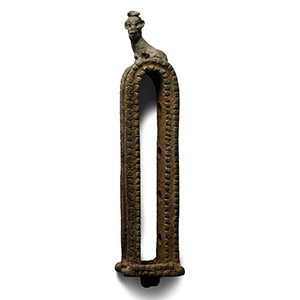
Romano-Egyptian Bronze Sistrum Fragment with Goat
2nd-3rd century A.D.Sold for (Inc. bp): £117
Comprising a slender U-shaped body with beaded border, the sides with four pairs of piercings to accept separate crossbars, an applied goat resting atop the body. 73.7 grams, 10.8 cm
Ex Paul Munro-Walker, Bournemouth, Hampshire, UK, 1980s. From a UK collection since before 1990.
When the sistrum was shaken, copper or bronze discs on its crossbars would rattle against each other, creating a clashing sound. The ancient Egyptian name for the sistrum, sesheshet, is onomatopoeic and mimics this sound. -
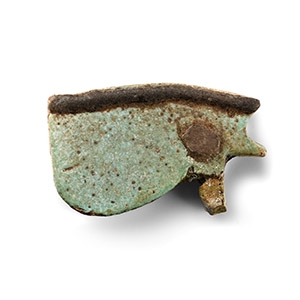
Egyptian Eye of Horus Amulet
Late Period, 664-332 B.C.Sold for (Inc. bp): £78
Wedjat amuletic bead with applied black detailing to the pupil and brow. 4 grams, 30.8 mm
with Archaeologia, Switzerland, before 1983. Ex private North American collection. London private collection, 2016. -
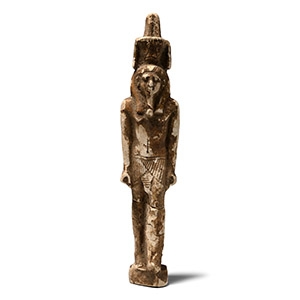
Egyptian Faience Nefertem Statuette with Hieroglyphs
Late-Ptolemaic Period, circa 664-30 B.C.Sold for (Inc. bp): £468
Presented in a striding pose with his left leg forward and his arms at his sides; wearing his emblem, the lotus-flower headdress from which two plumes emerge, and a menat on each side; dorsal pillar with hieroglyphs, beginning with the incantation: "Words spoken by Nefertum, son of Sekhmet...." 42.8 grams, 11.6 cm
From the collection of a gentleman, acquired on the London art market in the 1990s.
Nefertum is usually depicted as a young man wearing a headdress with a lotus flower or a crown featuring the flower. The god is often linked to beauty, healing, and the lotus flower, with his cult connected to the royal family and the cycle of rebirth. Nefertum’s imagery and symbolism associate him with themes of creation, renewal, and the sun; he symbolises the first sunlight and the pleasant scent of the Egyptian blue lotus flower, emerging from the primal waters within an Egyptian blue water lily.
