
Loading, please wait...
LOT 0576
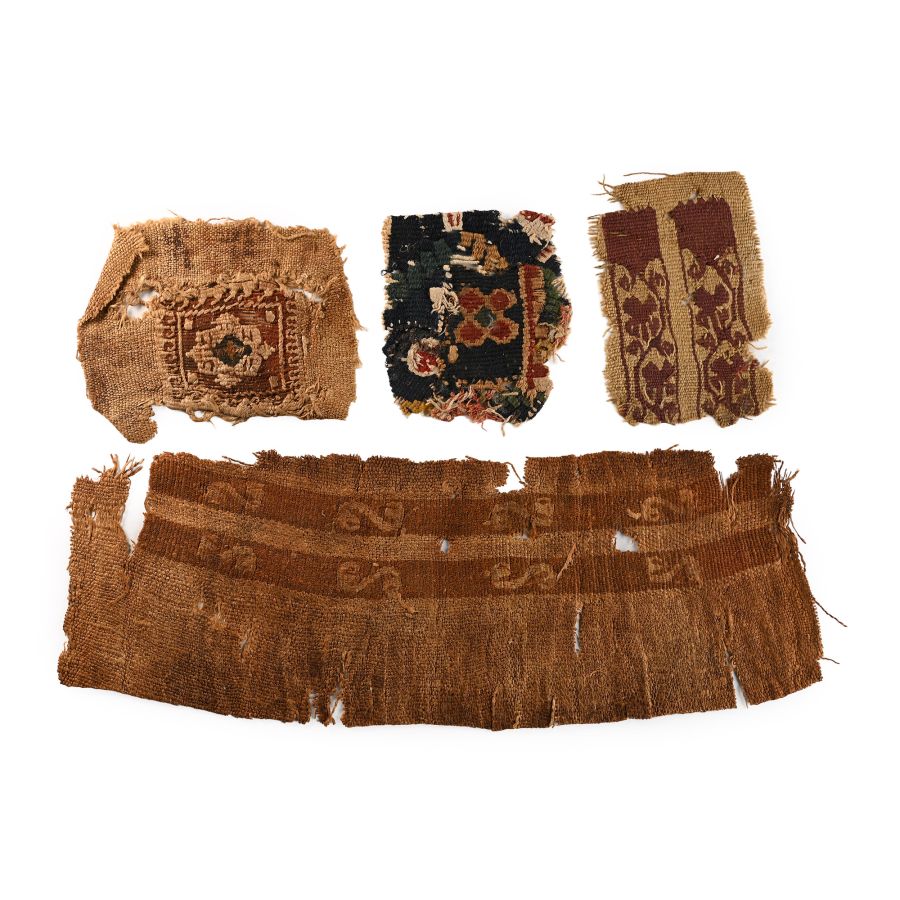
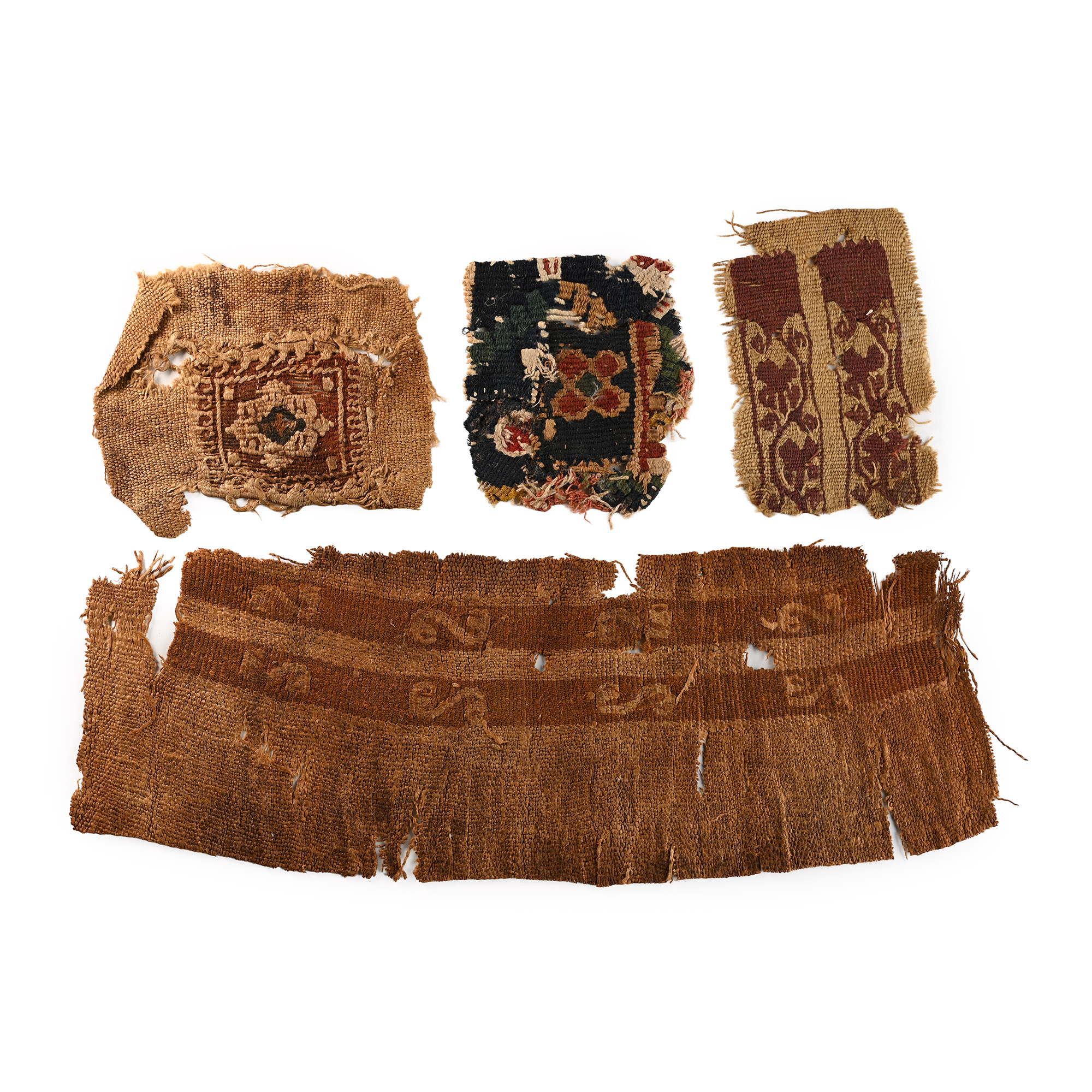
Egyptian Coptic Textile Fragment Group
CIRCA 4TH-5TH CENTURY A.D.
2 3/4 - 9 5/8 in. (59 grams total including package, 7-24.5 cm).
Comprising: a fragment of a double segmenta from the sleeve of a tunic in purple wool on linen, embroidered with vegetal motifs; the fragment of a double segmenta from the hem of a cloak in brown wool on linen, embroidered with S pattern; a tablion with central geometric motif and border embroidered with meanders; a fragment of tapestry in yellow, green and red wool, S torsion, embroidered with floral patterns. [4, No Reserve]
ProvenanceAcquired 1970s-1996.
Property of a North American collector.
London collection, 2016.
Cf. Del Francia Barocas, L., Antinoe, Cent’anni dopo, catalogo della mostra, Firenze, Palazzo Medici Riccardi, 10 Luglio – 1 novembre 1998, p.83, for similar textiles.
FootnotesThe fragments are decorative parts of tunics and cloaks. These are fabrics of great decorative finesse, with some elements displaying an unusual and extremely well-preserved color palette. The plant designs recall Iranian motifs.
CONDITIONTimeLine Auctions follows a vetting process to ensure the authenticity and legality of all items, reinforcing our commitment to integrity and responsible trading. Each antiquity, antique, and coin lot undergoes thorough examination by a vetting committee of at least ten external specialists, professional trade association members, scientists, and archaeologists: Our Vetting Process
AUCTIONS:
TimeLine is a leading auction house specialising in antiquities, ancient art, collectables, natural history, coins, medals, and books. Our auctions offer museums, collectors, historians, and enthusiasts the opportunity to acquire unique and historically significant pieces.
-
.jpg)
Egyptian Bronze Head of a Cat
Late-Ptolemaic Period, 664-30 B.C.Sold for (Inc. bp): £1,820
The head of goddess Bastet modelled in the round with alert ears and eyes, ears pierced; hollow-formed. 40.4 grams, 33.6 mm high
Acquired in the mid 1990s. Private collection, Switzerland, thence by descent. Private collection, since the late 1990s.
The feline's pierced ears likely once held earrings or other ornaments. It was probably attached to a statuette of a cat, whose body may have been crafted from wood. The cat was sacred to Bastet, a protective mother goddess and the daughter of the sun god Re. Amulets provided the wearer with the goddess's protection. Her name means ‘she of the bast [ointment jar],’ which may have contained a substance favoured by or exclusive to royalty. Originally, Bastet was depicted as a woman with the head of a lioness, but by the late New Kingdom, she was typically shown with a cat's head. She is sometimes portrayed with kittens, emphasising her maternal role as a fierce protector of her offspring. -
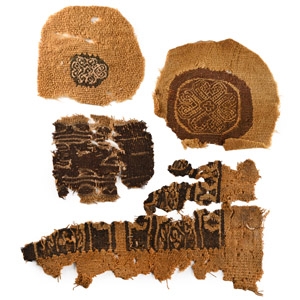
Egyptian Coptic Textile Fragment Group
Circa 5th-6th century A.D.Sold for (Inc. bp): £130
Comprising a fragment of a clavus in white and purple linen and wool, S torsion, the central scene representing a dancer; a small fragment of a double segmenta, ornamented with vegetal embroidery; two orbiculi, one embroidered with a flower inside a rondo and with a cross in the centre, the other with a simple vegetal ornament. 40 grams total including package, 7.2-15.7 cm
Acquired 1970s-1996. Property of a North American collector. London collection, 2016.
The segmentum with the dancer was probably part of the vertical clavus of a tunic; it is highly probable that the embroidery refers to the Dionysian cycle, with dancers, animals and probably, in the missing parts, hunters. -
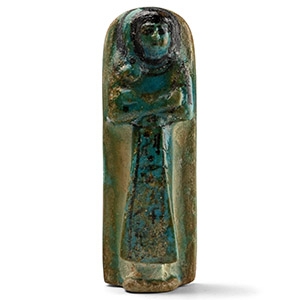
Egyptian Turquoise Faience Shabti of Prince Khaemwaset
New Kingdom, Ramesside Period, 19th Dynasty, 1282-1225 B.C.Estimate: £8,000 - 10,000 (+bp*)
Opening Bid: £3,500
Wearing daily dress and carrying agricultural implements, with dark blue details including his short wig with side-lock, designating him as a Sem-priest of Ptah at Memphis, the text on the kilt naming him as 'Sem-priest and King's son Khaemwaset'; with round-topped back support, the reverse with two columns of hieroglyphs with part of the shabti formula: "He says: O shabti, if one counts, if one is reckoned to do all the works that are to be done there in the God’s land—now indeed obstacles are implanted therewith—as a man at his duties, ‘Here I am,’ you shall say when you are counted off to cultivate the fields, transport by boat the sand of the east to the west and vice versa; ‘Here I am,’ you shall say". 284 grams, 15.1 cm
With Barakat, Beverly Hills: reputed to be from the Omar Pasha Sultan collection, (1806-1871) but unpublished in the 1929 catalogue of the collection, nor in Aubert's 1976 article on the shabtis in the collection. Bonhams, London, 1 May 2013, no.282. Accompanied by copies of the relevant Bonhams catalogue pages. Accompanied by an academic report by Egyptologist Paul Whelan. This lot has been checked against the Interpol Database of stolen works of art and is accompanied by search certificate number no.12938-243536.
Prince Khaemwaset was the fourth-ranked son of Ramesses II and the second born to Queen Isetnofret. More is known about Khaemwaset than any other son of Ramesses II, attested by over 150 objects, ranging from statues to temple reliefs. He is traditionally regarded as the “first Egyptologist” for his restoration of monuments belonging to earlier kings, including the pyramids at Giza and Saqqara. Recent reassessment, however, suggests that some of these activities involved dismantling parts of ancient structures for reuse in his father’s temple constructions.
