
Loading, please wait...
LOT 0429
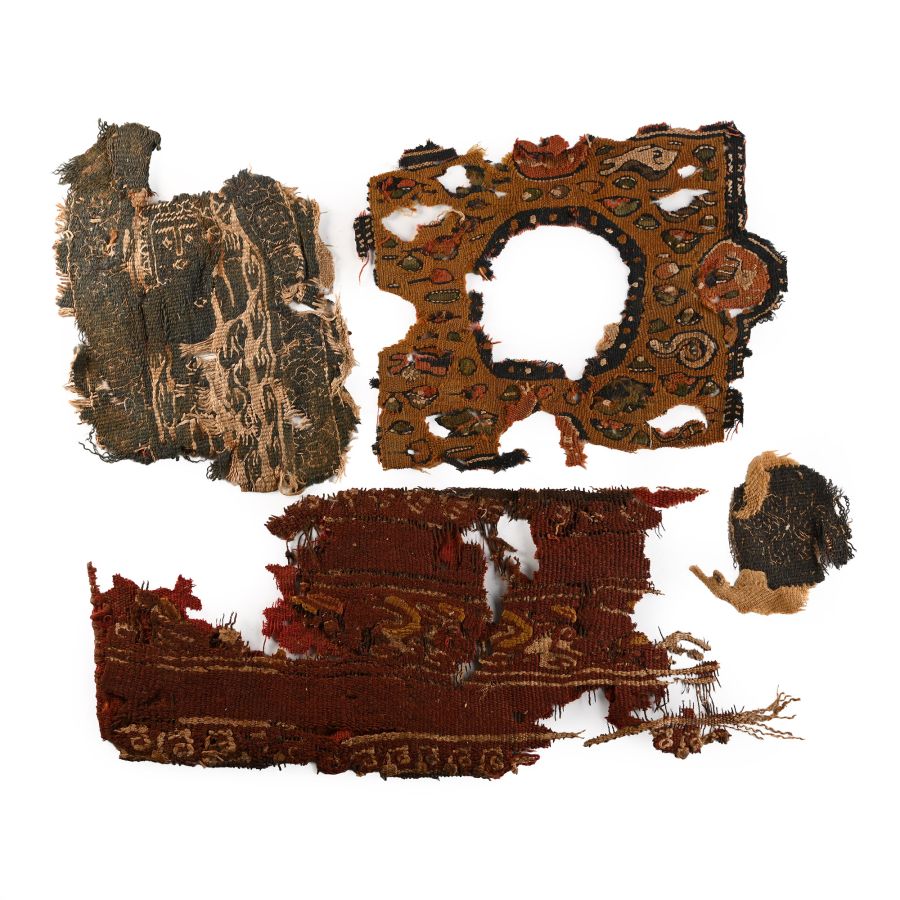
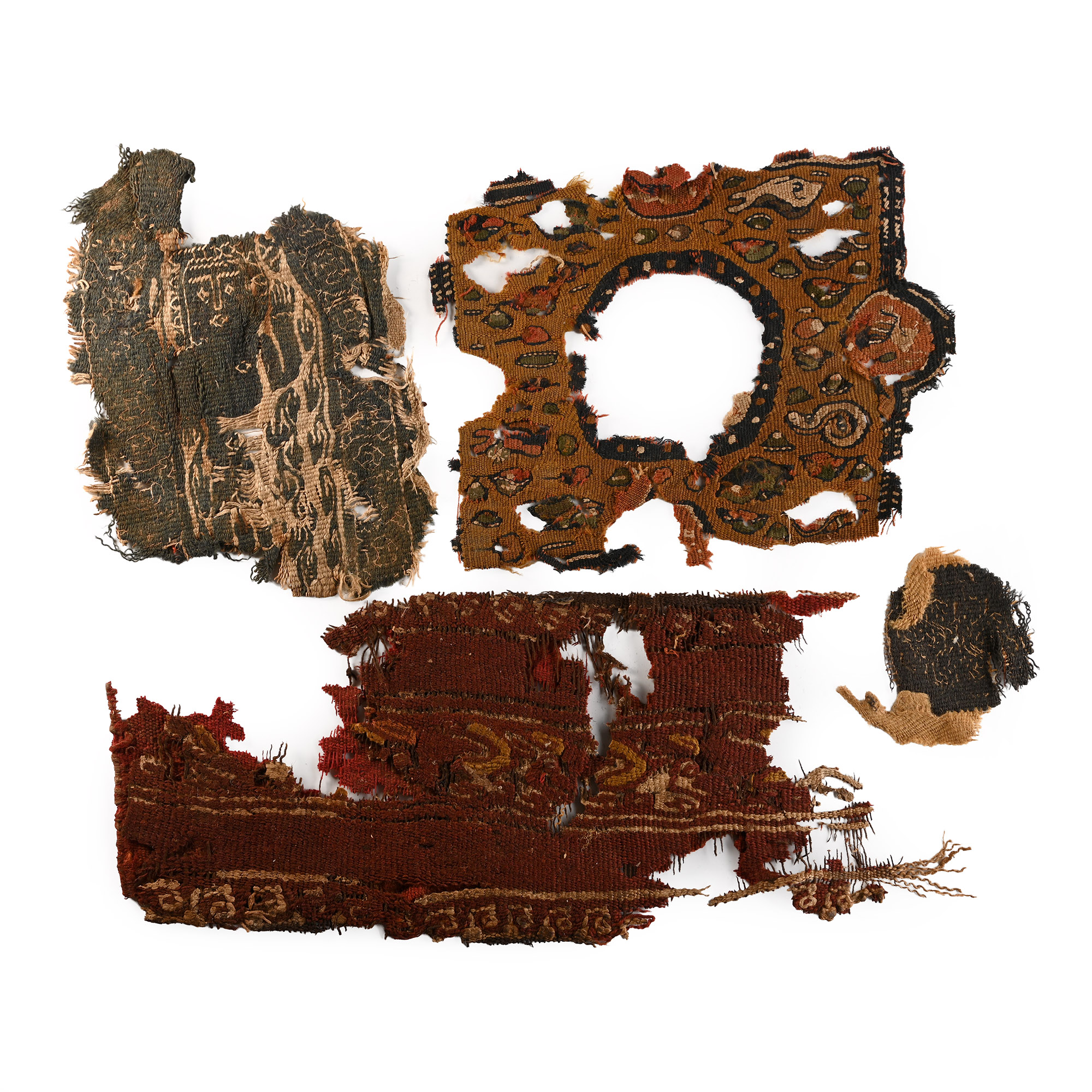
Egyptian Coptic Textile Fragment Group
CIRCA 6TH-7TH CENTURY A.D.
5 5/8 - 8 in. (66 grams total including package, 14.3-20.3 cm).
Comprising: a large fragment of a segmentum in white and red linen and wool, S torsion, borders embroidered with meanders, the central scene representing running hares; a purple on linen fragment of a clavus representing a dancer, borders with geometric decoration; and a large fragment of a tablion, ornamented with images of fishes, birds and vegetal patterns in red, green, yellow and dark blue wool, the central tondo missing. [3, No Reserve]
ProvenanceAcquired 1970s-1996.
Property of a North American collector.
London collection, 2016.
Cf. Del Francia Barocas, L., Museo dell'Alto Medioevo, Roma, I materiali Copti, pp.148-149, for similar textiles.
FootnotesWater plant elements are scattered across the bottom of the tablion, which is decorated with water birds; these decorations likely surrounded the image of a nereid. These abstract decorations show a strong stylisation often giving the marine animals a plant-like appearance.
CONDITIONTimeLine Auctions follows a vetting process to ensure the authenticity and legality of all items, reinforcing our commitment to integrity and responsible trading. Each antiquity, antique, and coin lot undergoes thorough examination by a vetting committee of at least ten external specialists, professional trade association members, scientists, and archaeologists: Our Vetting Process
AUCTIONS:
TimeLine is a leading auction house specialising in antiquities, ancient art, collectables, natural history, coins, medals, and books. Our auctions offer museums, collectors, historians, and enthusiasts the opportunity to acquire unique and historically significant pieces.
-
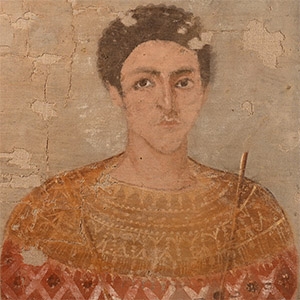
Romano-Egyptian Painted Portrait on Linen
1st-2nd century A.D.Sold for (Inc. bp): £26,000
Encaustic painting on thin linen fabric, upper part of the funeral shroud with half-length representation of the deceased, representing the bust of a young man in the guise of mummiform Osiris holding implements of his divinity, black hair, wearing a gilt broad collar (maniakion) and netting, pink dress ornamented with rosettes, traces of halo in white pigment; set in a glazed frame. 4.3 kg, 58 x 63 cm including frame
Collection of the estate of Patti Cadby Birch (1923-2007), New York, USA. with Sotheby’s, New York, Antiquities, 5 June 2008, sale no.8452, no.105. European private collection, acquired thereafter. Accompanied by a copy of an Art Loss Register certificate, no.S00014603. Accompanied by an academic report by Dr Raffaele D'Amato. This lot has been checked against the Interpol Database of stolen works of art and is accompanied by a search certificate number no.12612-234638. This lot has been cleared against the Art Loss Register database, and is accompanied by an illustrated lot declaration signed by the Head of the Antiquities Department, Dr Raffaele D'Amato.
Fayum portraits, painted on wood or linen, applied to the mummies of the Graeco-Roman period, are one of the most wonderful legacies that the koiné of the Graeco-Roman world has left us. Due to the favourable climate enhancing the state of preservation, these encaustic paintings have left us an almost photographic testimony of the faces of the inhabitants of Roman Egypt. The realistic portrait shows here the idea of the deceased as Osiris. This idea, already existing in the Ptolemaic Period regardless of the gender of the person represented, continued to exist in the Graeco-Roman period. The deceased is undoubtedly a young man, beardless, with black and slightly frizzy hair. A similar male portrait with the same type of clothing, the attributes: nimbus and the identifying elements of Osiris can be found in a portrait now in Paris (Parlasca, 2003, no.771, pl.172,3). Patti Cadby Birch (1923-2007) was a prominent American philanthropist and collector, known for her significant contributions to the arts. A patron of institutions such as The Metropolitan Museum of Art and the Museum of Modern Art in New York, she supported numerous exhibitions and acquisitions, particularly in the fields of antiquities and Islamic art. Works from her esteemed collection have been widely exhibited and are held in several major museum collections. -
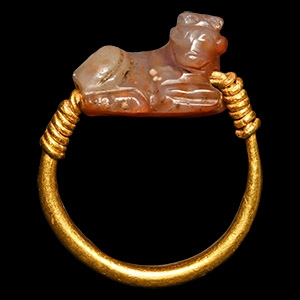
Egyptian Gold Ring with Agate Bull
New Kingdom, 1550-1292 B.C.Estimate: £6,000 - 8,000 (+bp*)
Opening Bid: £3,250
Comprising a round-section swivel ring set with a carved Apis bull depicted recumbent with its head turned to right. 4.71 grams, 27.98 mm overall, 19.07 mm internal diameter (approximate size British N, USA 6 1/2, Europe 13.72, Japan 13)
Private collection, UK. This lot has been checked against the Interpol Database of stolen works of art and is accompanied by search certificate number no.12939-245988.
The Apis bull was a sacred animal in ancient Egyptian religion, worshipped as a living manifestation of the god Ptah and later associated with Osiris and Ra. Regarded as an intermediary between the gods and humanity, the Apis bull was chosen based on specific physical characteristics, such as a black coat with unique white markings. Once identified, it was housed in a grand temple in Memphis, where it was treated with great reverence, adorned with jewellery, and participated in important religious ceremonies. Upon its death, the bull underwent elaborate mummification and burial rituals, symbolising its transition to the afterlife and its continued divine role. The cult of the Apis bull highlights the Egyptians’ deep connection to animals as symbols of divine power and their belief in the interconnectedness of the mortal and spiritual worlds. -
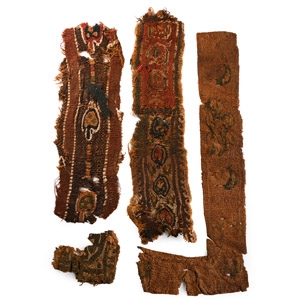
Egyptian Coptic Textile Fragment Group
Circa 7th-8th century A.D.Sold for (Inc. bp): £208
Comprising: a fragment of a segmentum in linen and red, brown, yellow and blue wool, S torsion, embroidered with a series of heads alternating with a flying putto holding a melograne; a fragment of another segmentum in linen and red, brown, yellow and blue wool, S torsion, embroidered with vegetal patterns, borders decorated with meanders; a fragment of a segmentum in linen and red, brown, white, yellow and blue wool, S torsion, embroidered with floral buds; a small fragment of a tablion with geometric decoration, purple wool on linen. 44 grams total including package, 4.3-20.5 cm
Acquired 1970s-1996. Property of a North American collector. London collection, 2016.
Some of these pieces are fragments from a tunic decoration, usually belonging to bands on red background, decorated with a series of motifs related to the Dionysian cult: usually these depict cherubs, fish, heads, palmettes, vegetal and floral ornaments, as well as figures of dancing puttoes within the orbiculi. The decorative motifs on these tunics were usually arranged vertically and horizontally.
