
Loading, please wait...
LOT 0484
Egyptian Coptic Textile Fragment Group
CIRCA 7TH CENTURY A.D.
12 1/8 - 13 1/8 in. (207 grams total including package, 31-33.5 cm).
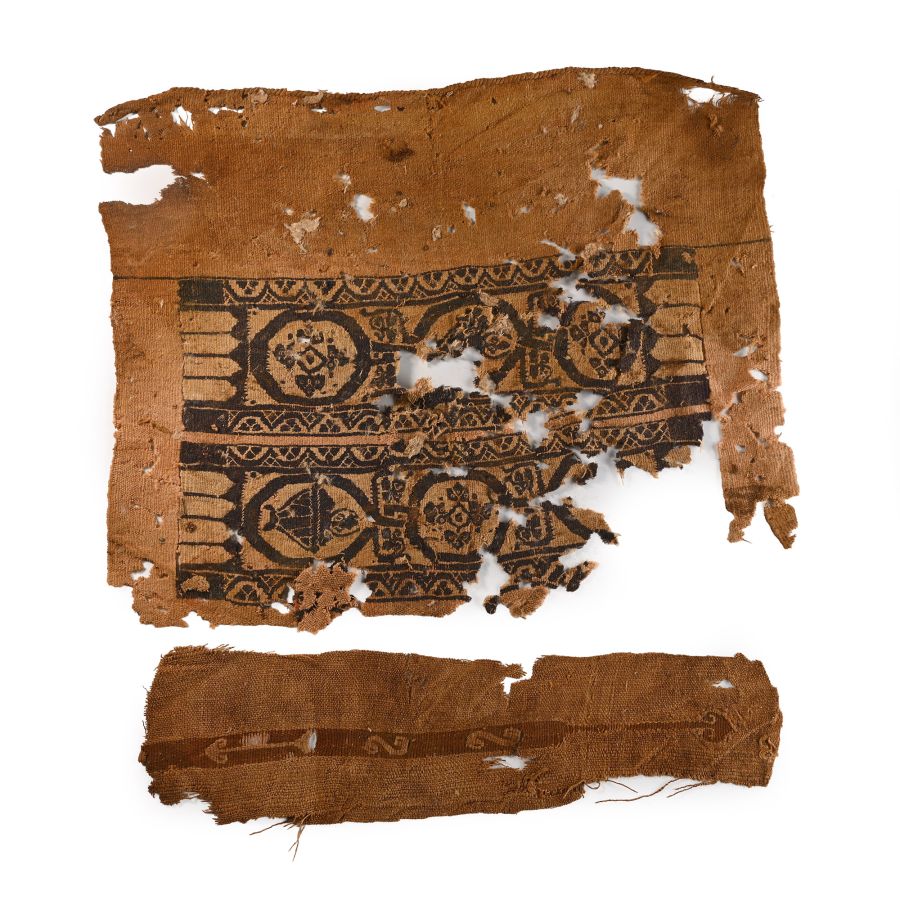
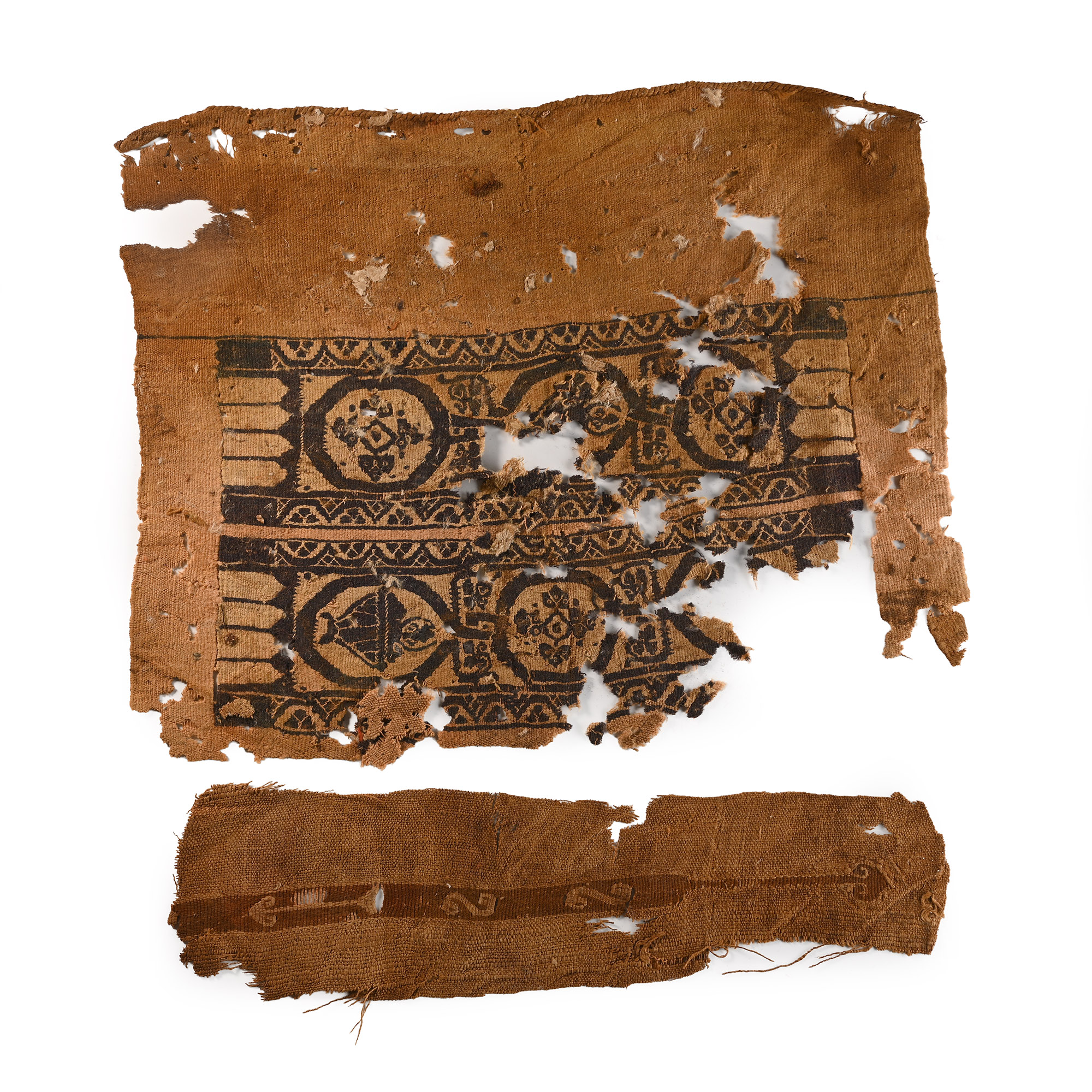
Comprising: a large fragment of a tunic with double segmenta in dark purple wool over linen, S torsion, formed by two parallel stripes, embroidered with kantharos and floral patterns, inscribed in tondos within bands with crenellated borders; a thin clavus connected to an orbiculus ending in an arrow shape, red purple and brown wool over linen, S torsion, embroidered with S shaped and lanceolate patterns. [2, No Reserve]
ProvenanceAcquired 1970s-1996.
Property of a North American collector.
London collection, 2016.
Cf. Pritchard, F., Clothing culture, Dress in Egypt in the collection of The Whitworth Art Gallery, The University of Manchester, Manchester, 2006, figs.3.5, for similar textiles.
FootnotesThis type of embroideries were typical of tunics and garments characterised by full-length clavi, and segmenta, decorated with either intricate geometric patterns or floral and vegetal motifs. In Christian symbology, the kantharos was an ancient Greek wine cup that symbolised resurrection and eternal life through Christ.
CONDITIONTimeLine Auctions follows a vetting process to ensure the authenticity and legality of all items, reinforcing our commitment to integrity and responsible trading. Each antiquity, antique, and coin lot undergoes thorough examination by a vetting committee of at least ten external specialists, professional trade association members, scientists, and archaeologists: Our Vetting Process
AUCTIONS:
TimeLine is a leading auction house specialising in antiquities, ancient art, collectables, natural history, coins, medals, and books. Our auctions offer museums, collectors, historians, and enthusiasts the opportunity to acquire unique and historically significant pieces.
-
Egyptian Coptic Textile Fragment Group
Circa 4th century A.D.Sold for (Inc. bp): £195
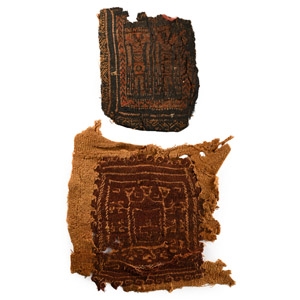
Comprising: a segmentum in red, green and black wool upon coarse linen, S torsion, embroidered with two stylised human figures, standing with the arms along the body, inscribed within a square framed with red and black chevrons, black and yellow borders; a tabula in purple wool and coarse linen, on brown linen background, S torsion, embroidered with a central cross, the borders decorated with meanders. 41 grams total including package, 10.5-13.3 cm
Acquired 1970s-1996. Property of a North American collector. London collection, 2016.
The tabula, or tablion, was a square embroidery used to decorate tunics or mantles. The Christian elements, like the cross at the centre of our tabula, began to decorate the garments from the 4th century onwards. -
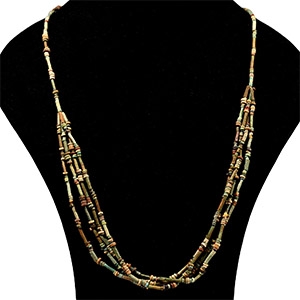
Egyptian Multi-Stranded Mummy Bead Necklace
Late Period, 664-332 B.C.Sold for (Inc. bp): £111
A four-strand designer necklace composed of polychrome beads of mainly annular and tubular types. 22.9 grams, 82 cm
Acquired before 1979. From the private collection of Mr F.A., South Kensington, London, UK; thence by descent 2014.
For thousands of years, artisans in Egypt created vibrant ceramics to echo the beauty of rare jewels. These ornaments were created with almost every material, colour, and texture imaginable and they come from across Egypt and beyond: vibrant blue lapis lazuli from Afghanistan, glossy black obsidian from Turkey, and aqua-green turquoise from the Sinai. They were worn in life and, after death, they served as precious ornamentation for mummies. -
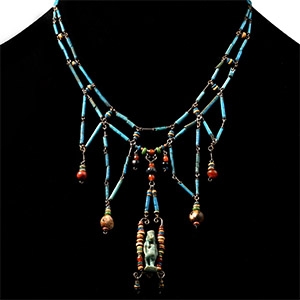
Egyptian Blue Faience Bead Necklace with Taweret
Ptolemaic Period, 332-30 B.C.Estimate: £600 - 800 (+bp*)
Opening Bid: £300
A restrung designer necklace composed of cylindrical and annular beads, central feature composed of polychrome annular beads flanking a Taweret amulet; modern clasp. 21.2 grams, 27.6 cm
Private collection, UK.
The ancient Egyptian goddess Taweret is mainly associated with fertility, childbirth, motherhood, and the protection of women during pregnancy and labour. She is depicted as a composite creature, combining various animal features, and is one of the more unique and striking deities in the Egyptian pantheon. Taweret’s name comes from the Egyptian word for "great" or "large" (tꜣwꜣrt), reflecting her formidable and protective nature.
