
Loading, please wait...
_900x900.jpg "Egyptian Carnelian Poppy Head Amulet")
_200x200.jpg "Egyptian Carnelian Poppy Head Amulet")
.jpg "Egyptian Carnelian Poppy Head Amulet")
LOT 0412
Egyptian Carnelian Poppy Head Amulet
NEW KINGDOM, 18TH DYNASTY, 1550-1292 B.C.
1/2 in. (0.53 grams, 13 mm).
Polished and with integral pierced suspension loop. [No Reserve]
ProvenanceUK gallery, early 2000s.
LiteratureCf. The Metropolitan Museum, New York, accession number 40.9.26, for similar; cf. Andrews, C., Amulets of Ancient Egypt, London, 1994, pl.65 (n).
CONDITIONTimeLine Auctions follows a vetting process to ensure the authenticity and legality of all items, reinforcing our commitment to integrity and responsible trading. Each antiquity, antique, and coin lot undergoes thorough examination by a vetting committee of at least ten external specialists, professional trade association members, scientists, and archaeologists: Our Vetting Process
AUCTIONS:
TimeLine is a leading auction house specialising in antiquities, ancient art, collectables, natural history, coins, medals, and books. Our auctions offer museums, collectors, historians, and enthusiasts the opportunity to acquire unique and historically significant pieces.
-
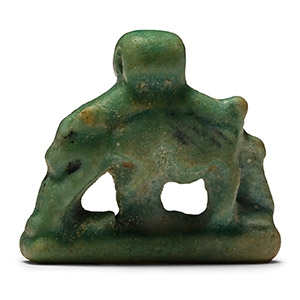
Egyptian Faience Amulet of Nut
Late Period, 664-332 B.C.Sold for (Inc. bp): £98
Amulet of a sow representing the goddess Nut; suspension loop on top. 2.63 grams, 24 mm
From the Florence Rosetti collection, UK, circa 1950s. Property of a Cambridgeshire, UK, gentleman.
This miniature sow pendant features a loop at the top and was worn as an amulet. The sow is often associated with the sky goddess Nut, who was believed to give birth to the stars every night, and then consume them at dawn. Despite the sow's reputation for devouring its offspring, Nut, in this form, was revered as a nurturing and safeguarding deity. A sow-shaped amulet was likely intended to offer protection to its wearer. -
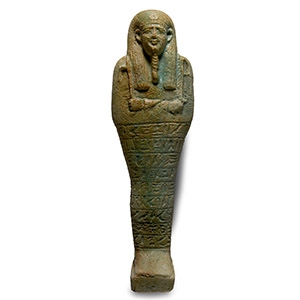
Large Egyptian Blue Glazed Hieroglyphic Shabti for a Sem Priest
Saite Period, 26th Dynasty, 664-525 B.C.Sold for (Inc. bp): £1,950
Pale blue composition with moulded detail to the wig, beard, tools and seed bag; nine horizontal bands of hieroglyphic text to the lower half of the body; dorsal pillar. 230 grams, 18.2 cm
Acquired on the German art market, 1989-1995. with The Museum Gallery, 19 Bury Place, London, WC1, UK, 1998-2003. Property of a London based academic, 2003-present. -
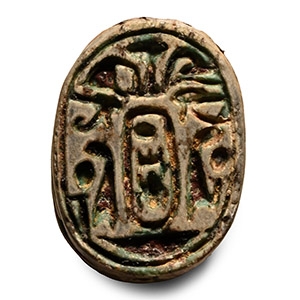
Egyptian Steatite Scarab for Thutmose III
New Kingdom or later, circa 1334-332 B.C.Estimate: £400 - 600 (+bp*)
Opening Bid: £175
Underside with cartouche of Pharaoh Thutmose III (Men-kheper-Re). 3.85 grams, 20 mm
Ex North London gentleman's collection, 1990s. Property of a Cambridgeshire, UK, gentleman.
The popularity of this great Egyptian pharaoh was such that his name appeared on scarabs during his reign and into the Late Period.
