
Loading, please wait...
LOT 0051
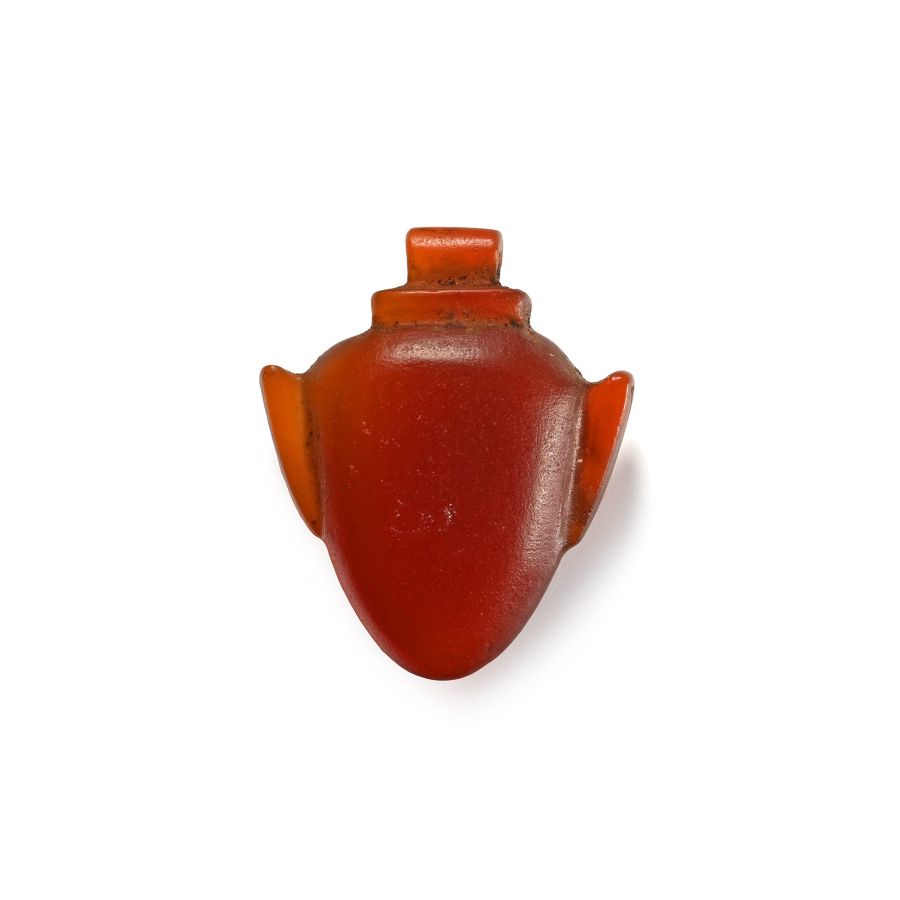
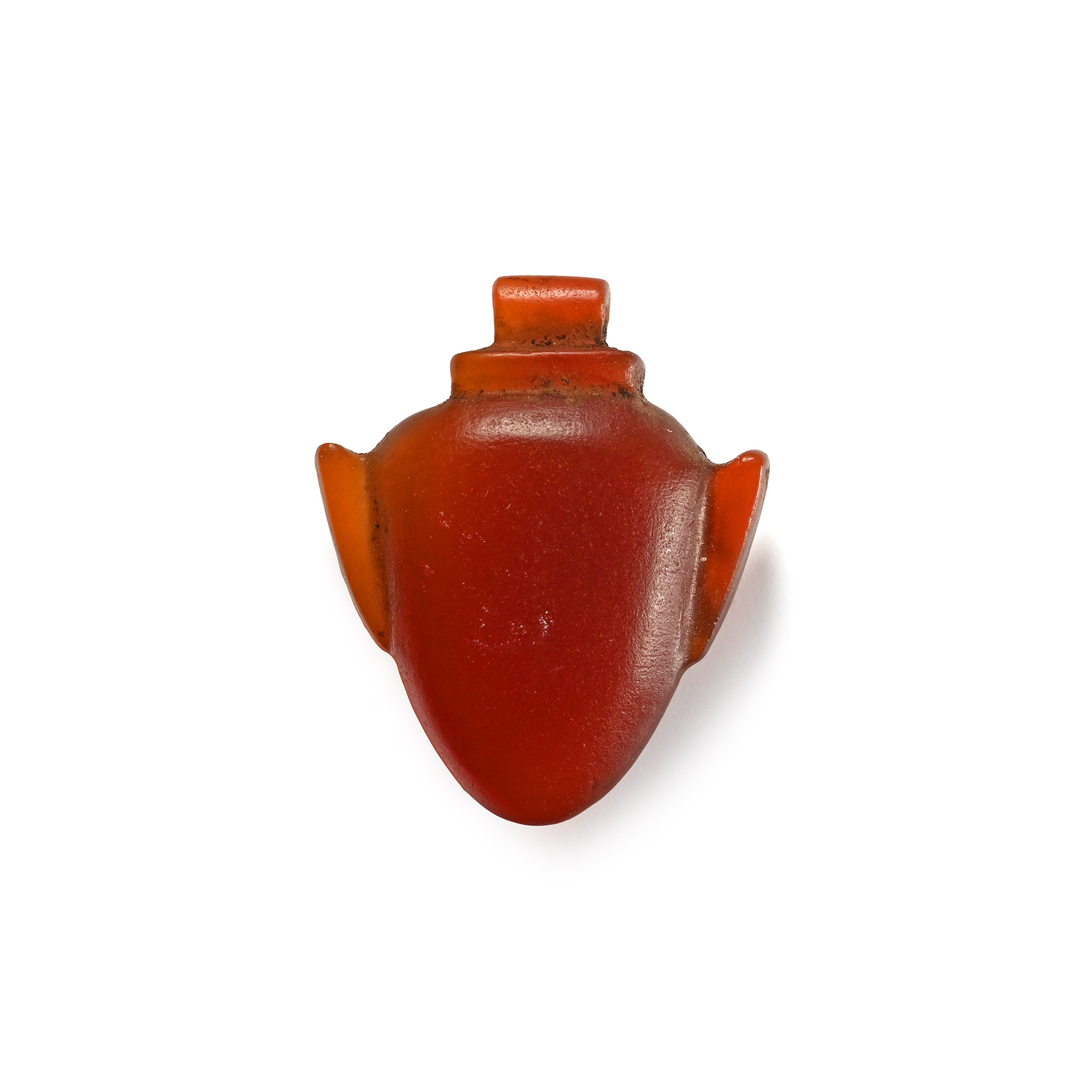
Egyptian Carnelian Heart Amulet
NEW KINGDOM, 1550-1070 B.C.
1 in. (5.27 grams, 26 mm).
A large heart, ib, amulet of classic egg-form with shallow lugs on either side with short flared top and tubular suspension loop.
ProvenanceFrom an early 20th century collection London and Home Counties, UK.
This lot is accompanied by an illustrated lot declaration signed by the Head of the Antiquities Department, Dr Raffaele D'Amato.
Cf. Petrie, W.M.F., Amulets. Illustrated by the Egyptian Collection in University College, London, 1914, pl. I, nos.7a-p, for type; Andrews, C., and van Dijk, J., Objects for Eternity: Egyptian Antiquities from the W. Arnold Meijer Collection, Mainz am Rhein, 2006, p.128, no. 2.34a.
FootnotesAccording to ancient Egyptian beliefs, the heart (ib) was considered to be the centre of intelligence, emotions, and behaviour. The heart was also believed to store an individual's memories. During the Weighing of the Heart ceremony in the afterlife, the heart could speak up for the deceased and account for their lifetime of actions before Osiris. For this reason, heart amulets were placed on the mummy to safeguard the organ and ensure a favourable outcome during judgment.
CONDITIONTimeLine Auctions follows a vetting process to ensure the authenticity and legality of all items, reinforcing our commitment to integrity and responsible trading. Each antiquity, antique, and coin lot undergoes thorough examination by a vetting committee of at least ten external specialists, professional trade association members, scientists, and archaeologists: Our Vetting Process
AUCTIONS:
TimeLine is a leading auction house specialising in antiquities, ancient art, collectables, natural history, coins, medals, and books. Our auctions offer museums, collectors, historians, and enthusiasts the opportunity to acquire unique and historically significant pieces.
-
.jpg)
Egyptian Brown Quartzite Baboon Animal Figurine
New Kingdom, circa 1550-1070 B.C.Estimate: £5,000 - 7,000 (‡+bp*)
Opening Bid: £2,250
Carved in a typical pose, sitting on its haunches with its tail curving around the right side, its front paws resting on its knees and protruding beneath its thick furry pelt, with incised detailing, its feet either side of the phallus, the head with bulbous, striated hair on either side, chipped, snout restored; seated on a high shrine-shaped plinth with squared front and rounded back, featuring a cavetto cornice and roll detailing on the upper part. 1.15 kg, 15 cm
From a deceased American estate, 1970-1989. with Bonham's, London, 28 October 2009, no.35. Accompanied by copies of the relevant Bonham's catalogue pages. This lot has been checked against the Interpol Database of stolen works of art and is accompanied by a search certificate number no.12368-226706. This lot has been cleared against the Art Loss Register database, and is accompanied by an illustrated lot declaration signed by the Head of the Antiquities Department, Dr Raffaele D'Amato.
The baboon was an animal manifestation of the god Thoth, the patron deity of Hermopolis Magna, who was revered for his association with knowledge, writing, and healing. -
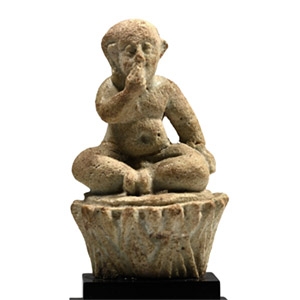
Egyptian Green Glazed Faience Figure of Somtous
Late Period, circa 664-332 B.C.Estimate: £1,000 - 1,400 (+bp*)
Opening Bid: £500
Modelled in the round, the nude seated figure of the child Somtous, with one hand to his lips and a prominent sidelock, emerging from a lotus flower; mounted on a custom-made stand. 39.7 grams total, 68 mm including stand
with Noriuchi Horiuchi, Tokyo, Japan. Private collection, London, UK, acquired from the above in 1993. This lot is accompanied by an illustrated lot declaration signed by the Head of the Antiquities Department, Dr Raffaele D'Amato.
The earliest attestations of the cult of Somtous, known as Sematawy in ancient Egyptian, date back to the New Kingdom, although it became particularly popular during the Late Period. Associated with Horus (Horsomtous), the symbol of the child emerging from the lotus represented the (re)birth of the sun god. Thus, Somtous was regarded as a life-giving amuletic symbol, sometimes even referred to as 'Sematawy the child who gives life.' -
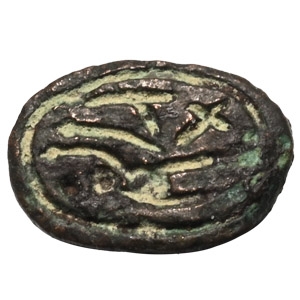
Phoenician Inscribed Bronze Scaraboid Seal
Late 1st millennium B.C.Estimate: £100 - 140 (+bp*)
Opening Bid: £50
Scaraboid featuring a grooved band across the upper face and an incuse schematic human figure with enigmatic symbols on the underside. 3.1 grams, 13.46 mm
Ex London, UK, gentleman, 1990. This lot is accompanied by an illustrated lot declaration signed by the Head of the Antiquities Department, Dr Raffaele D'Amato.
