
Loading, please wait...
LOT 0050
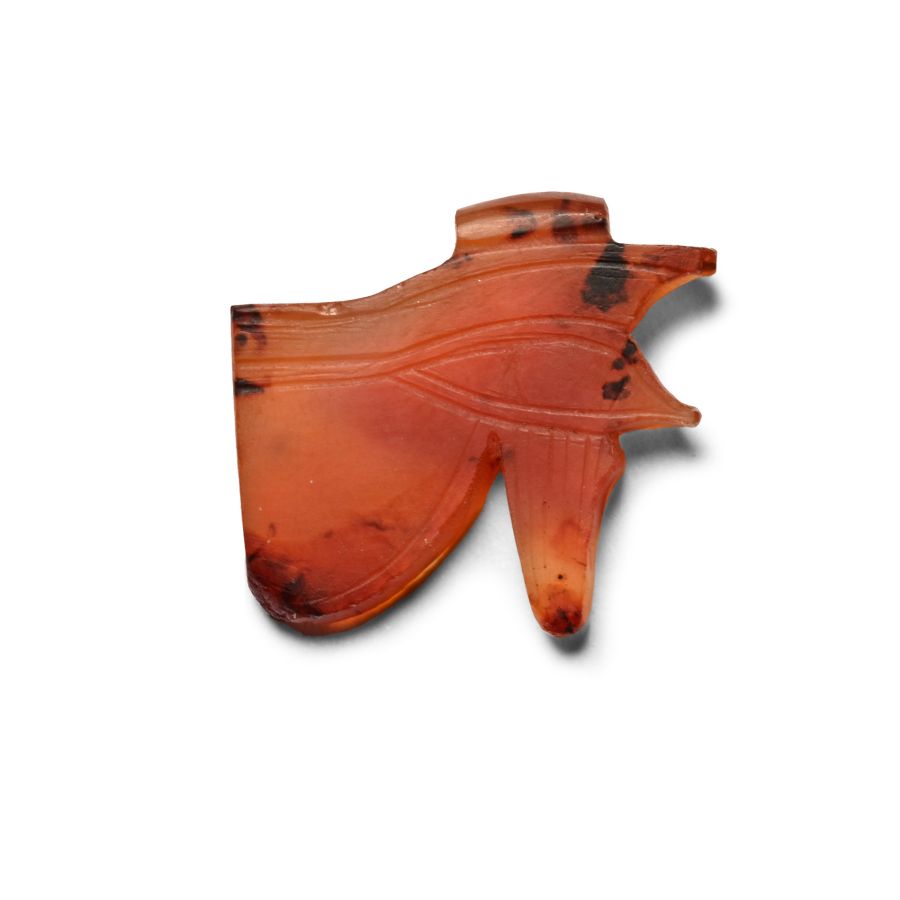
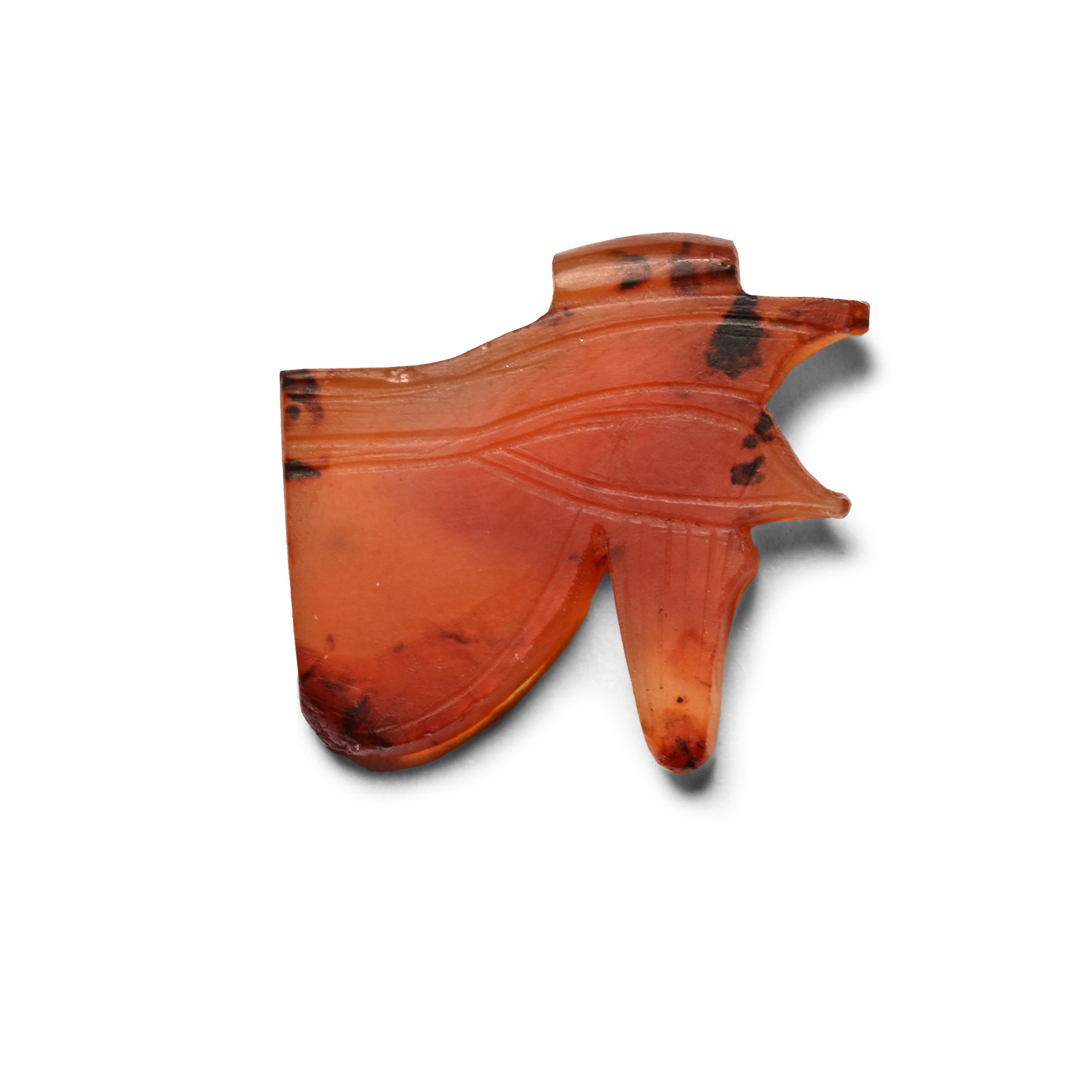
Egyptian Carnelian Eye of Horus Amulet
CIRCA 1000 B.C.
3/4 in. (1.64 grams, 19 mm).
With exceptional eye detailing carved in low-relief to one face.
ProvenanceEx R. Liechti (1934-2010) Geneva, Switzerland, formed between 1950-1990s.
Accompanied by a copy of an old collection inventory note.
Cf. Petrie, W.M.F., Amulets. Illustrated by the Egyptian Collection in University College, London, 1914, pl. XXV, no. 138z, for a wedjat-eye amulet of similar style.
FootnotesThe wedjat-eye amulet is a representation of the healed eye of the god Horus, featuring both human and falcon elements. The name wedjat in ancient Egyptian means ‘the one that is sound.’ According to Egyptian mythology, Horus' eye was wounded or taken by the god Seth and restored by Thoth. The wedjat-eye amulet was thought to protect its wearer and bestow the power of recovery and regeneration onto them. It was very popular and used by both the living and the dead.
CONDITIONTimeLine Auctions follows a vetting process to ensure the authenticity and legality of all items, reinforcing our commitment to integrity and responsible trading. Each antiquity, antique, and coin lot undergoes thorough examination by a vetting committee of at least ten external specialists, professional trade association members, scientists, and archaeologists: Our Vetting Process
AUCTIONS:
TimeLine is a leading auction house specialising in antiquities, ancient art, collectables, natural history, coins, medals, and books. Our auctions offer museums, collectors, historians, and enthusiasts the opportunity to acquire unique and historically significant pieces.
LOT 0050
Egyptian Carnelian Eye of Horus Amulet
Estimate £1,000 - 1,400€1,160 - 1,620 (for guidance only)$1,350 - 1,890 (for guidance only)
-
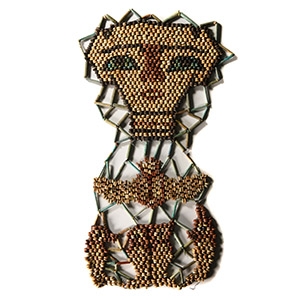
Large Egyptian Faience Beaded Mummy Mask with Sons of Horus
Ptolemaic Period, 332-30 B.C.Sold for (Inc. bp): £351
Restrung netted beadwork panel of annular and tubular glazed composition beads in blues, greens, black, cream and red-brown colours, depicting a mummy face mask with false beard, a scarab with extended wings below, the 'Four Sons of Horus’ beneath the scarab, joined together with areas of open netting of tubular beads; restrung with some later beads. 123 grams, 30 cm
Ex Mariaud de Serres, Paris, France, 1980-1990s. From a London, UK, collection.
The Four Sons of Horus were deities responsible for protecting the internal organs of the deceased. The human-headed Imsety protected the liver, the baboon-headed Hapy protected the lungs, the jackal-headed Duamutef protected the stomach, and the falcon-headed Qebehsenuef protected the intestines. -
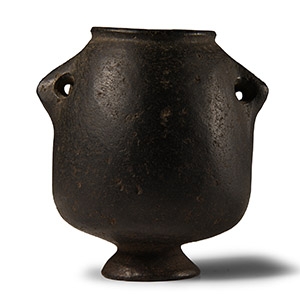
Egyptian Predynastic Basalt Vase
Naqada I-II, circa 3900-3300 B.C.Estimate: £5,000 - 7,000 (‡+bp*)
Opening Bid: £2,500
Barrel-shaped in profile with tapering neck and trumpet-shaped foot, two lateral pierced lug handles, flared rim (damaged). 330 grams, 86 mm
French private collection. From the 'Yvelines Department', Northern France. with Mme Digard, Drouot, Paris, 7 February 2011, no.107. Accompanied by a copy of a French cultural passport. This lot has been checked against the Interpol Database of stolen works of art and is accompanied by a search certificate number no.12072-218133. -
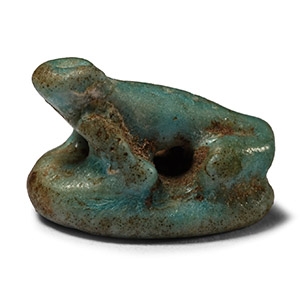
Egyptian Faience Frog Scarab
Ptolemaic Period, circa 300 B.C.Estimate: £500 - 700 (‡+bp*)
Opening Bid: £250
Discoid base with crouching frog pierced longitudinally for threading; underside with a solar disc and unidentified symbol. 0.56 grams, 13 mm
Ex R. Liechti (1934-2010) Geneva, Switzerland, formed between 1950-1990s. Accompanied by a copy of an old collection inventory note.
