
Loading, please wait...
LOT 0480
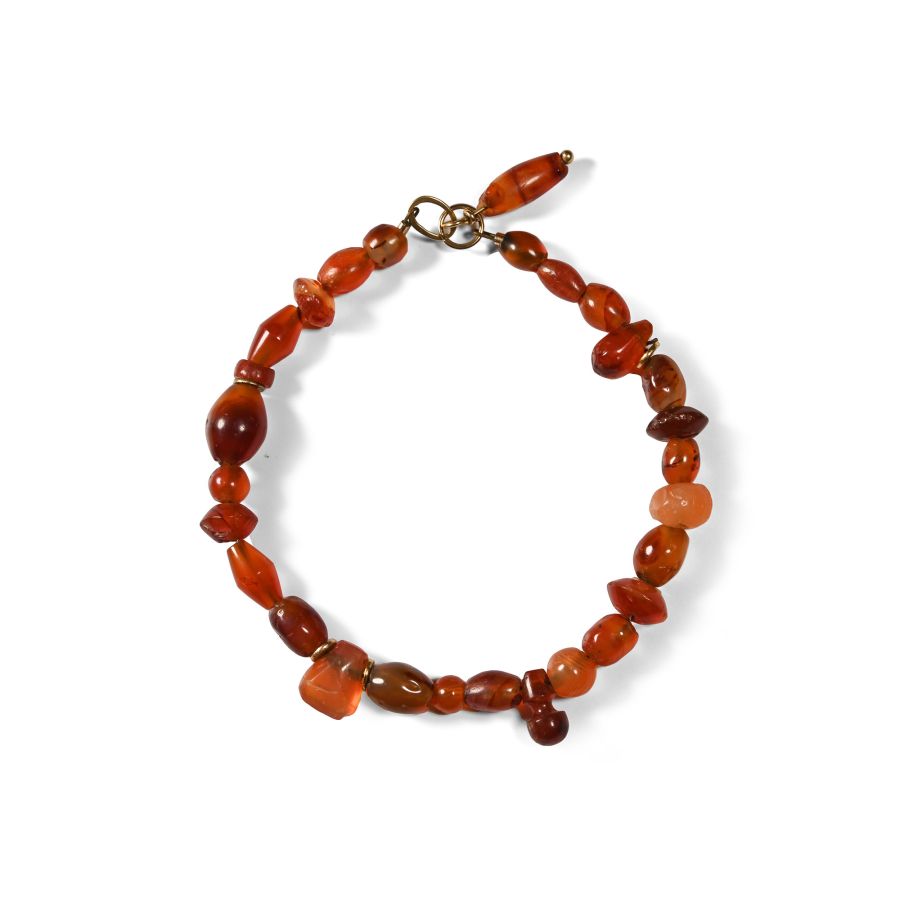
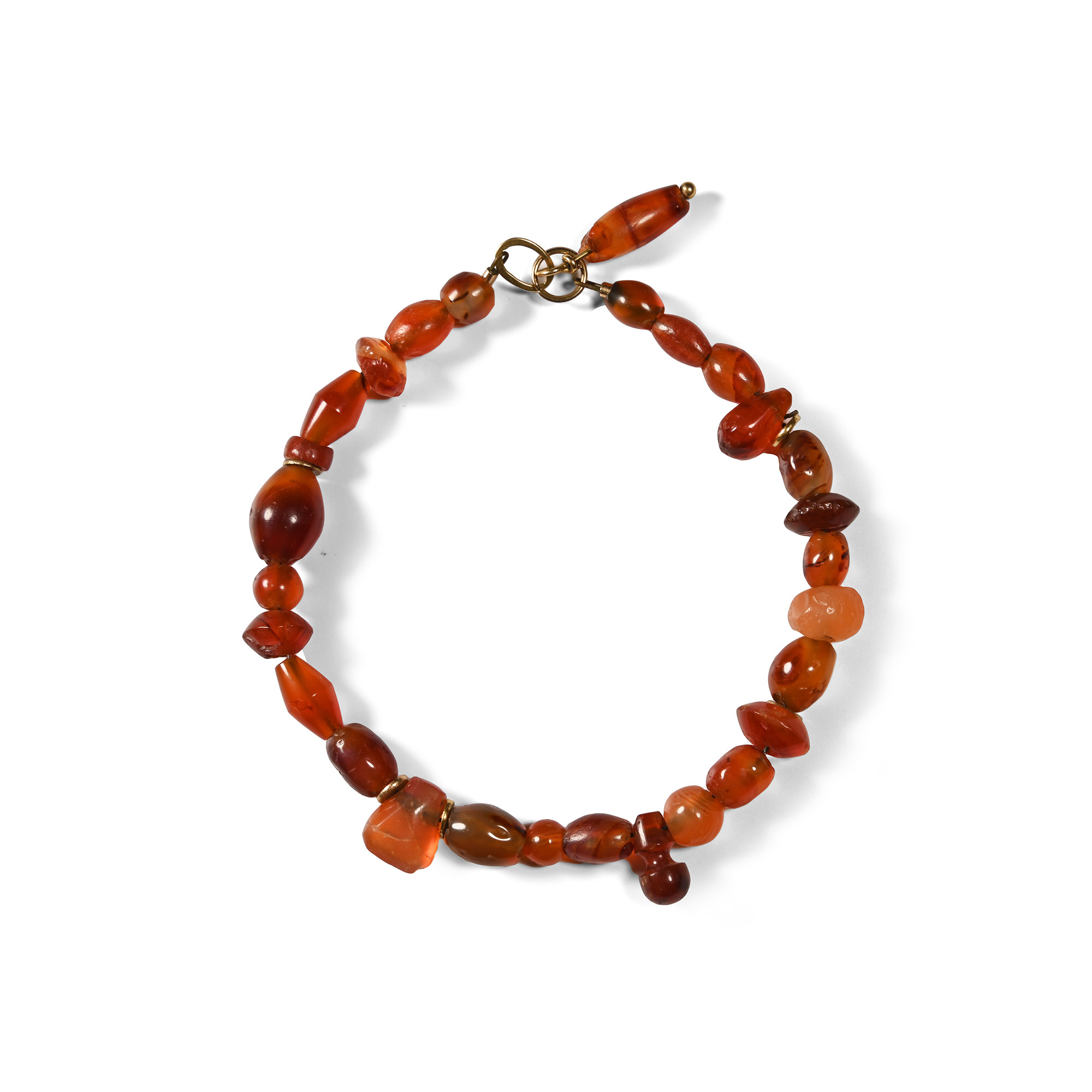
Egyptian Carnelian Bead Bracelet
LATE PERIOD, 664-332 B.C. OR LATER
8 1/4 in. (16.4 grams total, 21 cm long).
Composed mainly of biconical, oblate, and other beads with three larger pendants; with modern gold attachment.
ProvenanceFrom the private collection of the late Mrs Belinda Ellison, a long time member of the Egyptian Exploration Society, c.1940-2020.
This lot is accompanied by an illustrated lot declaration signed by the Head of the Antiquities Department, Dr Raffaele D'Amato.
TimeLine Auctions follows a vetting process to ensure the authenticity and legality of all items, reinforcing our commitment to integrity and responsible trading. Each antiquity, antique, and coin lot undergoes thorough examination by a vetting committee of at least ten external specialists, professional trade association members, scientists, and archaeologists: Our Vetting Process
AUCTIONS:
TimeLine is a leading auction house specialising in antiquities, ancient art, collectables, natural history, coins, medals, and books. Our auctions offer museums, collectors, historians, and enthusiasts the opportunity to acquire unique and historically significant pieces.
-
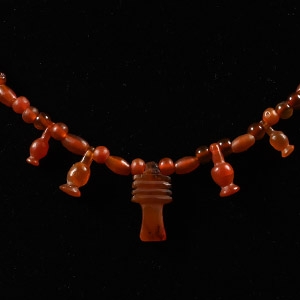
Egyptian Carnelian Necklace with Djed Pillar
Late Period, 664-332 B.C.Sold for (Inc. bp): £715
Composed mainly of oblate and spherical beads, four poppy seed pendants, and a larger djed pillar pendant; restrung with a modern clasp. 12.68 grams, 43.5 cm
From an Israeli collection, formerly with the Archaeological Centre in Jaffa. This lot is accompanied by an illustrated lot declaration signed by the Head of the Antiquities Department, Dr Raffaele D'Amato.
The djed pillar symbolises endurance and stability. Used as a funerary amulet since the Old Kingdom, it was first linked to Ptah and Sokar, later becoming associated with Osiris as his backbone. Chapter 155 of the Book of the Dead references it in the context of resurrection. Beads in the form of poppies were used to heal and alleviate pain and to ward off death. These types of amulets were also linked to Osiris, the Egyptian deity of agriculture, death, and the afterlife. -
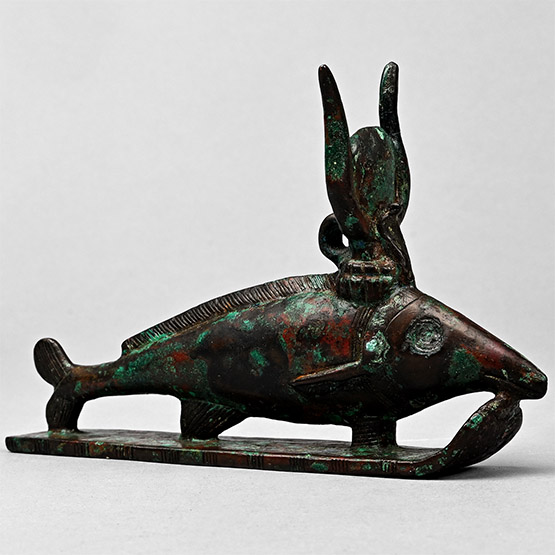
Large Egyptian Bronze Oxyrhynchus Fish of Per-Medjed with Hieroglyphic Inscription
Late-Ptolemaic Period, 664-30 B.C.Estimate: £5,000 - 7,000 (‡+bp*)
Opening Bid: £2,500
Modelled in the round on a sledge attached by ventral and pectoral fins, a forked tail, a dorsal ridge, and a tapering nose, featuring recessed circular eyes filled with enamel, a horned sun disc headdress fronted by a uraeus, and a suspension loop behind; a few hieroglyphs of a dedication remain visible on the underside of the sledge, which may be interpreted as ‘….the great give life (to)…’ (…t wr rdi͗ Ꜥnḫ t….); presumably, 'the great' followed the name of a deity, now lost. 585 grams, 17 cm
Acquired from Gallery Reiner, Paris, France, 1981. Private collection, Europe. Accompanied by a copy of French passport no.150583 dated 29 November 2013. This lot has been checked against the Interpol Database of stolen works of art and is accompanied by a search certificate number no.12375-226676. This lot has been cleared against the Art Loss Register database, and is accompanied by an illustrated lot declaration signed by the Head of the Antiquities Department, Dr Raffaele D'Amato.
The Medjed, a type of elephant-snout fish (Mormyrus kannume), was revered in ancient Egyptian religion, particularly in Per-Medjed, better known by its Greek name, Oxyrhynchus Polis. This version of the name, meaning "city of the sharp-nosed," reflects the fish's distinctive appearance as depicted in Egyptian art. These fish were believed to have consumed the penis of Osiris, the god who was dismembered and scattered by his brother Seth. As sacred creatures, figurines of the Medjed were often adorned with a horned sun-disc headdress worn by the goddesses Hathor and Isis, suggesting a close association with both. Some figurines, like this example, featured suspension loops, allowing them to be worn as pendant amulets. -
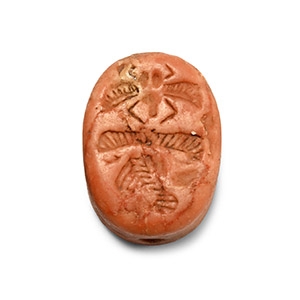
Phoenicio-Egyptian Orange Stone Scaraboid
1st millennium B.C.Estimate: £600 - 800 (+bp*)
Opening Bid: £300
Ellipsoid in plan with frieze comprising a large Maat feather, a winged sun disc, and a winged Khepri beetle. 13 grams, 27 mm
Ex collection of the late Mr S. M., London, UK, 1970-1990s. This lot is accompanied by an illustrated lot declaration signed by the Head of the Antiquities Department, Dr Raffaele D'Amato.
