
Loading, please wait...
_900x900.jpg "Egyptian Brown Quartzite Baboon Animal Figurine")
_200x200.jpg "Egyptian Brown Quartzite Baboon Animal Figurine")
_900x900.jpg "Egyptian Brown Quartzite Baboon Animal Figurine")
_200x200.jpg "Egyptian Brown Quartzite Baboon Animal Figurine")
.jpg "Egyptian Brown Quartzite Baboon Animal Figurine")
.jpg "Egyptian Brown Quartzite Baboon Animal Figurine")
LOT 0047
Egyptian Brown Quartzite Baboon Animal Figurine
NEW KINGDOM, CIRCA 1550-1070 B.C.
5 7/8 in. (1.15 kg, 15 cm).
Carved in a typical pose, sitting on its haunches with its tail curving around the right side, its front paws resting on its knees and protruding beneath its thick furry pelt, with incised detailing, its feet either side of the phallus, the head with bulbous, striated hair on either side, chipped, snout restored; seated on a high shrine-shaped plinth with squared front and rounded back, featuring a cavetto cornice and roll detailing on the upper part.
ProvenanceFrom a deceased American estate, 1970-1989.
with Bonham's, London, 28 October 2009, no.35.
Accompanied by copies of the relevant Bonham's catalogue pages.
This lot has been checked against the Interpol Database of stolen works of art and is accompanied by a search certificate number no.12368-226706.
This lot has been cleared against the Art Loss Register database, and is accompanied by an illustrated lot declaration signed by the Head of the Antiquities Department, Dr Raffaele D'Amato.
Cf. seated baboon of brown quartzite, Kozloff, A.P. & Bryan, B.M., Egypt's Dazzling Sun, Cleveland, 1992, fig 36, p.227.
FootnotesThe baboon was an animal manifestation of the god Thoth, the patron deity of Hermopolis Magna, who was revered for his association with knowledge, writing, and healing.
CONDITIONTimeLine Auctions follows a vetting process to ensure the authenticity and legality of all items, reinforcing our commitment to integrity and responsible trading. Each antiquity, antique, and coin lot undergoes thorough examination by a vetting committee of at least ten external specialists, professional trade association members, scientists, and archaeologists: Our Vetting Process
AUCTIONS:
TimeLine is a leading auction house specialising in antiquities, ancient art, collectables, natural history, coins, medals, and books. Our auctions offer museums, collectors, historians, and enthusiasts the opportunity to acquire unique and historically significant pieces.
LOT 0047
Egyptian Brown Quartzite Baboon Animal Figurine
Estimate £5,000 - 7,000€5,800 - 8,120 (for guidance only)$6,750 - 9,450 (for guidance only)
-
.jpg)
Coptic Marble Liturgical Vessel Fragment with Inscription
6th century A.D.Estimate: £1,800 - 2,400 (‡+bp*)
Opening Bid: £900
Tongue-shaped with low rounded pad on the underside, raised edge with low-relief decoration of grape vines and leaves, the edge with pairs of opposing doves eating grapes; dedicatory Demotic inscription on the underside. 87 grams, 55 mm
Acquired in the mid 1980s-1990s. Private collection, Switzerland, thence by descent. Private collection, since the late 1990s. Accompanied by an academic report by Dr Raffaele D'Amato. This lot has been checked against the Interpol Database of stolen works of art and is accompanied by a search certificate number no.12575-232108. This lot has been cleared against the Art Loss Register database, and is accompanied by an illustrated lot declaration signed by the Head of the Antiquities Department, Dr Raffaele D'Amato.
These vessels were used as liturgical objects for church offerings or ritual cult and were extensively employed from late antiquity in ecclesiastical contexts. -
.jpg)
Egyptian Gold Fly Amulet
Late Period, 664-332 B.C.Sold for (Inc. bp): £650
With hatched detailing to the body and wings. 1.62 grams, 17 mm
From the collection of a gentleman, acquired on the London art market in the 1990s. This lot is accompanied by an illustrated lot declaration signed by the Head of the Antiquities Department, Dr Raffaele D'Amato.
Considering that Egyptian artists often depicted fly whisks in the hands of pharaohs and high officials, one might assume that flies were merely a nuisance. However, the Egyptians held flies in high regard for their speed, quick reactions, and persistence. Small fly amulets first appeared in burials during the Naqada II Period, around 3200 B.C. These amulets gained popularity, and the materials used to make them varied during the New Kingdom. They were crafted from various materials such as gold, silver, lapis lazuli, carnelian, amethyst, faience, and bone. These amulets were believed to protect against insect bites and to ward off troublesome flying creatures through apotropaic magic. Some believe they may have even symbolised the fly’s fecundity. Additionally, pharaohs would bestow gold fly-shaped pendants as military awards to honour the bravery and persistence of soldiers in battle. -
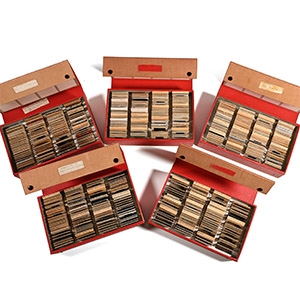
Historic Collection of 772 Slides of Archaeological Sites in Egypt
1960s-1980s A.D.Sold for (Inc. bp): £1,300
Housed in five linen-covered boxes, covering Saqqara, Step Pyramids, The Serapeum, Giza, Karnak, Tombs of the Nobles, Deir-el Medina Tombs, Ummuh Bured Tombs, Denderah and Edfu, etc. 4.17 kg total, 26.5 x 16.5 x 6.5 cm each box
Property of archaeologist Stephanie Gee, N.W. London, UK, 1960s-1980s. This lot is accompanied by an illustrated lot declaration signed by the Head of the Antiquities Department, Dr Raffaele D'Amato.
Stephanie Gee was a prominent archaeologist who took part in several expeditions in Egypt. She was a trusted assistant to the British-Australian archaeologist Veronica Seton-Williams, who excavated in Egypt, Britain, and the Near East. Stephanie also took part in the Tell El-Farâ'în expeditions of 1965-1968, and assisted Seton-Williams with preparing the 1966 expedition report. Their collaboration continued and Stephanie helped with the manuscript of Seton-Williams’ book ‘The Road to El-Aguzein’, a narrative account of her life that was first published in 1988.
