
Loading, please wait...
_900x900.jpg "Egyptian Bronze Striding Figure of Montu the Falcon God of War")
_200x200.jpg "Egyptian Bronze Striding Figure of Montu the Falcon God of War")
.jpg "Egyptian Bronze Striding Figure of Montu the Falcon God of War")
LOT 0025
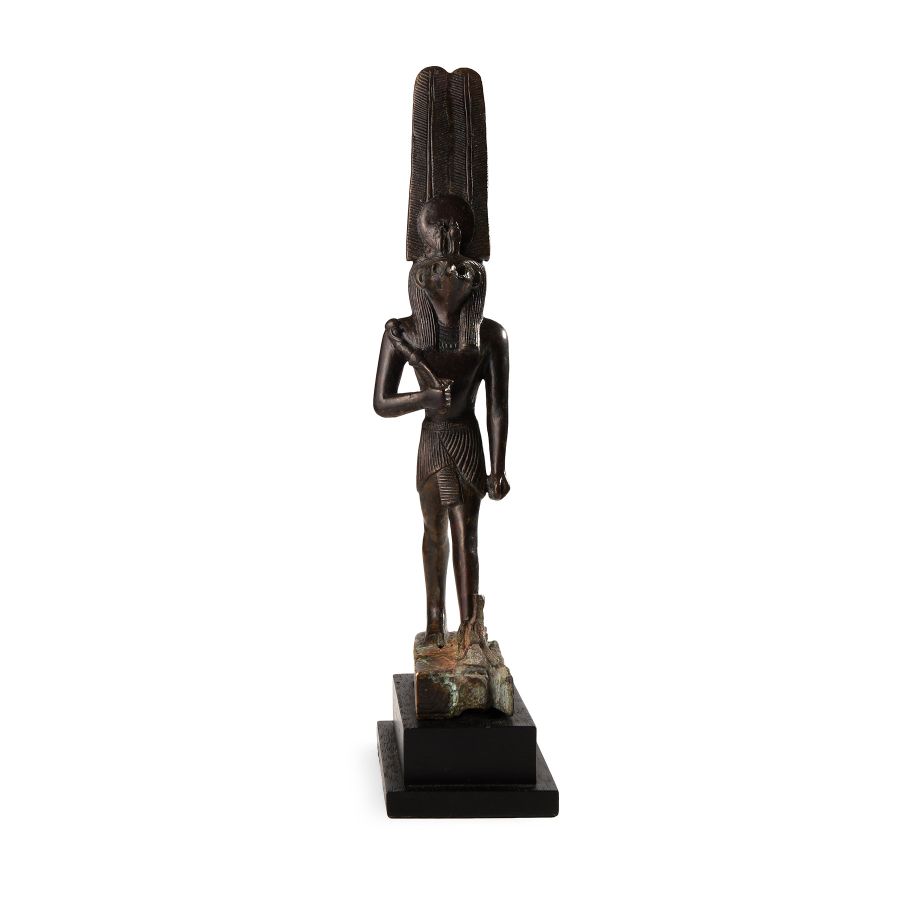
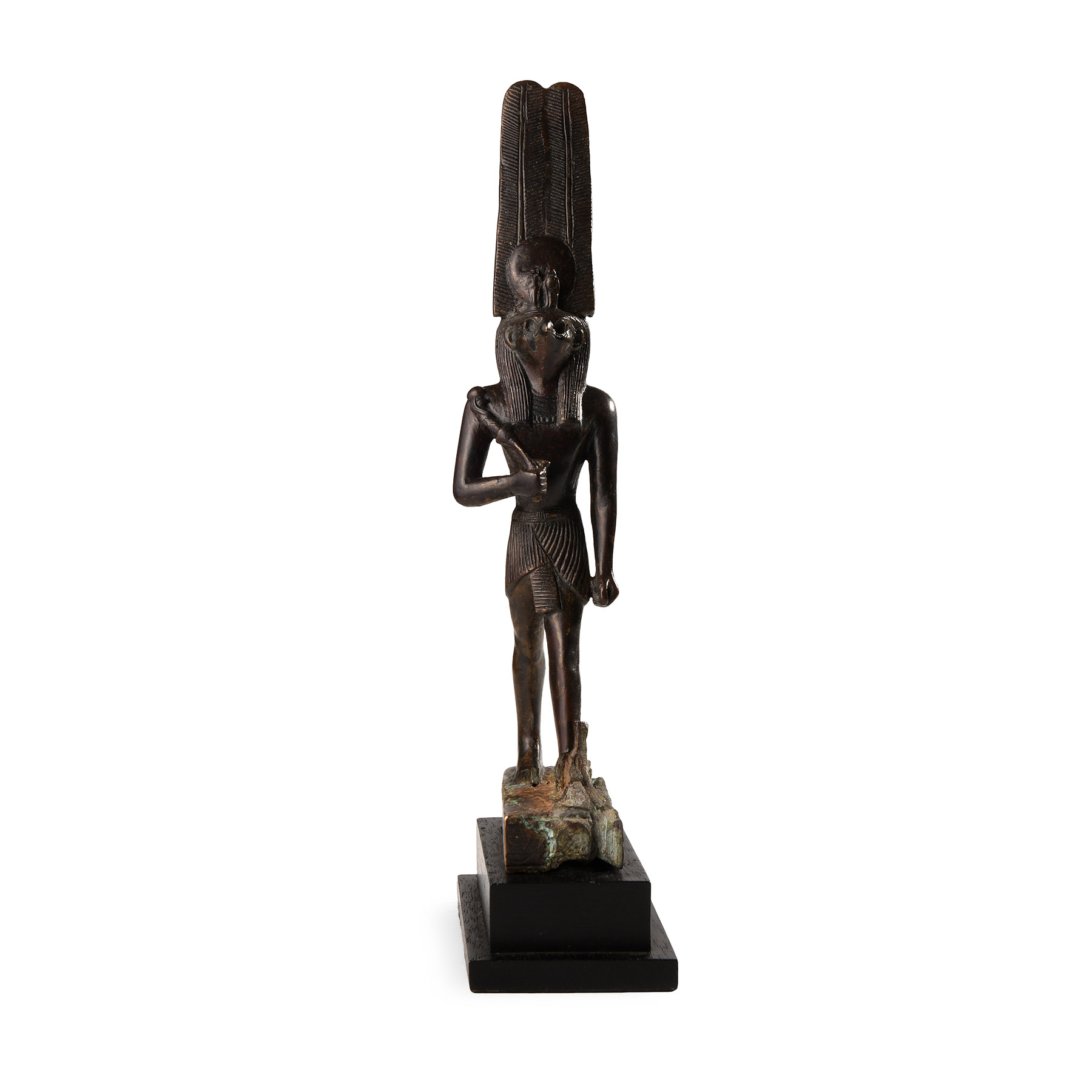
Egyptian Bronze Striding Figure of Montu the Falcon God of War
LATE PERIOD, 26TH-30TH DYNASTY, 664-343 B.C.
9 in. (10 in.) (553 grams, 22.7 cm high (639 grams total, 25.5 cm high including stand)).
With falcon head, wearing a shendyt kilt and a tripartite striated wig, surmounted by two ostrich plumes and fronted by a sun disc and double uraei, wearing a collar and holding a staff with a falcon-headed terminal emerging from a papyrus umbrel; standing on an integral rectangular plinth with a single line of inscription that probably ran around all sides, of which a few hieroglyphs remain, the front reading: '..? Lord (of)' and the left side reading 'Thebes, (that) he may give life..', the last hieroglyph on the front side and the first three on the left give the familiar epithet of Montu, 'Lord of Thebes' which is followed by the request from the statue’s dedicator for Montu to bestow life (and perhaps other benefits) upon him/her; accompanied by a custom-made tiered display base.
ProvenanceJapanese collection, prior to 1980.
AAL Geneva, Switzerland, 1980.
British collection since 1999.
with Pierre Bergé & Associés, Paris, 2 February 2017, no.78 (20,000-22,000 Euros).
Accompanied by copies of the relevant Pierre Bergé & Associés catalogue pages.
This lot has been checked against the Interpol Database of stolen works of art and is accompanied by search certificate no.12132-213615.
Cf. The British Museum, museum number EA60339, for a similar figure believed to possibly date to the Late Period; Musée du Louvre, inv.no. AF 588.
FootnotesThe statuette was most likely an offering made at one of Montu’s cult centres in the Theban region to ensure for the dedicator the good favour of the god. Commensurate with his warlike nature, Montu can sometimes be depicted holding a khepesh sickle-bladed sword, yet here he holds a rarer attribute: a carefully detailed staff with a falcon-headed terminal emerging from a papyrus umbel. This almost certainly
symbolises Montu’s association with Re – the Heliopolitan sun-god also depicted with a falcon head - as his Upper Egyptian counterpart.
TimeLine Auctions follows a vetting process to ensure the authenticity and legality of all items, reinforcing our commitment to integrity and responsible trading. Each antiquity, antique, and coin lot undergoes thorough examination by a vetting committee of at least ten external specialists, professional trade association members, scientists, and archaeologists: Our Vetting Process
AUCTIONS:
TimeLine is a leading auction house specialising in antiquities, ancient art, collectables, natural history, coins, medals, and books. Our auctions offer museums, collectors, historians, and enthusiasts the opportunity to acquire unique and historically significant pieces.
LOT 0025
Egyptian Bronze Striding Figure of Montu the Falcon God of War
Sold for (Inc. bp): £11,050
-
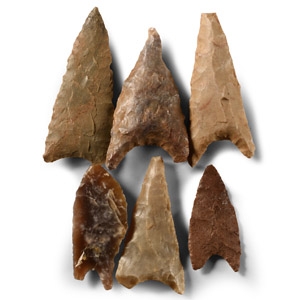
Egyptian Flint Arrowhead Group
Predynastic Period, Naqada II, 4000-3150 B.C.Sold for (Inc. bp): £72
With triangular blade and napped recess to the lower edge. 11.2 grams total, 24-36 mm
From a collection acquired on the UK art market from various auction houses and collections mostly before 2000. From an important Cambridgeshire estate; thence by descent. -
.jpg)
Egyptian Faience Bead Necklace String with Amulets
Amarna Period, 1353-1336 B.C.Estimate: £800 - 1,000 (+bp*)
Opening Bid: £400
Restrung using mainly annular and tubular beads with a large central heart amulet, interspersed with various amulets including: poppy seed, rosette, lotus flower, two Thoth baboons, djed pillar, Bes, and others. 10.4 grams, 40 cm
From the vendor's grandfather's collection, formed in the 1950s; thence by family descent circa 1974. -
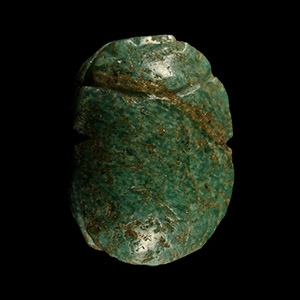
Egyptian Green Hardstone Scarab
Late Period, 664-332 B.C.Sold for (Inc. bp): £293
Pierced longitudinally; plain underside with old collector's label attached. 1.61 grams, 14 mm
From the property of the late Mr SM, London, UK, 1969-1999.
