
Loading, please wait...
LOT 0033
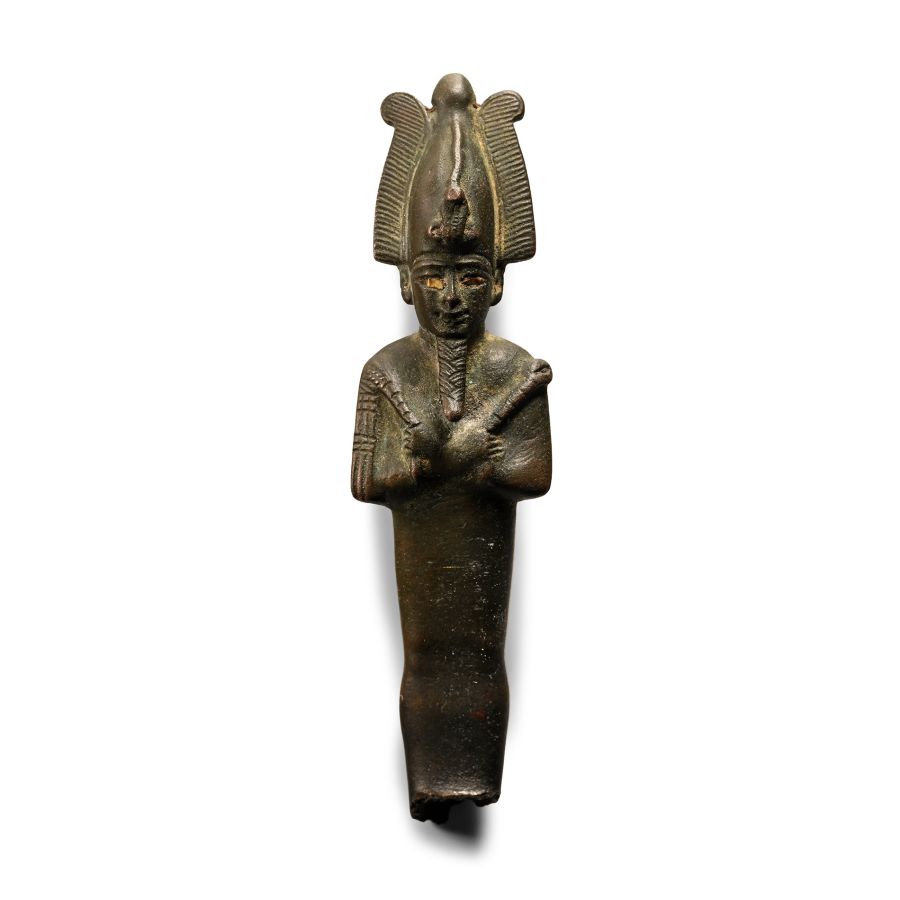
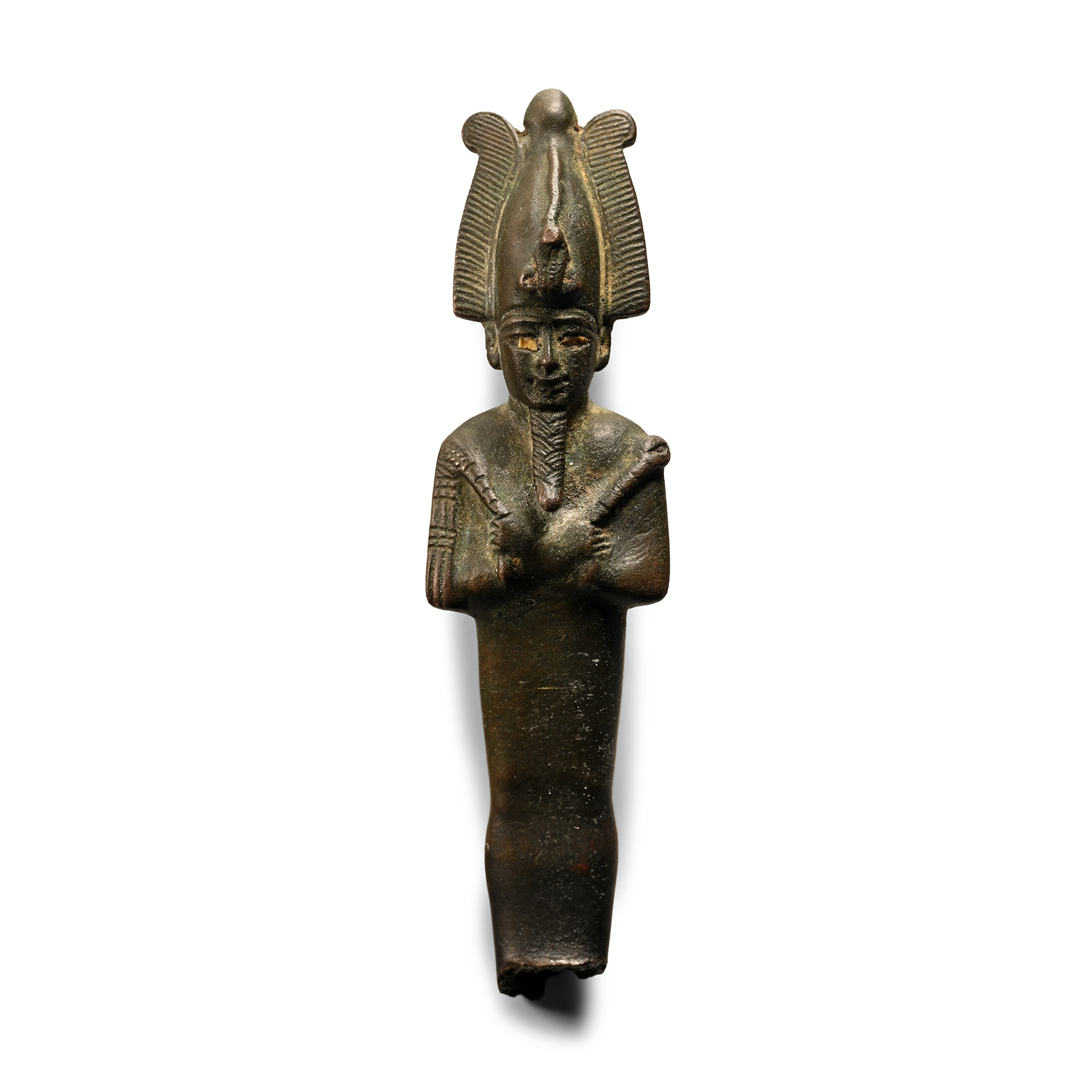
Egyptian Bronze Statuette of Osiris
LATE PERIOD, 664-525 B.C.
3 5/8 in. (74 grams, 92 mm).
Modelled in the round wearing the atef crown with a uraeus to the brow, arms crossed on the chest holding the nekhakha (flail) and heka (crook); loop to rear of the neck; feet absent and damage to left shoulder revealing original lead core.
ProvenanceAcquired on the German art market, 1989-1995.
with The Museum Gallery, 19 Bury Place, London, WC1, UK, 1998-2003.
Property of a London based academic, 2003-present.
Cf. Daressy, G., Catalogue général des antiquités égyptiennes du Musée du Caire N° 38001-39384 Statues de divinités, Cairo, 1906, pl. XVIII, no. 38.275, for a comparable figure.
FootnotesOsiris was a deity who represents death and fertility and is commonly regarded as the quintessential god of rebirth. Though he was once a mortal ruler, as a deceased entity, his domain was the Underworld. Small figurines like this example were dedicated to the god to ensure his good favour.
CONDITIONTimeLine Auctions follows a vetting process to ensure the authenticity and legality of all items, reinforcing our commitment to integrity and responsible trading. Each antiquity, antique, and coin lot undergoes thorough examination by a vetting committee of at least ten external specialists, professional trade association members, scientists, and archaeologists: Our Vetting Process
AUCTIONS:
TimeLine is a leading auction house specialising in antiquities, ancient art, collectables, natural history, coins, medals, and books. Our auctions offer museums, collectors, historians, and enthusiasts the opportunity to acquire unique and historically significant pieces.
-
David Roberts Print
19th century A.D.Sold for (Inc. bp): £52
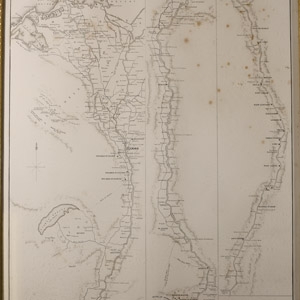
Printed map of Egypt and Nubia with locations marked of the sketches of David Roberts, RA on his 1849 expedition; mounted in a glazed wooden frame. 2.2 kg, 46 x 64 cm
From the private collection of the late Mrs Belinda Ellison, a long time member of the Egyptian Exploration Society, c.1940-2020. -
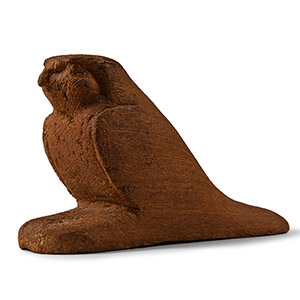
Egyptian Wooden Falcon
Late Period-Ptolemaic Period, 664-31 B.C.Sold for (Inc. bp): £1,170
Carved figure of a falcon perching on an ellipsoid base, with mortice in the top of the head for a separately-fashioned crown (missing); traces of painted decoration visible on the face; old collector's numbers to the underside 'E.18' and 'ΛOC'. 124 grams, 16.3 cm
Ex R. Liechti (1934-2010) Geneva, Switzerland, formed between 1950-1990s. -
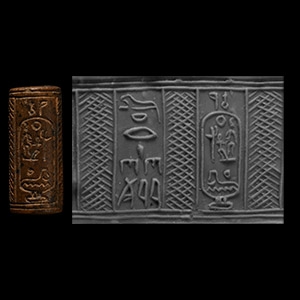
Egyptian Cylinder Seal with Cartouche of Ramesses II
New Kingdom, 19th Dynasty 1304-1237 B.C.Sold for (Inc. bp): £1,235
With crisp detail of crosshatched panels, hieroglyphic text in one and a cartouche in the other with the regnal name of Ramesses II (User-Maat-Re-setep-en-Re), supplied with a museum-quality impression. 5.01 grams, 25 mm
Gustave Mustaki, Alexandria, Egypt; exported from Egypt to the UK c.1950. Elsa McLellan, UK; by descent from the above. Private collection, London, UK; by descent from the above.
