
Loading, please wait...
LOT 0034
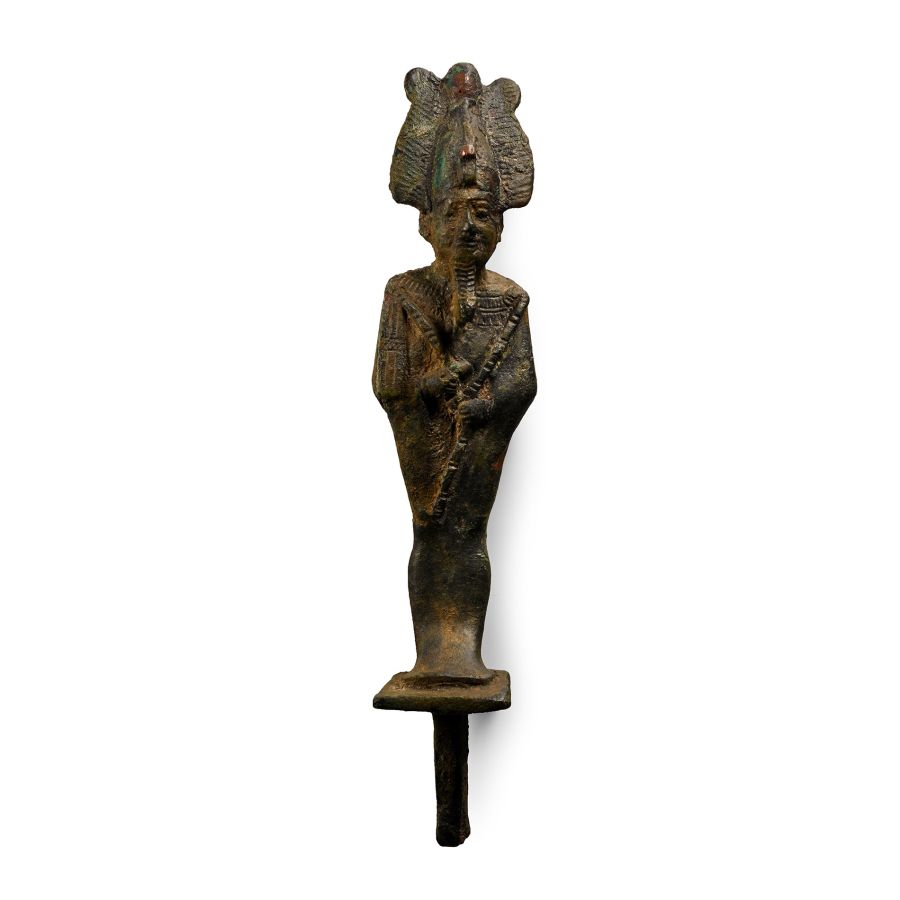
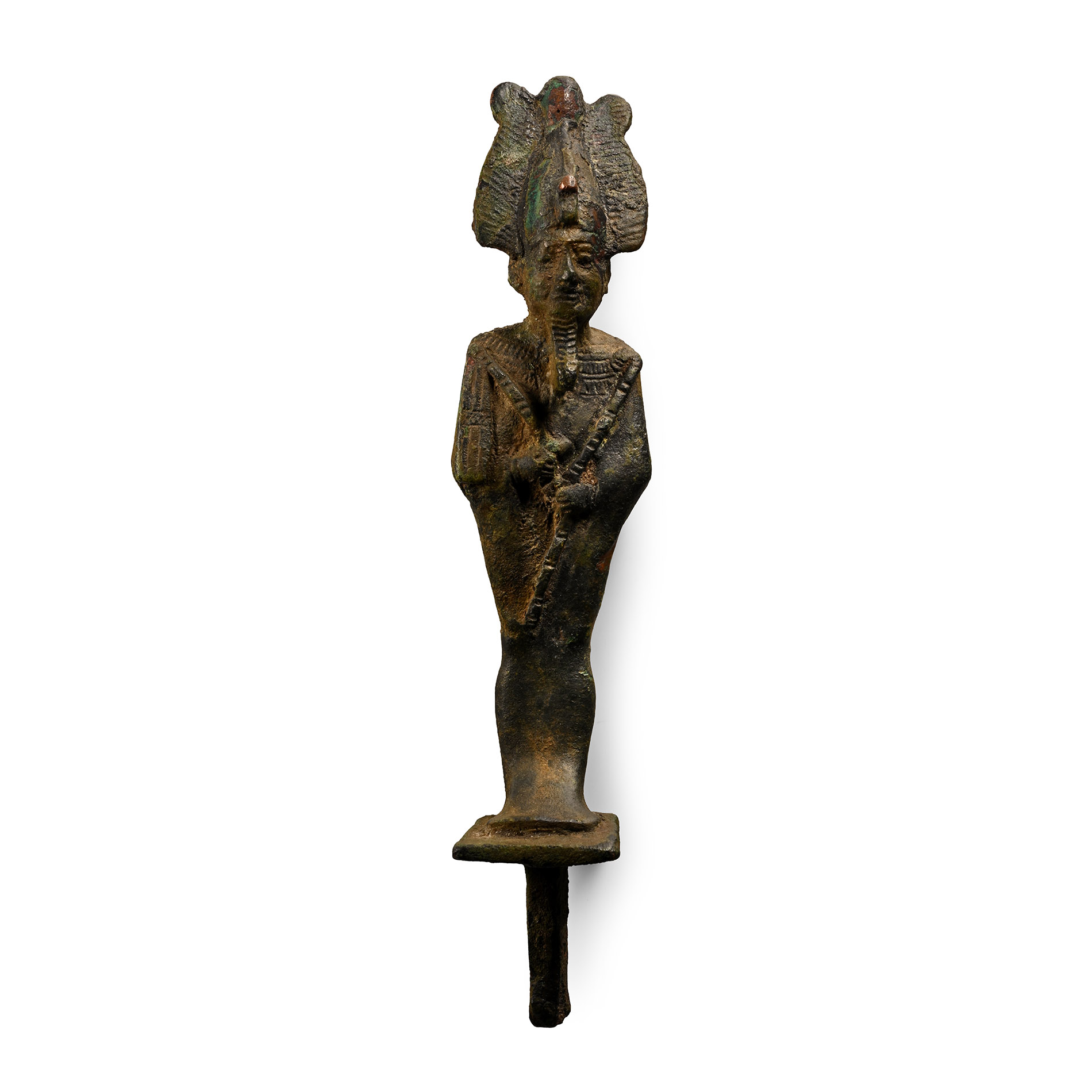
Egyptian Bronze Statue of the God Osiris
LATE PERIOD, 664-525 B.C.
5 1/2 in. (136 grams, 14 cm).
Modelled in the round wearing the Atef crown with a uraeus to the brow, arms crossed on the chest holding the nekhakha (flail) and heka (crook); trapezoidal base with long tenon beneath.
ProvenanceAcquired on the German art market, 1989-1995.
with The Museum Gallery, 19 Bury Place, London, WC1, UK, 1998-2003.
Property of a London based academic, 2003-present.
Cf. Tinius, I., Altägypten in Braunschweig. Die Sammlungen des Herzog Anton Ulrich-Museums und des Städtischen Museums, Wiesbaden, 2011, p.104, no. 152, for similar.
FootnotesOsiris is a deity who represents death and fertility and is commonly regarded as the quintessential god of rebirth. Though he was once a mortal ruler, as a deceased entity, his domain was the Underworld. Abydos was the primary centre of Osiris’ cult, where a renowned yearly celebration of the god was held. Many small figurines like this were dedicated to the god at temples throughout Egypt.
CONDITIONTimeLine Auctions follows a vetting process to ensure the authenticity and legality of all items, reinforcing our commitment to integrity and responsible trading. Each antiquity, antique, and coin lot undergoes thorough examination by a vetting committee of at least ten external specialists, professional trade association members, scientists, and archaeologists: Our Vetting Process
AUCTIONS:
TimeLine is a leading auction house specialising in antiquities, ancient art, collectables, natural history, coins, medals, and books. Our auctions offer museums, collectors, historians, and enthusiasts the opportunity to acquire unique and historically significant pieces.
-
.jpg)
Egyptian Limestone Painted Shabti Inscribed for Ir-Nu
New Kingdom, 19th-20th Dynasty, 1295-1077 B.C.Sold for (Inc. bp): £18,200
Inscribed for Ir-nu; with carefully modelled face, large eyes and unnaturally large ears, wearing a neck-strap, a long tripartite wig with incised striations and a broad three-band collar; holding a pick in his left hand, a hoe in the right and a seed bag hanging over the left shoulder; the unusual position of the hands opposed on the chest; the text beginning in the vertical column running down the front of the figure, continuing in five horizontal bands with pale red-ochre pigment colouring to the top, middle and bottom bands; the same pigment used to colour the implements and also alternates with blue striations of the wig, the neck strap and details of the collar also in blue; the inscription from the Book of the Dead Chapter 6, reading: (Vertical column:) 'The illuminated one, the Osiris' (Horizontal rows:) 1) Ir-nu, true of voice, he says: O, this shabti 2) if one is counted, if one is reckoned to do the work 3) [to do all that is to be done in] the god’s land, to cultivate the riparian lands, transport by boat 4) [sand of] the west to the east, to act 5) at any time, to serve there (you) shall say true of voice(?). 1.4 kg total, 28.4 cm high including stand
Carieau family collection, Belgium, acquired in 1952. Ex Maspero collection, Paris, 1963. Acquired from a private European collection, in 1978. Accompanied by a copy of a technical report by Edmund S. Meltzer Ph.D. Accompanied by an academic report by Egyptologist Paul Whelan. This lot has been checked against the Interpol Database of stolen works of art and is accompanied by a search certificate number no.12080-217053. -
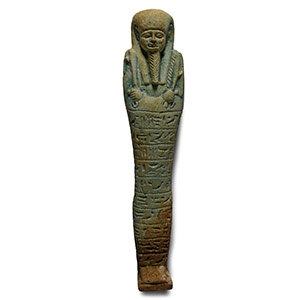
Large Egyptian Blue Glazed Hieroglyphic Shabti for Ta-Amun
Saite Period, 26th Dynasty, 664-525 B.C.Sold for (Inc. bp): £1,430
With finely modelled facial details, a plaited beard, holding a hoe and the cord of a seed bag at the left shoulder and a pick at the right, ten horizontal bands of hieroglyphic text to the lower body. 140 grams, 18 cm
Acquired on the German art market, 1989-1995. with The Museum Gallery, 19 Bury Place, London, WC1, UK, 1998-2003. Property of a London based academic, 2003-present. -
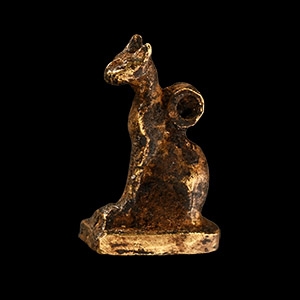
Egyptian Gold Goddess Bastet Cat Amulet
Late New Kingdom-Third Intermediate Period, circa 1069-900 B.C.Sold for (Inc. bp): £1,170
Modelled seated on a tongue-shaped base, with simple facial detailing and suspension loop to the back. 0.48 grams, 8 mm
From an early 20th century French collection.
The goddess Bastet was believed to be the daughter of the sun god and was shown with the features of a lion up until about 1000 B.C. when she was first portrayed as a cat or human with a cat head. As the daughter of Ra she was associated with the rage inherent in the sun god's eye which was considered to be his instrument of vengeance. Her development into a cat goddess occurred during the New Kingdom but did not fully develop until the Late Period. She was still associated with the destructive power of the sun and was shown on the prow of the solar boat, decapitating the evil serpent Apophis in the Book of the Dead. The maternal, protective and hunting characteristics of the cat are obvious in Bastet and she was seen as a protector of pregnant women and young children. In the Pyramid Texts she is invoked by the deceased king to act as his protector and to help him reach the sky to join the sun god; the king proclaims that Bastet is his mother and nurse. Like her counterpart, Sekhmet, Bastet has an aggressive side and, in a text from Karnak, Amenhotep II described his enemies being slaughtered like the victims of Bastet. The goddess had a shrine at Karnak, where she is known as the 'Lady of Asheru' which aligns her closely with the goddess Mut, the consort of Amun-Ra. Her most famous shrine was in the north-east Delta region, at Bubastis, and was known as Per-Bastet or 'the House of Bastet.' Herodotus describes the festival of Bastet as one of the most elaborate in all of Egypt and identifies her with the Greek Artemis. Cemeteries of cats have been excavated at Bubastis and at Saqqara and Memphis.
