
Loading, please wait...
LOT 0467
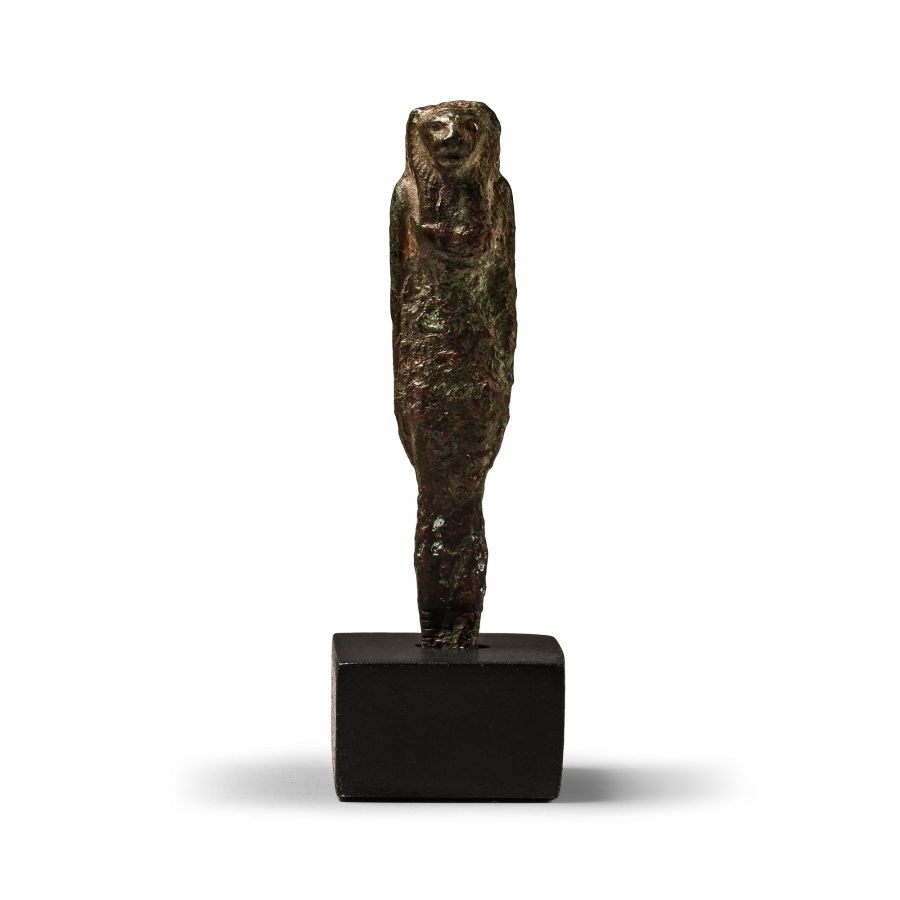
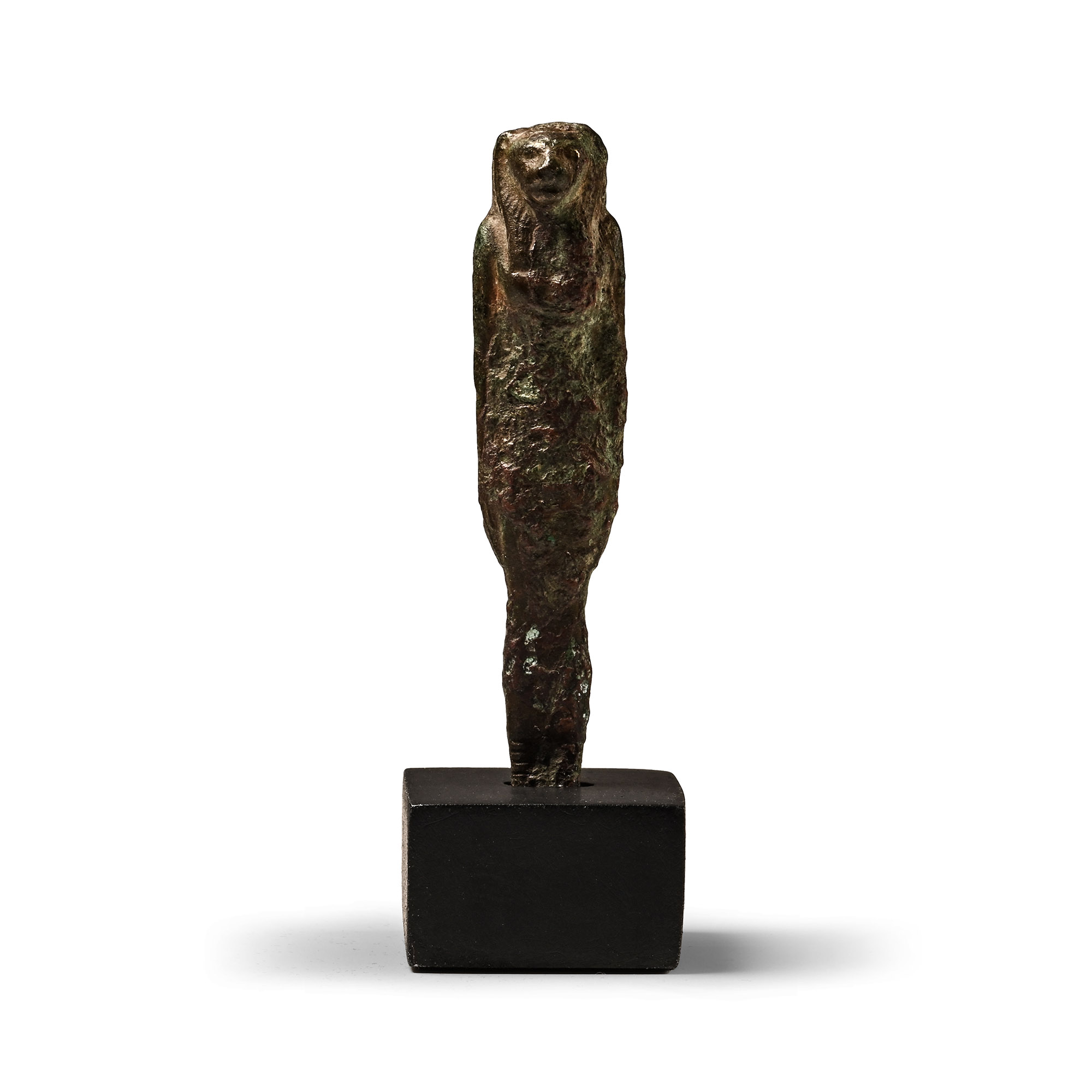
Egyptian Bronze Sekhmet Statuette
LATE PERIOD, 664-332 B.C.
2 7/8 in. (30 grams total, 73 mm including stand).
Standing figure of Sekhmet with arms held at her sides, wearing a wig and tight-fitting robe; mounted on a custom-made display stand. [No Reserve]
ProvenanceFrom a collection acquired on the UK art market from various auction houses and collections mostly before 2000.
From an important Cambridgeshire estate; thence by descent.
Cf. von Droste zu Hülsdorf, V. and Schlick-Nolte, B., Ägyptische Bildwerke II: Statuetten, Gefässe und Geräte, Melsungen, 1990, pp.308-309, no. 189, for a similar bronze figurine.
FootnotesSekhmet was a ferocious and aggressive deity, the consort of Ptah, and closely associated with the king. An amulet would imbue its wearer with her power.
CONDITIONTimeLine Auctions follows a vetting process to ensure the authenticity and legality of all items, reinforcing our commitment to integrity and responsible trading. Each antiquity, antique, and coin lot undergoes thorough examination by a vetting committee of at least ten external specialists, professional trade association members, scientists, and archaeologists: Our Vetting Process
AUCTIONS:
TimeLine is a leading auction house specialising in antiquities, ancient art, collectables, natural history, coins, medals, and books. Our auctions offer museums, collectors, historians, and enthusiasts the opportunity to acquire unique and historically significant pieces.
-
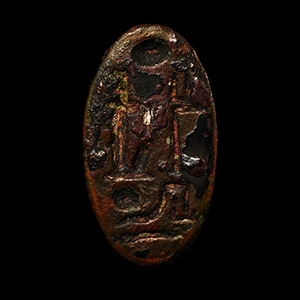
Egyptian Bronze Ring for Ramesses II
New Kingdom, 19th Dynasty, 1303-1213 B.C.Sold for (Inc. bp): £2,340
D-shaped hoop and ellipsoid plaque, hieroglyphic text in low relief giving the regnal name of Ramesses II (User-Maat-Re Setep-en-Re). 6.78 grams, 23.72 mm overall, 17.94 mm internal diameter (approximate size British Q, USA 8, Europe 17.49, Japan 16)
Ex R.K. collection, early 1980s. UK private collection before 2000. Property of a London gentleman. This lot has been checked against the Interpol Database of stolen works of art and is accompanied by a search certificate number no.12082-217353. -
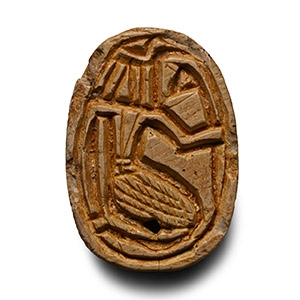
Egyptian White Stone Scarab with Falcon-headed God
New Kingdom-Late Period, 1550-332 B.C.Sold for (Inc. bp): £286
Underside with low-relief image of falcon-headed god holding a papyrus stem. 2.36 grams, 18 mm
From the private collection of P. Champman. Acquired 1992. Ex C.J. Martin, London, UK. -
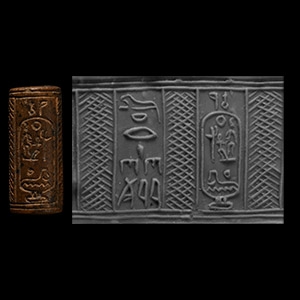
Egyptian Cylinder Seal with Cartouche of Ramesses II
New Kingdom, 19th Dynasty 1304-1237 B.C.Sold for (Inc. bp): £1,235
With crisp detail of crosshatched panels, hieroglyphic text in one and a cartouche in the other with the regnal name of Ramesses II (User-Maat-Re-setep-en-Re), supplied with a museum-quality impression. 5.01 grams, 25 mm
Gustave Mustaki, Alexandria, Egypt; exported from Egypt to the UK c.1950. Elsa McLellan, UK; by descent from the above. Private collection, London, UK; by descent from the above.
