
Loading, please wait...
_900x900.jpg "Egyptian Bronze Khonsu Statuette with Silver Eyes")
_200x200.jpg "Egyptian Bronze Khonsu Statuette with Silver Eyes")
.jpg "Egyptian Bronze Khonsu Statuette with Silver Eyes")
LOT 0011
Egyptian Bronze Khonsu Statuette with Silver Eyes
LATE PERIOD, 664-332 B.C.
7 1/2 in. (378 grams total, 19 cm including stand).
Modelled in the round figure of Khonsu standing, holding the crook, flail, and long was-sceptre, with false beard and sidelock, wearing a crown consisting of a lunar crescent and disc with uraeus, and a broad collar; the eyes with sheet-silver inlays; mounted on a custom-made stand.
ProvenanceEx Geneva collection, Switzerland, acquired before 1980.
Ex Galerie Günter Puhze GmbH, Germany, 2008.
Ex Keane collection, Kent, UK.
Accompanied by an original invoice from Galerie Günter Puhze GmbH.
This lot has been checked against the Interpol Database of stolen works of art and is accompanied by a search certificate number no.12628-235137.
This lot has been cleared against the Art Loss Register database, and is accompanied by an illustrated lot declaration signed by the Head of the Antiquities Department, Dr Raffaele D'Amato.
Cf. Daressy, G., Catalogue général des antiquités égyptiennes du Musée du Caire N° 38001-39384 Statues de divinités, Cairo, 1906, pl. XXVIII (38.489), for a comparable figure in the Cairo Museum.
FootnotesKhonsu is an ancient Egyptian god of the moon, often depicted as a young man with a sidelock, a uraeus, and headgear featuring a lunar crescent and disc. He is associated with Thoth, another moon god. Together with his father Amun and mother Mut, Khonsu forms the Theban Triad.
CONDITIONTimeLine Auctions follows a vetting process to ensure the authenticity and legality of all items, reinforcing our commitment to integrity and responsible trading. Each antiquity, antique, and coin lot undergoes thorough examination by a vetting committee of at least ten external specialists, professional trade association members, scientists, and archaeologists: Our Vetting Process
AUCTIONS:
TimeLine is a leading auction house specialising in antiquities, ancient art, collectables, natural history, coins, medals, and books. Our auctions offer museums, collectors, historians, and enthusiasts the opportunity to acquire unique and historically significant pieces.
LOT 0011
Egyptian Bronze Khonsu Statuette with Silver Eyes
Estimate £4,000 - 6,000€4,640 - 6,960 (for guidance only)$5,400 - 8,100 (for guidance only)
-
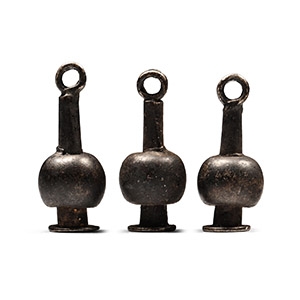
Egyptian Silver Poppy Amulet Group
Late-Ptolemaic Period, 664-30 B.C.Sold for (Inc. bp): £91
Three pendants each with poppy-head and loop at the apex. 3.67 grams total, 17-19 mm
From an early 20th century collection. This lot is accompanied by an illustrated lot declaration signed by the Head of the Antiquities Department, Dr Raffaele D'Amato.
Amulets in the form of poppies were used to heal and alleviate pain and to ward off death. These types of amulets were also linked to Osiris, the Egyptian deity of agriculture, death, and the afterlife. -
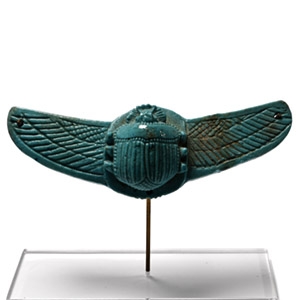
Egyptian Blue Faience Scarab
Late Period, 7th-6th century B.C.Sold for (Inc. bp): £4,550
Comprising a crescentic plaque with central scarab modelled in the half-round, and lateral wings with hatched texturing; scarab with ribbing and other detailing; pierced in four places for attachment; accompanied by a custom-made stand. 22.3 grams, 10 cm wide (44 grams total, 10 cm wide including stand)
Acquired in the 1950-1990s. Mr C., Geneva, Switzerland. Private collection, Europe. This lot has been checked against the Interpol Database of stolen works of art and is accompanied by a search certificate number no.12592-232170. This lot has been cleared against the Art Loss Register database, and is accompanied by an illustrated lot declaration signed by the Head of the Antiquities Department, Dr Raffaele D'Amato.
Winged scarabs were thought to ensure the rebirth and regeneration of the deceased, making them popular funerary amulets. This is a particularly fine example of a rarer one-piece amulet, as they are usually made from three separate elements. -
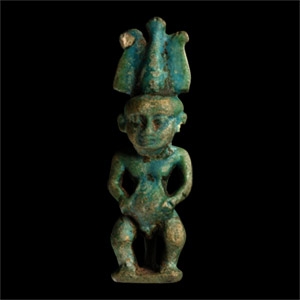
Egyptian Blue Glazed Pataikos Statuette
Third Intermediate Period, 1069-702 B.C.Estimate: £600 - 800 (+bp*)
Opening Bid: £300
Modelled in the round standing nude on a D-shaped base with atef crown, dorsal pillar with loop. 13.68 grams, 73 mm
Acquired on the German art market, 1989-1995. with The Museum Gallery, 19 Bury Place, London, WC1, UK, 1998-2003. Property of a London based academic, 2003 to present. This lot is accompanied by an illustrated lot declaration signed by the Head of the Antiquities Department, Dr Raffaele D'Amato.
Herodotus mentions Pataikos as a dwarf-like representation of Ptah, although the ancient Egyptian name of the god remains unclear. These diminutive amulets symbolise Ptah’s immense magical power, which serves to protect the wearer from dangerous creatures such as snakes and crocodiles. The role of the deity in the funerary sphere is explained in Spell 164 of the Book of the Dead, where Pataikos is used to protect the deceased’s heart from enemy attacks and the putrefaction of the body. The atef crown worn by this example, clearly links the figure to the underworld god, Osiris.
